
Best LED bulbs for the home
The best LED bulbs for the home
The bulbs worth putting in the lamps you already own - picked on published lumens and CRI, not on wattage equivalence.
Top pick
Philips Ultra Definition A19 LED, 60W equivalent, 2700K
Color temperature, CRI and lumens explained with numbers you can check, plus the bulbs worth putting in the lamps you already own.
Sconce & Socket earns a commission on qualifying purchases made through links on this page, at no extra cost to you. It does not change which products we pick. Full disclosure.
01
Buying bulbs is genuinely simple once you know to turn the box over. The large friendly "60W equivalent" on the front is a translation for people who have not switched from incandescent yet, and manufacturers apply it loosely - two bulbs both labeled 60W equivalent can differ by 150 lumens.
The useful information is in the Lighting Facts panel on the back, and it is three numbers.
| Spec | What it tells you | What to buy |
|---|---|---|
| Lumens | How much light comes out | 800 for most lamps, 1,500 where a room is short |
| Kelvin | How warm or cool it looks | 2700K living spaces, 3000K work surfaces |
| CRI | How accurately colors render | 90 minimum, 95 where you look closely |
| R9 | Deep red specifically | Published at all is a good sign; 80+ is strong |
| Watts | Energy used, not light made | Only to check the fixture's maximum rating |
R9 deserves a note. CRI is an average across a set of reference colors, and in the most common calculation the deep-red sample is not among them - so a bulb can post a respectable CRI while rendering reds poorly. Since skin, wood, brick and cooked food all depend heavily on red content, that omission is why a room can look slightly wrong under a light that measures fine on paper. Almost no mainstream brand publishes R9, and the ones that do are telling you something.
02
Before buying a lamp, read the lumen figure on the bulbs already in the room. This is where a surprising number of dark rooms are actually solved.
Two checks before you do it. Look for the maximum wattage marked on the fixture, comparing against the LED's real draw rather than its equivalence. And avoid putting a high-output LED into a fully enclosed fitting, where trapped heat shortens its life considerably.
03
"Soft white," "warm white," "bright white" and "daylight" are marketing conventions, not standards. Different retailers apply them to different kelvin values, so two boxes carrying the same words can genuinely be different colors - which is how a room ends up with three whites in it after a year of buying bulbs one pack at a time.
The fix is to ignore the phrase and read the kelvin figure, and to buy in multipacks of one specification rather than replacing bulbs individually. The full mapping is in warm white vs soft white vs daylight, and the chart of what each value looks like in a room is in the color temperature guide. If you still cannot choose, the best color-selectable LED bulbs carry several settings on a switch, so one pack decides it in your own room.
04
Two of the most common bulb complaints are not bulb problems, and this section exists so you do not spend money solving the wrong thing.
Flicker on a dimmer is usually a dimmer mismatch. Old leading-edge dimmers were built for incandescent filaments and handle low-load LED drivers poorly, and many need a minimum wattage that three modern bulbs do not reach. You can work through several brands of bulb and get the same result - diagnose it first in why dimmable LED bulbs flicker.
Light that feels too harsh is usually glare rather than quantity. An LED produces its output from a much smaller area than an old frosted incandescent, so it reads as intense even when the room is not brighter. Shading or aiming it fixes that; reducing the output makes a dark room darker. When LED lights are too bright separates the two.
05
Most of this hub is about choosing light. These five are about choosing a bulb for a socket with its own rules.
06
Five head-to-head pages for the choices that come up at the shelf.
07
The brightest LED bulbs you can actually fit - the ladder from 800 lumens to 4,000, and the two limits that decide how far up it your fixture lets you go.
The best LED tube lights - replacing a fluorescent tube, and the ballast question that decides which type you need.
The best rechargeable emergency bulbs - bulbs with a battery inside, and the switch rule that decides whether they work.
Pages
Best LED bulbs for the home
The bulbs worth putting in the lamps you already own - picked on published lumens and CRI, not on wattage equivalence.
Top pick
Philips Ultra Definition A19 LED, 60W equivalent, 2700K
Best high-CRI LED bulbs
High-CRI bulbs judged on published CRI and R9 - the deep-red figure the headline number leaves out.
Top pick
YUJILEDS CRI-MAX CRI 95+ 16W BR30 LED Bulb, 3000K
#ad Price as of October 18, 2026. How we earn
Comparison
The two warm whites compared room by room, with a straight answer on when the difference actually matters.
Top pick
Philips Ultra Definition A19 LED, 60W equivalent, 2700K
Comparison
The retailer naming decoded - which marketing name maps to which kelvin value, and what to read instead.
Top pick
Philips Ultra Definition A19 LED, 60W equivalent, 2700K
Guide
The full kelvin chart - what each color temperature looks like and which room it belongs in.
Top pick
Philips Ultra Definition A19 LED, 60W equivalent, 2700K
Guide
Diagnose LED flicker properly: the dimmer, the minimum load, and the few cases where the bulb really is at fault.
Top pick
Philips Ultra Definition A19 LED, 60W equivalent, 2700K
Guide
Glare or output? Diagnose which one is making a room uncomfortable, then fix it in order of cost.
Top pick
Philips Ultra Definition A19 LED, 60W equivalent, 2700K
Best bulbs for a bedroom
Warm, dimmable bedside bulbs - and why the brightest bulb in the pack is the wrong one here.
Top pick
Philips Ultra Definition A19 LED, 60W equivalent, 2700K

Best bulbs for enclosed fixtures
Bulbs rated for sealed and damp fixtures - the reason your bathroom bulbs keep failing early.
Top pick
Feit Electric 100W Equivalent A19 LED, 2700K, Enclosed-Rated
#ad Price as of October 18, 2026. How we earn
Guide
Decoding the codes on a bulb box - which shape fits which fitting, and which base limits your choices.
Top pick
Philips Ultra Definition A19 LED, 60W equivalent, 2700K
Best dimmable LED bulbs
What separates a bulb that dims smoothly to a low level from one that flickers out at 30 percent.
Top pick
Philips Ultra Definition A19 LED, 60W equivalent, 2700K

Guide
What 2200K amber light really does to a room, where it belongs, and what you give up for it.
Top pick
EDISHINE Vintage LED Edison Bulb, A19, 8W, 2200K
#ad Price as of October 18, 2026. How we earn
Comparison
Efficiency, lifespan, warm-up and dimming compared - and whether halogen or CFL is ever still right.
Top pick
Philips Ultra Definition A19 LED, 60W equivalent, 2700K

Best candelabra LED bulbs
E12 candelabra bulbs judged on published output, CRI, dimming and the enclosed-fixture rating.
Top pick
Satco 5.5W Vintage Edison B11 Candelabra LED, 90 CRI
#ad Price as of October 18, 2026. How we earn
Comparison
Philips, Cree and Feit compared on the specific bulbs this site recommends - output, color, CRI and ratings.
Top pick
Philips Ultra Definition A19 LED, 60W equivalent, 2700K
Best daylight LED bulbs
5000K and 6500K daylight bulbs judged on published CRI, lumens and enclosed ratings - and where to use them.
Top pick
Cree Lighting A19 60W Equivalent LED, 5000K, Good for Enclosed

Best light bulbs for ceiling fans
Ceiling fan bulbs for E26 and E12 kits judged on published lumens, CRI, shape and enclosed ratings.
Top pick
Feit Electric A15 LED Filament Bulb, 60W Replacement, E26, 2700K (BPA1560927CAFIL/2/RP)
#ad Price as of October 18, 2026. How we earn
Comparison
3000K and 4000K compared room by room, from published guidance, with high-CRI examples of each.
Top pick
YUJILEDS CRI-MAX CRI 95+ 16W BR30 LED Bulb, 3000K
#ad Price as of October 18, 2026. How we earn

Best 3-way LED bulbs
3-way LED bulbs judged on published lumens at each step, color, CRI, wattage and ratings.
Top pick
Feit Electric 3-Way LED A21, 50/100/150W Equivalent, 2700K (A50/150/927CA)
#ad Price as of October 18, 2026. How we earn

Best color-selectable LED bulbs
Bulbs with a switch for 2700K to 5000K, judged on where the switch is, enclosed ratings, lumens, dimming and CRI.
Top pick
Feit Electric Selectable Color A19 LED, 60W Equivalent, Dimmable (OM60DM/5CCTCA/LED/10)
#ad Price as of October 18, 2026. How we earn

Best BR30 LED bulbs
BR30 flood bulbs for recessed cans, ranked on published lumens, beam angle, CRI, dimming and ratings.
Top pick
Sunco Lighting BR30 LED Flood, 65W Equivalent, 2700K (BR30-11W-27K)

Best appliance bulbs
Appliance bulbs for ovens, fridges, microwaves and range hoods, with the maker guidance for each socket.
Top pick
GE 40W A15 Appliance Bulb, Soft White (43237-2)
#ad Price as of October 18, 2026. How we earn

Best G25 globe bulbs
G25 globe bulbs for vanity bars, judged on CRI, diffusion, published lumens and damp ratings.
Top pick
Sunco Lighting G25 Globe LED Vanity Bulb, Clear Filament
#ad Price as of October 18, 2026. How we earn

Best garage door opener bulbs
Opener bulbs judged on vibration resistance, published output and the interference guidance opener makers publish.
Top pick
Genie Garage Door Opener LED Bulb, 4000K (GLEDB2-R2)

Best GU10 LED bulbs
Twist-lock GU10 bulbs for track and spotlight heads, judged on beam angle, CRI, dimming and published lumens.
Top pick
Feit Electric MR16 GU10 Adjustable White LED, 50W Equivalent (BPMR16GU10503CCTCA/3)
#ad Price as of October 18, 2026. How we earn
Comparison
Neutral white against daylight, room by room, with the reason 5000K reads brighter than it is.
Top pick
Waveform Lighting CENTRIC DAYLIGHT Full Spectrum A19, 4000K (4005C.40)
#ad No live price right now, so we show none. How we earn
Comparison
The standard bulb against the recessed flood, on beam shape, size, output and where each belongs.
Top pick
Philips Ultra Definition A19 LED, 60W equivalent, 2700K

Comparison
Clear filament against frosted glass, on glare, spread, decorative value and the small output cost of diffusion.
Top pick
GE Lighting Relax HD G25 Vanity Globe LED, 40W Replacement
#ad Price as of October 18, 2026. How we earn

Comparison
Dim-to-warm bulbs against ordinary dimmable LEDs, with the three ways to get warmer light as the evening goes on.
Top pick
Philips BR30 LED with Warm Glow, 65W Equivalent (7.2BR30/PER/922-27)
#ad Price as of October 18, 2026. How we earn
Best flicker-free LED bulbs
LED bulbs sold as flicker-free, judged on what each maker actually publishes - plus the phone test and the dimmer check.
Top pick
Philips Ultra Definition A19 LED, 60W equivalent, 2700K
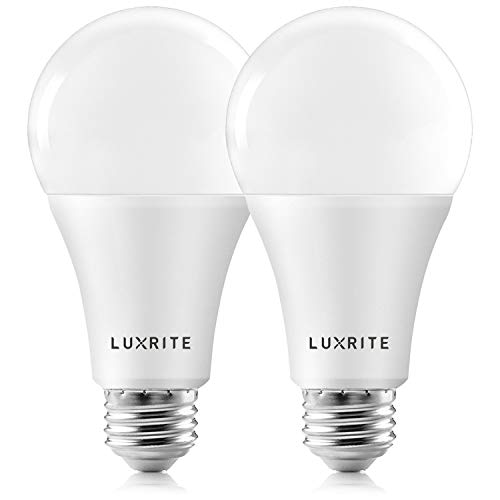
Brightest LED bulbs
High-lumen bulbs from 1,500 to 4,000 lumens, judged on published output, physical size, color rendering and whether the fixture can take them.
Top pick
Luxrite A21 LED, 150W Equivalent, 2700K (LR21450 / LED22A21/D927/E2)
#ad Price as of October 18, 2026. How we earn

Best LED tube lights
T8 LED tubes for fluorescent fixtures, with the Type A, Type B and hybrid difference and the ballast check that decides which you need.
Top pick
Sunco Lighting 4 ft T8 LED Tube, Hybrid Type A+B, 20W, 10-Pack

Best rechargeable emergency bulbs
Battery-backup bulbs for power cuts, judged on published runtime, what the maker will commit to in writing, and how they behave at the switch.
Top pick
GE Lighting LED+ Battery Backup A21, 3 Color Temperatures, 2-Pack
#ad Price as of October 18, 2026. How we earn

Guide
4100K, cool white, daylight deluxe and the /741 and /830 tube codes, translated into the kelvin values LED bulbs are actually sold in.
Top pick
Feit Electric 4 ft T8 LED Tube, Type A, 18W (T848/840/LEDG2/2)
Comparison
Warm versus neutral, decided room by room: what each value does to skin, wood and worktops, and which rooms sit on the line.
Top pick
Philips Ultra Definition A19 LED, 60W equivalent, 2700K

Comparison
The cool end of the scale: where 5000K still works, the narrow set of jobs 6500K is genuinely better at, and why most rooms should stop at 5000K.
Top pick
Feit Electric A19 LED, 60W Equivalent, 5000K Daylight, CRI 90, 10-Pack (OM60/950CA10K/10)
#ad Price as of October 18, 2026. How we earn

Comparison
Which holiday white suits your house, why mixing the two reads as a fault, and the sets to buy at either value.
Top pick
Brizled C9 LED Christmas String Lights, 16 ft, 25 Bulbs, Warm White
Comparison
The holiday bulb shapes decoded: C9, C7, 5mm wide angle and the old mini, with the base each uses and the job each is for.
Top pick
Brizled C9 LED Christmas String Lights, 16 ft, 25 Bulbs, Warm White

Comparison
Running cost, heat, lifespan and color rendering compared honestly - including the case for keeping incandescent on a tree.
Top pick
Minetom Clear Incandescent Christmas String Lights, 100 Count, 20 ft
Comparison
The amber end of the scale compared with standard warm white, including the output penalty nobody mentions and the dim-to-warm option that gives you both.
Top pick
Philips Ultra Definition A19 LED, 60W equivalent, 2700K

Best flame effect bulb
Flame effect bulbs compared on upside-down operation, gravity sensors, pack size and cost per bulb - and what none of them publishes.
Top pick
Hompavo Flame Light Bulbs with Upside-Down Effect, 2 Pack
FAQ
Lumens measure light emitted; watts measure energy consumed. A 60-watt incandescent and an 8-watt LED both produce around 800 lumens. Buying by wattage made sense when every bulb was incandescent and is now actively misleading - read the lumen figure.
2700K for living rooms and bedrooms, 3000K for kitchen and bathroom surfaces, 3500K to 4000K for a desk used during working hours. Keep everything within one visual field at the same value - a mismatch is far more visible than either choice alone.
90 as a floor, 95 anywhere you look at things closely. CRI 80 is the cheap standard, is entirely legal, and renders deep reds badly enough that wood looks flat and skin looks unwell. A CRI 95 bulb makes the same lumens read as a brighter, warmer room.
Either the bulb is a low kelvin value, around 2200K to 2700K, which genuinely reads amber - or it has poor color rendering, which makes the whole room look muddy rather than yellow specifically. If the light itself looks yellow, it is kelvin. If the room looks drab, it is CRI.
Usually. Check the maximum wattage marked on the fixture against the LED's actual draw, not its incandescent equivalent - an 8W LED producing 800 lumens is far inside a fixture rated for 60W. The exception is fully enclosed fittings, where trapped heat shortens LED life.
Rated life assumes open fixtures at normal room temperature. It drops sharply in enclosed fittings, in poorly ventilated recessed cans, and on an incompatible dimmer. The number is a laboratory condition rather than a promise about your ceiling.
Elsewhere