Sconce & Socket earns a commission on qualifying purchases made through links on this page, at no extra cost to you. It does not change which products we pick. Full disclosure.
| # | Product | Best for | Lumens | Price |
|---|---|---|---|---|
| 01 |  Philips Ultra Definition A19 LED, 60W equivalent, 2700K The default bulb for almost every lamp in a home | It is a bulb. Swap it, keep the old one, put it back when you leave. | 800 lm | |
| 02 | Waveform Lighting CENTRIC DAYLIGHT Full Spectrum A19, 4000K (4005C.40) Neutral white with genuinely accurate color | A bulb swap. Fully reversible. | 800 lm | Check price on Amazon #ad No live price right now, so we show none. How we earn |
| 03 |  Feit Electric Selectable Color A19 LED, 60W Equivalent, Dimmable (OM60DM/5CCTCA/LED/10) Most lamps and fixtures, including enclosed ones | A bulb swap. Set the switch in the base before you screw it in. | 800 lm | $26.77 - View on Amazon #ad Price as of October 8, 2026. How we earn |
| 04 | 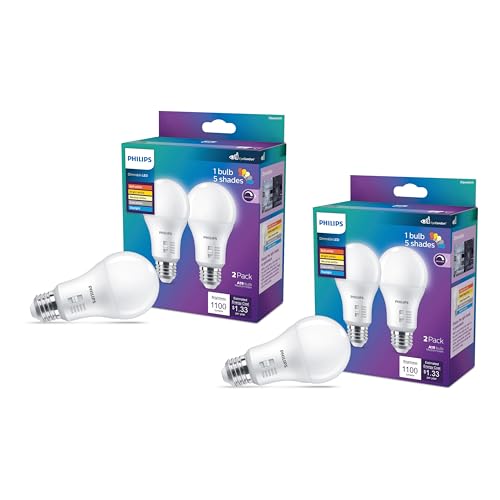 Philips LED Selectable White A19, 75W Equivalent, Dimmable (11A19/DipS/5CCT) Open lamps that need more light than a 60W-class bulb | A bulb swap. Set the switch on the bulb before installing. | 1,100 lm | $26.08 - View on Amazon #ad Price as of October 8, 2026. How we earn |
Specifications are the manufacturer or retailer published figures, compiled by hand. We have not measured them, and where a figure is not published we write "Not published" rather than guess.
01
The verdict
2700K for every room you relax in - living room, bedroom, dining room. 4000K for every room you work in - home office, garage, laundry, workshop. The bathroom and the kitchen are the two that genuinely sit on the line, and for both the answer is usually to split the difference at 3000K rather than pick a side.
This is a bigger jump than the comparisons either side of it. 2700K against 3000K is a matter of taste. 2700K against 4000K is a change of character: the same furniture, the same lumens, and a room that feels domestic in one and functional in the other.
| 2700K | 4000K | |
|---|---|---|
| Marketing name | Soft white | Cool white / bright white |
| Looks like | Incandescent bulb, amber-leaning | Neutral white, no cast either way |
| Does well | Skin, wood, warm textiles, food | Paper, screens, tools, white surfaces |
| Does badly | Blues and grays read muddy | Faces look tired; wood looks flat |
| Right rooms | Living room, bedroom, dining room | Office, garage, laundry, workshop |
| Wrong rooms | A workbench or a laundry sink | Anywhere you have guests sit down |
| Evening use | Yes - does not suppress wind-down | Poor - reads as daytime light |
02
What the jump actually changes
The useful way to think about 1,300 kelvin is not "warmer and cooler" but what each one is honest about.
2700K is flattering and slightly dishonest. It pushes everything toward amber. Skin looks healthy, wood looks rich, and a beige wall looks cream. It also means a gray-blue sofa will not look gray-blue, and if you are trying to match paint or fabric under it, you will get it wrong.
4000K is honest and slightly unkind. No cast in either direction, so colors are what they are. That is exactly what you want over a workbench, a laundry pile or a desk. It is also why people describe 4000K living rooms as feeling like an office: nothing is being flattered.
Neither is brighter. This is the single most common misunderstanding about color temperature, and it is worth being blunt: an 800-lumen 2700K bulb and an 800-lumen 4000K bulb put out exactly the same amount of light. The cooler one often feels brighter because our perception of crispness tracks blue content, but the lumen figure is unchanged. The two numbers are set out separately in lumens vs kelvin.
03
The bulbs, and who each is for
For the 2700K side: the Philips Ultra Definition A19. 800 lumens at 2700K with CRI 95 and dimmable. High CRI matters more at 2700K than anywhere else, because warm light with poor rendering is where the muddy, drab look comes from.
Who should skip it: anyone lighting a work surface. This is a living space bulb, and no amount of CRI makes 2700K right over a bench.
For the 4000K side: the Waveform CENTRIC DAYLIGHT 4000K. 800 lumens, CRI 95+, R9 above 80 - the neutral white with the color rendering to justify it. If you are going neutral so colors are accurate, a CRI 80 bulb defeats the point.
Who should skip it: anyone with a dimmer. Waveform publishes it as non-dimmable.
For deciding without buying twice: the Feit selectable A19. 800 lumens, CRI 90, dimmable, and a switch that runs 2700K, 3000K, 3500K, 4000K and 5000K. Put it in the fitting, live with each value for an evening, then buy the rest at whatever won.
Who should skip it: anyone furnishing a whole house. Selectable bulbs cost more per socket; they are a decision tool, not a bulk buy.
For a room that needs more light than 800 lumens: the Philips Selectable White 75W equivalent. 1,100 lumens, CRI 90, dimmable, same five values. The right choice for a kitchen or an office where an 800-lumen bulb was never going to be enough.
Who should skip it: anyone putting it in a bedside lamp - 1,100 lumens at close range is too much regardless of color.
04
If this is not quite your comparison
Choosing between two warm values - that is 2700K vs 3000K, a much finer distinction about how warm is too warm.
Already decided against 2700K and now choosing how neutral - 3000K vs 4000K is the one step rather than the full jump.
Working at the cool end entirely - 4000K vs 5000K and 5000K vs 6500K cover the utility range.
Confused by the names rather than the numbers - warm white vs soft white vs daylight untangles the marketing adjectives, and the legacy color codes handle 4100K and the fluorescent names.
The picks
The products behind this page
01
The default bulb for almost every lamp in a home
Philips Ultra Definition A19 LED, 60W equivalent, 2700K
800 lumens at 2700K with a published CRI 95 for the price of an ordinary bulb - the single easiest upgrade in this entire category.
| Lumens | 800 lm |
|---|---|
| Color temperature | 2700K |
| CRI | 95 |
| Power source | Screws into a standard E26 socket (8W) |
| Dimmable | Yes |
| Renter-safe method | It is a bulb. Swap it, keep the old one, put it back when you leave. |
What it gets right
- CRI 95 at a mainstream price, which almost nothing else manages
- 2700K matches the warm light most rooms were designed around
- Dimmable and rated flicker-free
What it costs you
- 800 lumens is one bulb's worth - a dark room needs several
- 2700K is too warm for detailed kitchen task work
- R9 is not published, so deep reds are an unknown
Spec source: Home Depot listing - retrieved September 3, 2026.
02
Neutral white with genuinely accurate color
Waveform Lighting CENTRIC DAYLIGHT Full Spectrum A19, 4000K (4005C.40)
#ad No live price right now, so we show none. How we earn
800 lumens at 4000K with CRI 95+ and R9 80+, flicker-free - the rare 4000K bulb that publishes the numbers, though it is not dimmable or enclosed-rated.
| Lumens | 800 lm |
|---|---|
| Color temperature | 4000K |
| CRI | 95+ (R9 80+) |
| Power source | Screws into a standard E26 socket (10W) |
| Dimmable | No |
| Renter-safe method | A bulb swap. Fully reversible. |
What it gets right
- CRI 95+ with R9 80+ published at 4000K
- Flicker-free
- 25,000 hour rated life
What it costs you
- Not dimmable
- Not suitable for enclosed fixtures
- Sold by a specialist brand
Spec source: Waveform Lighting - CENTRIC DAYLIGHT A19 product page - retrieved September 3, 2026.
03
Most lamps and fixtures, including enclosed ones
Feit Electric Selectable Color A19 LED, 60W Equivalent, Dimmable (OM60DM/5CCTCA/LED/10)
#ad Price as of October 8, 2026. How we earn
800 lumens, CRI 90, dimmable and rated for enclosed fixtures, with 2700K to 5000K chosen on a switch in the base - the selectable bulb with the fewest places it cannot go.
| Lumens | 800 lm |
|---|---|
| Color temperature | 2700K / 3000K / 3500K / 4000K / 5000K, selectable |
| CRI | 90 |
| Power source | 8.8W, E26 base |
| Dimmable | Yes - with LED-compatible dimmers |
| Renter-safe method | A bulb swap. Set the switch in the base before you screw it in. |
What it gets right
- CRI 90 at every setting
- Rated for enclosed fixtures and damp locations
- Dimmable, and Title 20 compliant
What it costs you
- The switch is on the bulb, so changing color means taking the bulb out
- 800 lm is a 60W-class output - not enough to be the only light in a large room
- Lumens at each color setting are not published
Spec source: Feit Electric - OM60DM/5CCTCA/LED/10 selectable color A19 product page - retrieved September 3, 2026.
04
Open lamps that need more light than a 60W-class bulb
Philips LED Selectable White A19, 75W Equivalent, Dimmable (11A19/DipS/5CCT)
#ad Price as of October 8, 2026. How we earn
1,100 lumens with CRI 90 and dimming, plus five settings from 2700K to 5000K on a switch on the bulb - the brightest dimmable pick, provided the fixture is not enclosed.
| Lumens | 1,100 lm |
|---|---|
| Color temperature | 2700K / 3000K / 3500K / 4000K / 5000K, selectable |
| CRI | 90 |
| Power source | 11W, E26 base |
| Dimmable | Yes |
| Renter-safe method | A bulb swap. Set the switch on the bulb before installing. |
What it gets right
- 1,100 lm - a 75W-class output
- CRI 90 and dimmable
- Rated for 50,000 switching cycles
What it costs you
- Philips says it is not for closed (enclosed) fixtures
- The switch is on the bulb, so changing color means taking the bulb out
- Pack size differs by source: Philips lists a 2-pack, the Amazon listing says 4
Spec source: Philips Lighting US - LED bulb 75W A19 E26, selectable white (specifications) - retrieved September 3, 2026.
FAQ
Questions people actually ask
+Is 2700K or 4000K better for a living room?
2700K, with very little argument. A living room is a space people relax in, and 4000K reads as neutral-institutional there - correct light, wrong room. The only common exception is a living room that doubles as a full-time workspace, and even then the better answer is a 4000K task lamp inside a 2700K room.
+Is 4000K too bright for a bedroom?
Brightness and color temperature are separate things - a 4000K bulb is not brighter than a 2700K bulb of the same lumens. But 4000K is stimulating in a way that works against a bedroom, so the answer is still no for the main light. If you want crisp light for dressing or reading, put it in a task lamp rather than the ceiling.
+What is the difference between 2700K and 4000K?
1,300 kelvin, which is the largest step most people ever make. 2700K is the incandescent color - amber-leaning, flattering to skin and wood. 4000K is neutral white - no warm cast, no blue cast, which makes it honest about color and unflattering about faces.
+Should a kitchen be 2700K or 4000K?
It depends on whether the kitchen is a room you also sit in. A closed galley kitchen used only for cooking takes 4000K well. An open-plan kitchen that faces a sofa should be 3000K, because 4000K visible from the living area makes the whole space read as neutral.
+Can I mix 2700K and 4000K in the same house?
Across rooms, yes - that is normal and correct. Within one visual field, no. If you can see two fittings at once they should be the same value, because a mismatch of this size reads as a broken bulb rather than a design decision.
+Which is better for a home office?
4000K, for a room used during working hours. It keeps you alert and renders documents and screens honestly. If the office is also where you sit in the evening, a 4000K desk lamp over a 3000K room light gives you both without a compromise that suits neither.
Sources
Where the numbers came from
- ENERGY STAR - Light Bulbs Key Product Criteria (correlated color temperature requirements for qualified lamps)
- U.S. Department of Energy - Lighting Facts label and how brightness, color and efficiency are declared
- Home Depot listing - Philips 60W Equivalent A19 Ultra Definition Dimmable LED, 2700K, 800 lm, CRI 95
- Waveform Lighting - CENTRIC DAYLIGHT Full Spectrum Flicker-Free A19 10W, 4000K, 800 lm, CRI 95+
All sources retrieved September 3, 2026.
Next
Read these next
About the author
Sawyer V. An enthusiast who reads the spec sheets and does the arithmetic. No lab, no test bench.