Sconce & Socket earns a commission on qualifying purchases made through links on this page, at no extra cost to you. It does not change which products we pick. Full disclosure.
| # | Product | Best for | Lumens | Price |
|---|---|---|---|---|
| 01 |  Feit Electric 4 ft T8 LED Tube, Type A, 18W (T848/840/LEDG2/2) Swapping tubes without touching the wiring | A tube swap in an existing fixture. Fully reversible. | 1,800 lm per tube | |
| 02 | 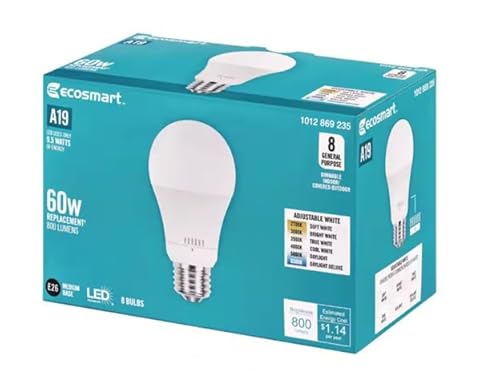 EcoSmart A19 60W Equivalent Dimmable LED with Selectable Color Temperature (14A19060W6CCT02) Anyone who wants a 6500K option as well as warm white | A bulb swap. Rotate the switch on the base before screwing it in. | 800 lm | $19.74 - View on Amazon #ad Price as of October 9, 2026. How we earn |
| 03 | Waveform Lighting CENTRIC DAYLIGHT Full Spectrum A19, 4000K (4005C.40) Neutral white with genuinely accurate color | A bulb swap. Fully reversible. | 800 lm | Check price on Amazon #ad No live price right now, so we show none. How we earn |
| 04 |  Philips Ultra Definition A19 LED, 60W equivalent, 2700K The default bulb for almost every lamp in a home | It is a bulb. Swap it, keep the old one, put it back when you leave. | 800 lm |
Specifications are the manufacturer or retailer published figures, compiled by hand. We have not measured them, and where a figure is not published we write "Not published" rather than guess.
01
The short answer
4100K is neutral white - the fluorescent industry's standard "cool white", sitting between 4000K and 5000K. If you are replacing a 4100K tube or bulb, buy 4000K. It is the value LED makers actually stock, and the 100K difference is invisible in a room. The reason 4100K confuses people is that it belongs to an older naming system that ran in parallel with the one on LED boxes today, and the two systems use the same words for different numbers.
There are three legacy systems still in circulation, and this page decodes all of them: the kelvin values the fluorescent trade standardized on, the adjectives printed on bulb boxes, and the slash codes on tubes.
02
The legacy names, translated
These are the fluorescent-era trade names. They still appear on tube packaging, on old fixture labels, and in the specifications of commercial buildings that were lit before LEDs existed - which is why they turn up in home searches at all: somebody is standing in a garage or a basement reading an old tube.
| Legacy name | Kelvin | What it looks like | Buy instead |
|---|---|---|---|
| Warm white | 3000K | Warm, but not as warm as an old bulb | 3000K |
| Soft white / incandescent | 2700K | The classic household bulb color | 2700K |
| White / neutral | 3500K | Between warm and neutral | 3500K |
| Cool white | 4100K | Neutral white, despite the name | 4000K |
| Daylight white | 5000K | Crisp, slightly blue-leaning | 5000K |
| Daylight deluxe | 6500K | Clearly blue; a utility light | 6500K |
| Halogen | 2800K - 3000K | Marginally crisper than incandescent | 3000K |
Two of these are worth dwelling on. Cool white at 4100K is not cool - it is the exact middle of the range, and people who buy "cool white" LEDs expecting what their old tubes did often end up with 5000K and a room that feels like a waiting area. And deluxe meant CRI, not quality: a cool white deluxe tube was the same 4100K with better color rendering.
03
The slash codes on tubes
A tube marked F32T8/741 tells you four things in eleven characters, and the last three are the ones that matter when you are matching a replacement.
The practical use: if a fixture has four tubes and two have been replaced over the years with a different code, that is why the light looks wrong. Mismatched tubes in one fitting read as a fault rather than a choice, and the code on the end cap is how you find out which one is the odd one.
04
What to buy, by situation
Replacing 4100K tubes in a garage, basement or workshop: the Feit Type A T8 LED tube. This is the rare modern product that is actually sold at 4100K - 1,800 lumens per tube, CRI 80, and it runs on the existing ballast, so it is a tube swap rather than a rewire. If you are matching tubes you already have, this removes the guesswork entirely.
Skip it if: your ballast is dead or you want to be rid of ballasts altogether - then you want a ballast-bypass tube instead, which is a different and more involved job. CRI 80 is also the floor, not a good number, for anywhere you examine things closely.
Not sure which legacy value your room wants: the EcoSmart 6-CCT selectable A19. One bulb that switches between 2700K, 3000K, 3500K, 4000K, 5000K and 6500K at 800 lumens and CRI 90. It covers every value in the table above except 4100K, and 4000K is the correct stand-in for that. Buy one, try the room, then buy the rest in a fixed value.
Skip it if: you already know what you want - a selectable bulb costs more than a fixed one and the selector switch is a thing that can be knocked.
The modern equivalent of cool white, done properly: the Waveform CENTRIC DAYLIGHT 4000K. 800 lumens at 4000K with CRI 95+ and R9 above 80 - the neutral white that 4100K was always trying to be, with color rendering the fluorescent era never managed.
Skip it if: you need it dimmable. Waveform publishes this one as non-dimmable, which rules it out of any room on a dimmer.
Replacing old incandescents and wanting the same color: the Philips Ultra Definition A19. 2700K at 800 lumens with CRI 95 - the incandescent color, rendered better than the incandescent did.
Skip it if: you are lighting a workshop or a garage. 2700K is the right answer for living space and the wrong one anywhere you need to see detail.
05
Where this leaves you
Once the legacy names are decoded, the remaining question is which value your room actually wants - and that is a different question with a room-by-room answer, set out in the light bulb color temperature chart.
If the confusion was never really about color at all but about the two numbers on the box, lumens vs kelvin is the page that separates them. And if the bulbs in question are 4-foot tubes, the whole retrofit decision is in the best LED tube lights.
The picks
The products behind this page
01
Swapping tubes without touching the wiring
Feit Electric 4 ft T8 LED Tube, Type A, 18W (T848/840/LEDG2/2)
1,800 lumens from 18 watts that drops straight into a working fluorescent fixture - no ballast removal, no rewiring, and a maker that publishes which ballasts it works with.
| Lumens | 1,800 lm per tube |
|---|---|
| Color temperature | 4100K |
| CRI | 80 |
| Power source | Bi-pin G13, 18W, 120-277V - runs on the existing ballast |
| Dimmable | No |
| Renter-safe method | A tube swap in an existing fixture. Fully reversible. |
What it gets right
- Type A, so it is a tube swap rather than an electrical job
- 35,000 hour rated life and a 5-year warranty published by Feit
- Enclosed fixture rated, and mercury free unlike the tube it replaces
- Feit publishes a ballast compatibility list you can check before buying
What it costs you
- Works with instant-start ballasts only - check the ballast label first
- The old ballast stays in the circuit, so it keeps drawing power and can still fail
- 4100K only, which is a working white rather than a living-space one
- 1,800 lm is the least light of the tubes here, and it is not dimmable
Spec source: Feit Electric - T848/840/LEDG2/2 4 ft T8 LED (1,800 lm, 18W, 4100K, CRI 80, 35,000 hours, Type A direct replacement, enclosed rated, 5-year warranty) - retrieved September 3, 2026.
02
Anyone who wants a 6500K option as well as warm white
EcoSmart A19 60W Equivalent Dimmable LED with Selectable Color Temperature (14A19060W6CCT02)
#ad Price as of October 9, 2026. How we earn
Six settings from 2700K up to 6500K, CRI 90, dimmable and rated for enclosed fixtures - the widest range here, sold on Amazon through a third-party seller.
| Lumens | 800 lm |
|---|---|
| Color temperature | 2700K / 3000K / 3500K / 4000K / 5000K / 6500K, selectable |
| CRI | 90 |
| Power source | 9.5W, E26 base |
| Dimmable | Yes - with LED-rated dimmers |
| Renter-safe method | A bulb swap. Rotate the switch on the base before screwing it in. |
What it gets right
- Six settings, including 6500K
- CRI 90 and dimmable
- Listed as suitable for totally enclosed fixtures
What it costs you
- On Amazon it ships from a third-party seller, not from EcoSmart or Home Depot
- Home Depot's own product page could not be checked; specs come from the Amazon listing and the manual
- Damp-location rating is not published for this model
Spec source: Amazon listing - EcoSmart A19 60W equivalent selectable color temperature, 8-pack - retrieved September 3, 2026.
03
Neutral white with genuinely accurate color
Waveform Lighting CENTRIC DAYLIGHT Full Spectrum A19, 4000K (4005C.40)
#ad No live price right now, so we show none. How we earn
800 lumens at 4000K with CRI 95+ and R9 80+, flicker-free - the rare 4000K bulb that publishes the numbers, though it is not dimmable or enclosed-rated.
| Lumens | 800 lm |
|---|---|
| Color temperature | 4000K |
| CRI | 95+ (R9 80+) |
| Power source | Screws into a standard E26 socket (10W) |
| Dimmable | No |
| Renter-safe method | A bulb swap. Fully reversible. |
What it gets right
- CRI 95+ with R9 80+ published at 4000K
- Flicker-free
- 25,000 hour rated life
What it costs you
- Not dimmable
- Not suitable for enclosed fixtures
- Sold by a specialist brand
Spec source: Waveform Lighting - CENTRIC DAYLIGHT A19 product page - retrieved September 3, 2026.
04
The default bulb for almost every lamp in a home
Philips Ultra Definition A19 LED, 60W equivalent, 2700K
800 lumens at 2700K with a published CRI 95 for the price of an ordinary bulb - the single easiest upgrade in this entire category.
| Lumens | 800 lm |
|---|---|
| Color temperature | 2700K |
| CRI | 95 |
| Power source | Screws into a standard E26 socket (8W) |
| Dimmable | Yes |
| Renter-safe method | It is a bulb. Swap it, keep the old one, put it back when you leave. |
What it gets right
- CRI 95 at a mainstream price, which almost nothing else manages
- 2700K matches the warm light most rooms were designed around
- Dimmable and rated flicker-free
What it costs you
- 800 lumens is one bulb's worth - a dark room needs several
- 2700K is too warm for detailed kitchen task work
- R9 is not published, so deep reds are an unknown
Spec source: Home Depot listing - retrieved September 3, 2026.
FAQ
Questions people actually ask
+What does 4100K mean on a light bulb?
4100K is a correlated color temperature - a neutral, very slightly cool white that sits between 4000K and 5000K. It is a fluorescent-era value: the old tube industry standardized on 4100K cool white, and LED makers standardized on 4000K instead. The two look near enough identical; 4100K survives mainly on T8 tubes and the LED tubes built to replace them.
+Is 4100K the same as 4000K?
Not numerically, but in a room you will not tell them apart - 100K is far below the difference most people can see, and both read as neutral white. If a fixture takes 4100K tubes and you are replacing them with 4000K LEDs, that is a correct swap, not a compromise.
+What color is 'cool white'?
In the fluorescent naming system, cool white is 4100K - despite the name, it is neutral rather than blue. This is the single biggest trap in legacy bulb naming, because in LED marketing 'cool white' is routinely used for 5000K and above. Read the kelvin number, never the adjective.
+What do the numbers like /741 or /830 on a fluorescent tube mean?
They are a two-part code. The first digit is the CRI in tens, the next two are the color temperature in hundreds of kelvin. So /741 is CRI 70, 4100K. /830 is CRI 80, 3000K. /850 is CRI 80, 5000K. It is the most compact spec on the tube and almost nobody is told how to read it.
+What is 'daylight deluxe'?
A fluorescent trade name for roughly 6500K, the top of the usual range - deliberately bluer than daylight white. 'Deluxe' in these old names meant higher CRI, not higher quality overall, which is why cool white deluxe and daylight deluxe exist alongside the plain versions.
+Why do incandescent bulbs not have a kelvin number on the box?
Because they only ever made one color. A standard incandescent runs about 2700K and a halogen slightly higher, around 2800K to 3000K, and there was nothing to choose between, so nobody printed it. Kelvin only became a label once bulbs could be made in more than one color.
Sources
Where the numbers came from
- ENERGY STAR - Light Bulbs Key Product Criteria (correlated color temperature requirements for qualified lamps)
- Federal Trade Commission - Lighting Facts label rule (16 CFR Part 305), the label that puts lumens and kelvin on the box
- U.S. Department of Energy - Lighting Facts label and how brightness, color and efficiency are declared
- Feit Electric - T848/840/LEDG2/2 4 ft T8 LED Tube, Type A, 18W, 1,800 lm, 4100K, CRI 80
- Amazon listing - EcoSmart A19 60W Equivalent Dimmable LED with Selectable Color Temperature, 2700K to 6500K, 800 lm, CRI 90 (14A19060W6CCT02)
- Waveform Lighting - CENTRIC DAYLIGHT Full Spectrum Flicker-Free A19 10W, 4000K, 800 lm, CRI 95+
- Home Depot listing - Philips 60W Equivalent A19 Ultra Definition Dimmable LED, 2700K, 800 lm, CRI 95
All sources retrieved September 3, 2026.
Next
Read these next
About the author
Sawyer V. An enthusiast who reads the spec sheets and does the arithmetic. No lab, no test bench.