Skip to content
Sconce & Socket

Hub

Lighting a Room With No Ceiling Light

The whole plan for a room with no overhead fixture: how much light you actually need, where it has to go, and what plugs in to deliver it.

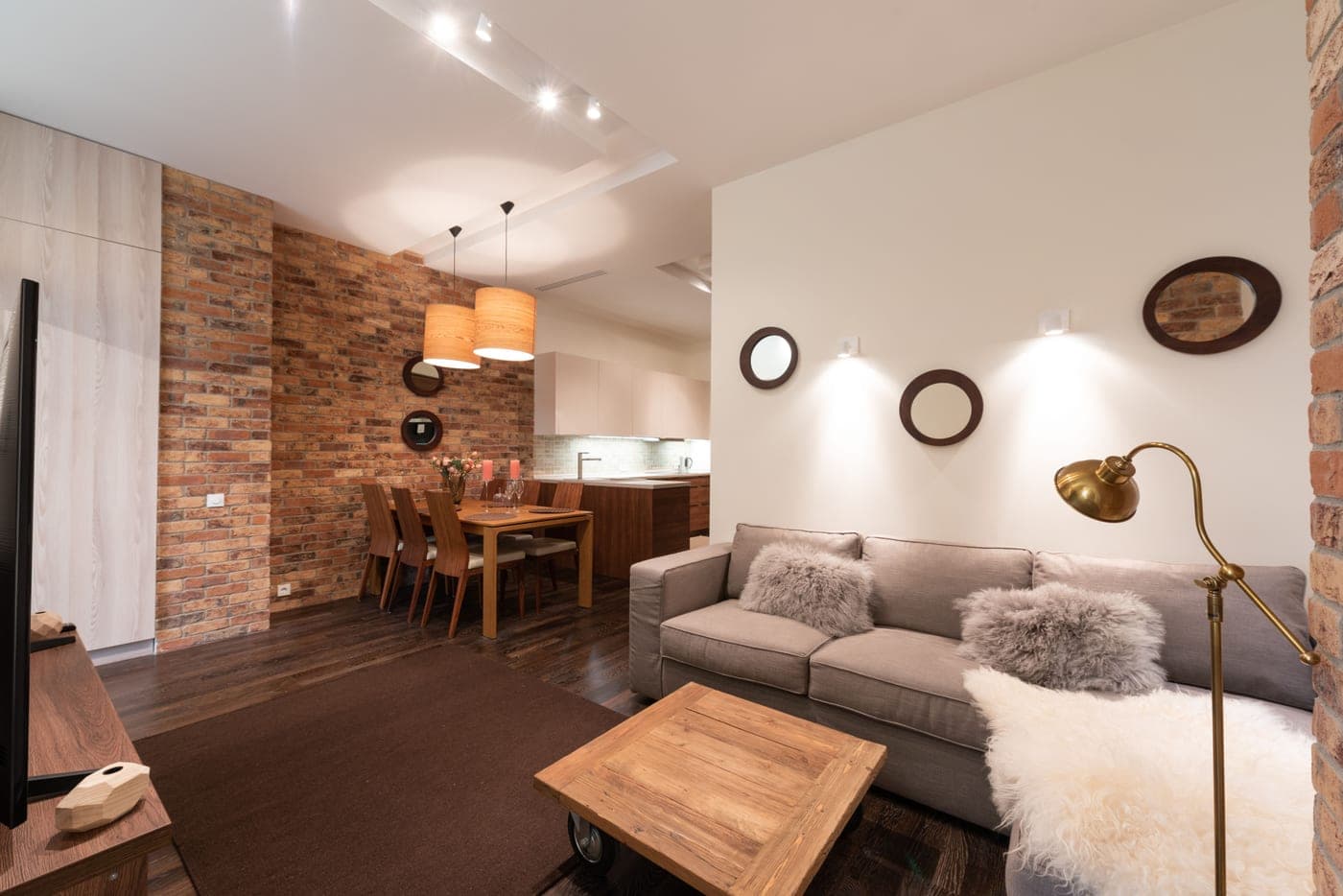
A living room lit after dark by a tall floor lamp bouncing light off the ceiling, with no overhead fixture fitted

Sconce & Socket earns a commission on qualifying purchases made through links on this page, at no extra cost to you. It does not change which products we pick. Full disclosure.

01

You did not do anything wrong

A room with no ceiling fixture is not a defect and not an oversight. Across much of the United States, bedrooms and living rooms are routinely wired with a switched outlet instead of an overhead light: the wall switch by the door controls half a receptacle, and the assumption is that a lamp goes there. It is a construction convention, which is exactly why it is so common in rented buildings and why nobody warned you.

The result is a room where the only light comes from whatever lamps you happened to own, positioned wherever there was an outlet, with whatever bulbs came in the multipack. That is not a lighting plan. It is an accident, and it is the actual cause of most rooms that feel dark.

The good news is genuinely good: a room without a ceiling fixture, planned properly, ends up better lit than a room with one. A single overhead source produces glare in your eye line, hard shadows on faces and dark corners - which is why rooms that have one still need lamps. Starting from nothing means you get to distribute the light correctly from the beginning.

This section is that plan. Four steps: find out how much light the room owes you, find out how much it currently produces, put the difference in the right places, and do all of it with things that plug in.

02

Step one: the number

Published guidance for residential interiors puts living-room ambient light at 10 to 20 footcandles. A footcandle is one lumen falling on one square foot, so the target for a whole room is one multiplication: floor area times footcandles.

That number is a budget to spend across the room, not a target for one fixture. Hitting it with a single lamp technically satisfies the arithmetic and produces a room nobody enjoys being in.

03

Step two: what the room already makes

Go and read the small print on the bulbs currently in the room. Not the wattage equivalence on the front of the box - the lumen figure, which is printed on every bulb sold.

This is where most people find their answer. Three lamps with 600-lumen bulbs produce 1,800 lumens, which is below the minimum for a mid-sized living room, in a room that visibly contains three lamps. The complaint is "this room is dark despite having lamps in it," and the explanation is that the lamps are producing about half of what the room needs.

The fix costs a few dollars. Standard bulbs sold as 60W equivalent produce around 800 lumens; 100W equivalent produce around 1,500. Swapping three sockets from the first to the second adds roughly 2,100 lumens - about the same as buying a floor lamp, for a fraction of the price and with nothing new to position. Check the maximum rating marked on each fixture first, comparing against the LED's actual watts rather than its equivalence.

Do this before buying anything else. It frequently closes most of the gap and it changes what the rest of the plan has to achieve. The bulbs worth using are in best LED bulbs for the home.

04

Step three: four sources, four heights

A working plan for a 150 - 200 sq ft room with no ceiling fixture.
SourceWhereRoughlyJob
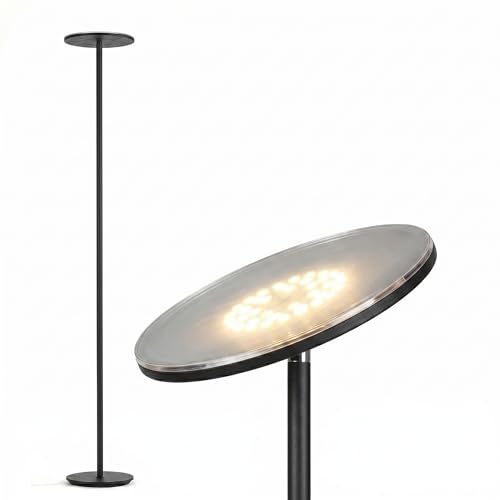
Torchiere uplightCorner diagonally opposite your seat2,000 - 2,500 lmAmbient. Carries the room.
Reading or task lampBeside and slightly behind your main seat800 - 2,000 lm, dimmableTask. Its own switch.
Table lampConsole or side table across the room600 - 800 lmAccent. Depth.
Low sourceShelf, plant, or behind a screenUnder 300 lmAccent. Kills screen contrast.

The uplight is the piece doing the job the missing fixture would have done. It throws its light at the ceiling, the ceiling reflects and diffuses it, and the whole room lifts. It is the only shape of lamp that genuinely substitutes for an overhead light, and it depends entirely on having a pale ceiling to bounce off. Against a dark or timber ceiling, a great deal of the output simply disappears and a shaded lamp at seated height does more work.

Put it in the corner diagonally opposite where you sit. The light then crosses the whole ceiling before it comes down, which evens out the distribution, and the lamp itself never sits in your eye line.

The remaining three are the task and accent layers. Each on its own switch, so the room has settings rather than one state - everything on for cleaning, ambient and task for reading, accent only late in the evening. The reasoning behind the three layers is in layered lighting explained.

Keep every source within about 500K of the others. For a living space, 2700K throughout is the safe answer; the one step up is covered in 2700K vs 3000K.

05

Step four: nothing that needs an electrician

Everything in the plan above plugs into an existing outlet. That is not a compromise made for renters - it is the correct engineering answer for most rooms, because plug-in fixtures now match hardwired ones on output and color quality, and they move with you.

There are three tiers of change in a rental and they get confused constantly. Plugging something in is not an alteration and needs nobody's permission. Attaching something to a wall is a fixing, which is a make-good obligation rather than an alterations one, and adhesive avoids it entirely. Replacing a hardwired fixture or a switch is an electrical alteration, which generally needs both a landlord's agreement and a qualified person. The full picture, with the standard caveat that this is general information and not legal advice, is in can you change a light fixture in an apartment.

The one objection to plug-in lighting is the cord, and it is a twenty-minute problem rather than a reason to change plans - adhesive channel painted to match the wall, cord clips along the baseboard, or simply routing behind furniture. The methods, including the one route that is genuinely unsafe, are in how to hide a plug-in fixture cord.

If you want something fixture-shaped rather than lamp-shaped, that exists too: plug-in wall sconces run from an outlet and mount with adhesive, and a plug-in pendant hangs over a table from a hook. Neither touches a junction box.

06

Where to go from here

The pages below take each part of this in turn. If you only read two, make them how many lumens does a room need for the arithmetic and the best lamps for a room with no overhead light for the one substantial purchase. If your room is specifically a living room or a bedroom, the room-specific plans are more detailed than this page, and if the room is dark for reasons other than a missing fixture, how to light a dark room diagnoses which of the four causes you actually have.

Pages

Everything in Rooms With No Ceiling Light

Several modern floor lamps of different shapes in a minimal living room

Comparison

Torchiere vs arc vs tripod

Three floor-lamp shapes compared on the only thing that matters in a dark room: where each one puts its light.

A dim room lit by a single lamp, with the corners falling into shadow

Guide

How to light a dark room

Diagnose why a room reads as dark - output, placement, surfaces or color - then fix it in order of cost.

FAQ

Questions people actually ask

+How do you light a room with no overhead lighting?

Work out the lumen target from the floor area, then spread it across four sources at different heights: an uplight in the corner diagonally opposite your seat for ambient light, a task lamp at the chair you use, and two smaller accent sources. Everything plugs in, so nothing needs an electrician or a landlord's permission.

+Why do so many apartments have no ceiling lights?

In much of the United States, bedrooms and living rooms are commonly wired with a switched outlet instead of a ceiling fixture - the wall switch controls half of a receptacle, and the expectation is that you plug a lamp into it. It is a construction convention rather than a fault, which is why it is so widespread in rented buildings.

+Is a floor lamp enough to light a whole room?

A torchiere aimed at a pale ceiling can carry the ambient layer of a typical living room on its own - a 2,190 lumen lamp sits inside the published range for a 168 square foot room. It will still look better with two or three smaller sources sharing the load, because one bright source produces glare and hard shadows.

+What is a switched outlet and how do I find it?

It is a receptacle where one or both sockets are controlled by a wall switch. Plug a lamp in, turn it on at the lamp, then flip the wall switch. If the lamp responds, you have found it - and that outlet is where the room's main lamp belongs, because it gives you a wall switch by the door.

+Can I add a ceiling light to a room that has none?

Hardwiring a new fixture means new cable and a junction box, which is an electrical alteration and generally needs a landlord's agreement and a qualified person. A plug-in swag pendant hangs from a hook and runs to an outlet instead, which moves it from an electrical question to a fixing question.

+How much does it cost to fix a room with no overhead lighting?

Start with bulbs for the lamps you already own - the cheapest change and often the largest. A torchiere is the one substantial purchase. Most rooms are solved for less than the price of a single hardwired fixture installation, and every part of it moves with you.

Elsewhere

The other sections