Sconce & Socket earns a commission on qualifying purchases made through links on this page, at no extra cost to you. It does not change which products we pick. Full disclosure.
| # | Product | Best for | Lumens | Price |
|---|---|---|---|---|
| 01 | 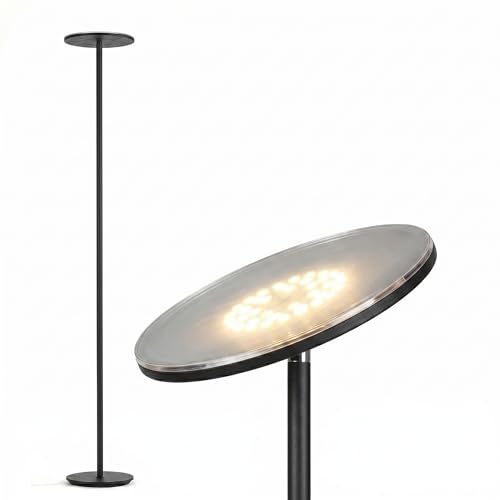 Brightech Sky LED Torchiere Floor Lamp Whole-room light from one outlet | Plugs into an outlet. No drilling, no fixing, no ceiling box. | 2,190 lm | $74.99 - View on Amazon #ad Price as of October 18, 2026. How we earn |
| 02 |  Brightech Eden LED Wood Tripod Floor Lamp Rooms where you want to pick your own bulb | Plugs into an outlet. Nothing is fixed to the wall or ceiling. | Depends on the bulb you fit | |
| 03 |  OttLite ClearSun LED Floor Lamp Reading and close work where color accuracy matters | Plugs into an outlet. Height adjusts 47.5 to 64 inches. | Not published | $139.99 - View on Amazon #ad Price as of October 18, 2026. How we earn |
Specifications are the manufacturer or retailer published figures, compiled by hand. We have not measured them, and where a figure is not published we write "Not published" rather than guess.
01
Why one light is always wrong
Put 3,000 lumens in the middle of a ceiling and you get a room where everything is lit from one angle. Faces get shadows under the eyes. The corners fall away. Anything glossy throws the source straight back at you. The room is bright and still looks bad.
Split the same 3,000 lumens across four sources at four heights and the shadows cross each other out, the corners come back, and no single source is bright enough to glare. Nothing about the lumen budget changed - only its distribution.
This is why we treat the number from the lumen guide as a budget rather than a target for one fixture, and it is why a room with no ceiling light is not the disadvantage it feels like. You were going to want several sources anyway.
02
The three layers
| Layer | Job | Height | Share of the budget |
|---|---|---|---|
| Ambient | Fills the room so nothing is in darkness. Usually bounced off the ceiling. | 6 ft and above, or aimed up | About 50 - 60% |
| Task | Aimed at a specific surface: a page, a chopping board, a desk. | 30 - 48 in, at the surface | About 25 - 35% |
| Accent | Depth and warmth. A pool of light that makes a corner look intentional. | Under 30 in, or eye level on a wall | About 10 - 20% |
Ambient
In a home with a ceiling fixture, this layer is the fixture. In a home without one, it is a torchiere or an uplight aimed at the ceiling. Bouncing light off a white ceiling costs you some output to absorption but buys enormous spread - the ceiling becomes the light source, which is the softest large-area emitter you can get for free.
This layer wants the highest output of the three and it should be dimmable. Ambient light at full brightness is right at 4pm in January and unbearable at 11pm.
Task
Task light is the layer people skip, and it is the one that decides whether a room is comfortable to use. Published guidance puts a desk surface at 50 to 75 footcandles against a living room ambient level of 10 to 20 - three to five times as much light, in a very small area. You are never going to get there by making the whole room brighter.
Put the source beside and slightly behind your shoulder for reading, or directly over the surface for kitchen prep. This is also the layer where CRI matters most - you are looking closely at something and want to see it accurately.
Accent
A small lamp on a shelf, a plug-in sconce beside a bed, a strip behind a plant. It contributes little to the lumen total and most of the character. Skip this layer and a correctly lit room still reads as institutional.
03
Building all three when you rent
Every layer has a version that plugs in. This is the whole plan for a rented living room with no ceiling fixture and no permission to drill:
- Ambient: one torchiere aimed at the ceiling, in the corner diagonally opposite the main seat. Around 2,000 lumens covers a typical living room on its own.
- Task: one reading or desk lamp beside the chair you actually sit in, on its own switch so you are not lighting the whole room to read.
- Accent: a small table lamp or a plug-in wall sconce on the far side of the room, so the eye has something to land on.
Three plugs, no fixings, nothing to make good when you leave. The only real constraint is outlet position, which is what hiding a plug-in cord is for.
04
Color temperature across the layers
Keep the layers within about 500K of each other or the room reads as two rooms badly stitched together. A 2700K table lamp beside a 5000K desk lamp looks like a fault, not a design decision.
For most living spaces, run everything at 2700K or everything at 3000K. Kitchens can justify a cooler task layer - 3500K to 4000K over a counter next to 3000K ambient - because the counter reads as a separate zone. The full breakdown is in the color temperature chart, and the narrow question of whether the 300K step between the two warm options matters is in 2700K vs 3000K.
The picks
The products behind this page
01
Whole-room light from one outlet
Brightech Sky LED Torchiere Floor Lamp
#ad Price as of October 18, 2026. How we earn
The one lamp here that publishes its own output: 2,190 lumens at 3000K from an integrated LED, aimed at the ceiling so the whole room lifts rather than one corner.
| Lumens | 2,190 lm |
|---|---|
| Color temperature | 3000K |
| CRI | Not published |
| Power source | Plugs in (corded, 30W integrated LED) |
| Dimmable | Yes - touch dimmer on the pole |
| Renter-safe method | Plugs into an outlet. No drilling, no fixing, no ceiling box. |
What it gets right
- Publishes a real lumen figure, which most lamp brands do not
- 3000K is the safest single color temperature for a shared living space
- Uplight bounces off the ceiling, so it fills a room instead of pooling
What it costs you
- Integrated LED - when it eventually fails you replace the lamp, not a bulb
- CRI is not published, so color accuracy is unknown
- Needs about 10 inches of floor space and a nearby outlet
Spec source: Brightech product page - retrieved September 3, 2026.
02
Rooms where you want to pick your own bulb
Brightech Eden LED Wood Tripod Floor Lamp
A standard-socket tripod lamp, which means light quality is entirely your choice - put a 95 CRI bulb in it and it beats most integrated-LED lamps on color.
| Lumens | Depends on the bulb you fit |
|---|---|
| Color temperature | Depends on the bulb you fit |
| CRI | Depends on the bulb you fit |
| Power source | Plugs in (standard E26 socket) |
| Dimmable | With a dimmable bulb and an inline or plug dimmer |
| Renter-safe method | Plugs into an outlet. Nothing is fixed to the wall or ceiling. |
What it gets right
- A standard socket means you control lumens, kelvin and CRI
- A failed bulb is a few dollars, not a new lamp
- Tripod base is stable on rugs and uneven floors
What it costs you
- Downward shade - it lights a zone, not a whole room
- Brightech publishes no output figure, because there is nothing to publish
- You have to buy the bulb separately and get it right
Spec source: Brightech product page - retrieved September 3, 2026.
03
Reading and close work where color accuracy matters
OttLite ClearSun LED Floor Lamp
#ad Price as of October 18, 2026. How we earn
CRI 95+ is the number that separates a reading lamp from a merely bright one - print, thread and skin tones stop looking washed out under it.
| Lumens | Not published |
|---|---|
| Color temperature | Not published |
| CRI | 95+ |
| Power source | Plugs in (integrated LED) |
| Dimmable | 3 brightness settings via touch |
| Renter-safe method | Plugs into an outlet. Height adjusts 47.5 to 64 inches. |
What it gets right
- CRI 95+ published, which is rare on a floor lamp
- Height adjusts, so it works over a chair or a craft table
- Touch control rather than a floor switch you hunt for
What it costs you
- Lumen output is not published
- Stepped brightness, not stepless dimming
- Priced well above a plain reading lamp
Spec source: Talk of the House roundup (published specification, attributed) - retrieved September 3, 2026.
FAQ
Questions people actually ask
+What is layered lighting?
Layered lighting means splitting a room's light between three roles: ambient light that fills the space, task light aimed at where you read or work, and accent light that gives the room depth. The layers sit at different heights, and together they use the same total lumens that one overhead fixture would - just distributed so nothing is glaring and nothing is in shadow.
+How many light sources does a room need?
Three or four for a typical living room. Below three, one source has to do too much and produces glare and hard shadows. Above five in an ordinary room, you are usually adding switches rather than usable light.
+Can you layer lighting in a rental with no ceiling fixture?
Yes, and it is often easier. Ambient light comes from a torchiere bouncing off the ceiling, task light from a reading or desk lamp, accent light from a plug-in sconce or a small table lamp. All three plug in, none of them touches the ceiling, and nothing needs a landlord's permission.
+What height should each layer sit at?
Ambient light works at ceiling level or bounced up to it, roughly 6 feet and above. Task light sits at or just above the working surface, around 30 to 48 inches. Accent light sits low or on a wall, typically under 30 inches or at eye level on a wall. Spreading the sources vertically is what stops a room looking flat.
Sources
Where the numbers came from
- SuperBrightLEDs - Home Lighting Guide: IES residential recommended lighting levels
- Archtoolbox - Recommended Lighting Levels in Buildings
All sources retrieved September 3, 2026.
Next
Read these next
About the author
Sawyer V. An enthusiast who reads the spec sheets and does the arithmetic. No lab, no test bench.