Sconce & Socket earns a commission on qualifying purchases made through links on this page, at no extra cost to you. It does not change which products we pick. Full disclosure.
| # | Product | Best for | Lumens | Price |
|---|---|---|---|---|
| 01 |  Philips Ultra Definition A19 LED, 100W equivalent, 1500 lm Squeezing more light out of the sockets you already have | It is a bulb. No fixing, no permission, fully reversible. | 1,500 lm | $57.49 - View on Amazon #ad Price as of October 18, 2026. How we earn |
| 02 | 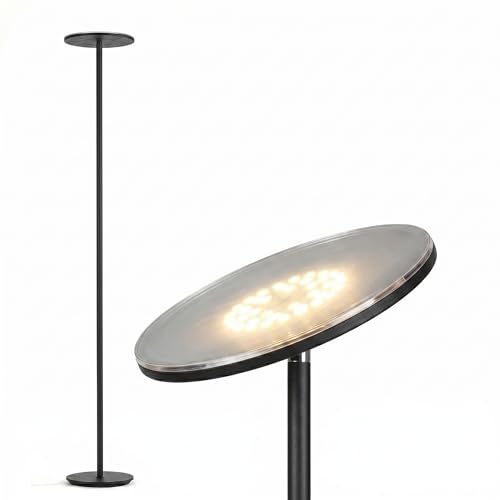 Brightech Sky LED Torchiere Floor Lamp Whole-room light from one outlet | Plugs into an outlet. No drilling, no fixing, no ceiling box. | 2,190 lm | $74.99 - View on Amazon #ad Price as of October 18, 2026. How we earn |
| 03 |  Philips Ultra Definition A19 LED, 60W equivalent, 2700K The default bulb for almost every lamp in a home | It is a bulb. Swap it, keep the old one, put it back when you leave. | 800 lm |
Specifications are the manufacturer or retailer published figures, compiled by hand. We have not measured them, and where a figure is not published we write "Not published" rather than guess.
01
The formula
Almost nobody publishes this, which is strange, because it is one multiplication.
Lumens needed = floor area in square feet x target footcandles.
A footcandle is one lumen falling on one square foot. Lighting standards are written in footcandles because that is what a light meter reads at the surface you care about. Multiply the target back out by the area and you get a total lumen budget for the room - a number you can compare against the boxes on the shelf. If the budget comes out higher than the sockets you have, the brightest LED bulbs shows how much one socket can actually produce.
The published targets come in ranges rather than single figures, because a bedroom used for reading needs more light than one used for sleeping. Take the low end for ambient light and the high end where close work happens.
02
Published illuminance targets by room
These are the ranges published for residential interiors. The lumen columns are this table doing the multiplication for you at two common room sizes.
| Room / task | Footcandles | 120 sq ft | 200 sq ft |
|---|---|---|---|
| Living room, ambient | 10 - 20 fc | 1,200 - 2,400 lm | 2,000 - 4,000 lm |
| Bedroom, ambient to task | 20 - 50 fc | 2,400 - 6,000 lm | 4,000 - 10,000 lm |
| Kitchen, general | 20 - 50 fc | 2,400 - 6,000 lm | 4,000 - 10,000 lm |
| Kitchen, prep and cooking surface | 50 - 100 fc | n/a - task area only | n/a - task area only |
| Hallway and stairs | 5 - 10 fc | 600 - 1,200 lm | 1,000 - 2,000 lm |
| Home office, desk surface | 50 - 75 fc | n/a - task area only | n/a - task area only |
A second published shorthand is lumens per square foot: roughly 70 for bedrooms and 80 for kitchens and living rooms. It lands in the same territory as the footcandle method and is quicker if you only want a ballpark. We use the footcandle version throughout the site because it separates ambient from task, which is the distinction that actually changes what you buy.
03
Where the formula is wrong
The multiplication gives you a target at the surface. Real rooms do not deliver every lumen a bulb produces to that surface, and pretending otherwise is how people end up with a room that is technically correct and visibly dark.
- Dark walls and furniture absorb light. A room with charcoal walls, a dark rug and a full bookcase can eat a quarter of the output. Add about 25 percent to the target.
- Shades and diffusers cost you. A drum shade in heavy fabric does not pass the full rating of the bulb inside it. An uplight bouncing off a white ceiling loses light to the ceiling too - but it spreads what survives far more evenly.
- Ceiling height matters. The published targets assume roughly eight-foot ceilings. A ten-foot ceiling puts the source further from the floor and the light spreads over more area on the way down.
- Age of the occupant. Published guidance recommends progressively higher illuminance with age. If the room is used mainly by someone over 60, work from the top of the range.
None of this makes the formula useless. It makes it a floor rather than a ceiling: hit the number, then check the room with your eyes.
04
What that means when you go shopping
The most common version of "my room is too dark" is not a missing lamp. It is three lamps with 450-lumen bulbs in them, adding up to less light than a single modern bulb produces on its own.
Before buying anything, do the cheapest thing first: read the lumen figure on the bulbs already in the room. If they are 450 or 600 lumens, swapping to 1,500-lumen bulbs roughly triples the room's output for the price of a takeaway - no new furniture, no new outlet, nothing to install. Check the fixture's maximum rating before you do it.
If the sockets are already full of bright bulbs and the room is still dark, the problem is placement rather than output, and layered lighting is the next thing to read. If there is no ceiling fixture at all, start at lighting a room with no ceiling light.
The picks
The products behind this page
01
Squeezing more light out of the sockets you already have
Philips Ultra Definition A19 LED, 100W equivalent, 1500 lm
#ad Price as of October 18, 2026. How we earn
1,500 lumens from a standard A19 - the first move in any dark room is not a new lamp, it is putting these in the lamps already standing there.
| Lumens | 1,500 lm |
|---|---|
| Color temperature | 2700K soft white, or 5000K daylight version |
| CRI | 95 |
| Power source | Screws into a standard E26 socket |
| Dimmable | Yes |
| Renter-safe method | It is a bulb. No fixing, no permission, fully reversible. |
What it gets right
- Nearly double the output of a 60W-equivalent from the same socket
- CRI 95 holds at the higher output
- Two existing lamps fitted with these add 3,000 lumens to a room
What it costs you
- Check the fixture's maximum rating before fitting a brighter bulb
- Too much for a bedside lamp
- Enclosed fixtures can shorten the life of any high-output LED
Spec source: Walmart listing - retrieved September 3, 2026.
02
Whole-room light from one outlet
Brightech Sky LED Torchiere Floor Lamp
#ad Price as of October 18, 2026. How we earn
The one lamp here that publishes its own output: 2,190 lumens at 3000K from an integrated LED, aimed at the ceiling so the whole room lifts rather than one corner.
| Lumens | 2,190 lm |
|---|---|
| Color temperature | 3000K |
| CRI | Not published |
| Power source | Plugs in (corded, 30W integrated LED) |
| Dimmable | Yes - touch dimmer on the pole |
| Renter-safe method | Plugs into an outlet. No drilling, no fixing, no ceiling box. |
What it gets right
- Publishes a real lumen figure, which most lamp brands do not
- 3000K is the safest single color temperature for a shared living space
- Uplight bounces off the ceiling, so it fills a room instead of pooling
What it costs you
- Integrated LED - when it eventually fails you replace the lamp, not a bulb
- CRI is not published, so color accuracy is unknown
- Needs about 10 inches of floor space and a nearby outlet
Spec source: Brightech product page - retrieved September 3, 2026.
03
The default bulb for almost every lamp in a home
Philips Ultra Definition A19 LED, 60W equivalent, 2700K
800 lumens at 2700K with a published CRI 95 for the price of an ordinary bulb - the single easiest upgrade in this entire category.
| Lumens | 800 lm |
|---|---|
| Color temperature | 2700K |
| CRI | 95 |
| Power source | Screws into a standard E26 socket (8W) |
| Dimmable | Yes |
| Renter-safe method | It is a bulb. Swap it, keep the old one, put it back when you leave. |
What it gets right
- CRI 95 at a mainstream price, which almost nothing else manages
- 2700K matches the warm light most rooms were designed around
- Dimmable and rated flicker-free
What it costs you
- 800 lumens is one bulb's worth - a dark room needs several
- 2700K is too warm for detailed kitchen task work
- R9 is not published, so deep reds are an unknown
Spec source: Home Depot listing - retrieved September 3, 2026.
FAQ
Questions people actually ask
+How many lumens do I need for a 12 by 14 foot living room?
A 12 by 14 foot room is 168 square feet. At the low end of the published living-room range (10 footcandles) that is about 1,680 lumens; at the top of the range (20 footcandles) it is about 3,360 lumens. Most people find the middle of that band comfortable, so plan for roughly 2,500 lumens spread across three or four light sources rather than one.
+Is watts the same as brightness?
No. Watts measure the energy a bulb consumes; lumens measure the light it emits. A 60-watt incandescent and an 8-watt LED can both produce about 800 lumens. Buying by wattage was a workable habit when every bulb was incandescent and is now actively misleading - read the lumen figure on the box.
+Should all the lumens come from one fixture?
No, and this is the single most common mistake. One 3,000-lumen source produces glare and hard shadows. The same 3,000 lumens split across three or four sources at different heights produces a room that reads as evenly lit. See our guide to layered lighting.
+Does the formula account for wall color?
It does not. Lumens times area gives you a planning target at the surface. A room with dark walls and dark furniture absorbs a great deal of that light, so add roughly 25 percent. A room with white walls and a white ceiling gives some of it back, so the low end of the range is usually enough.
+Do I need more light as I get older?
Published guidance consistently recommends higher illuminance for older occupants, on the basis that less light reaches the retina with age. If the room is used mainly by someone over 60, plan toward the top of the published range rather than the bottom.
Sources
Where the numbers came from
- SuperBrightLEDs - Home Lighting Guide: IES residential recommended lighting levels
- Archtoolbox - Recommended Lighting Levels in Buildings
- LEDYi Lighting - Residential Recommended Lighting Levels
All sources retrieved September 3, 2026.
Next
Read these next
About the author
Sawyer V. An enthusiast who reads the spec sheets and does the arithmetic. No lab, no test bench.