Sconce & Socket earns a commission on qualifying purchases made through links on this page, at no extra cost to you. It does not change which products we pick. Full disclosure.
| # | Product | Best for | Lumens | Price |
|---|---|---|---|---|
| 01 |  Sunco 6 in. Slim Recessed LED Light, Selectable CCT, 1,200 lm High output with good color from a wafer | NOT renter-safe. Cuts a hole in the ceiling. | 1,200 lm | |
| 02 | 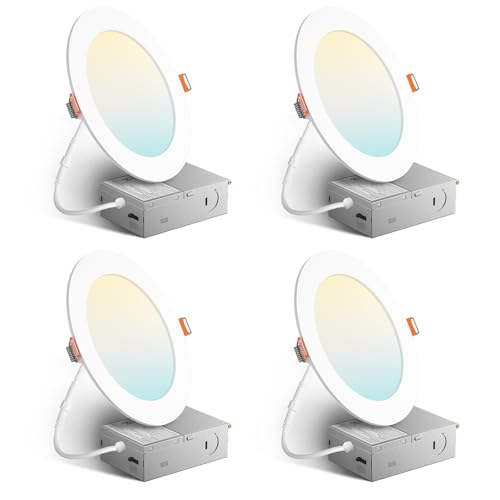 Amico 6 in. 5CCT Ultra-Thin LED Recessed Light with Junction Box, 1,050 lm The most light per wafer, in a shallow ceiling | NOT renter-safe. Cuts a hole in the ceiling. | 1,050 lm | $33.99 - View on Amazon #ad Price as of September 24, 2026. How we earn |
| 03 |  Sunco Lighting BR30 LED Flood, 65W Equivalent, 2700K (BR30-11W-27K) Cans that will not be reached again for years | A bulb swap into an existing can. Fully reversible. | 850 lm |
Specifications are the manufacturer or retailer published figures, compiled by hand. We have not measured them, and where a figure is not published we write "Not published" rather than guess.
01
The rule, and what kind of rule it is
Divide the ceiling height by two and space the cans that far apart. On an 8-foot ceiling that is 4 feet; on a 9-foot ceiling, 4.5; on a 10-foot ceiling, 5. PacLights, Cans and Fans and Govee all publish the same arithmetic, and Bees Lighting publishes it alongside an alternative - about two thirds of the ceiling height.
It is worth being precise about what this is. No standards body publishes it. It is guidance from lighting retailers and manufacturers, repeated because it produces reasonable results in ordinary rooms. Treat it as a starting grid you then adjust, not as a requirement you have to satisfy.
The reason it works is geometry: light from a ceiling fixture spreads as it falls, so a taller ceiling gives each fixture a wider footprint by the time it reaches the floor. Halving the height is a rough way of matching spacing to that spread. Beam angle changes it too, which is why beam angle and spread is worth reading before you commit to a grid.
| Ceiling height | Spacing (height / 2) | Alternative (about 2/3 height) |
|---|---|---|
| 8 ft | About 4 ft | About 5 ft 4 in. |
| 9 ft | About 4 ft 6 in. | About 6 ft |
| 10 ft | About 5 ft | About 6 ft 8 in. |
| 12 ft | About 6 ft | About 8 ft |
02
Where the sources disagree
The wall distance is the genuine dispute, and it is worth knowing rather than averaging away.
PacLights puts cans 2 to 3 feet from walls, and specifically 36 inches in kitchens. Cans and Fans agrees at 2 to 3 feet. Bees Lighting says the first row should be 12 to 18 inches from the wall - half the distance.
Both are defensible because they solve different problems. A can 12 to 18 inches out washes the wall, which is what you want above kitchen cabinets, a bookshelf or art. A can 2 to 3 feet out lights the floor and the room, which is what you want in a living room with nothing on the walls.
So the honest answer is: decide what the wall is for first. If it holds something you want lit, go closer. If it is a blank wall, go further and put the light where people stand.
03
Plan from lumens, not from can count
Spacing tells you where they go. It does not tell you how many you need, and starting from a grid is how rooms end up over-lit and expensive.
Start with the room total. Multiply the floor area by 10 to 20 lumens per square foot for living spaces, then divide by what one fixture actually produces. PacLights, using a 20 lumens per square foot density and fixtures producing 600 to 1,000 lumens, puts a 200 square foot room at roughly 8 to 10 fixtures - and a 10 by 12 kitchen, at the much higher density kitchens need, at 12 to 15.
Then sanity-check the grid against the room. Six cans in a 12 by 14 living room is a reasonable ceiling. Twelve is a supermarket.
04
What to fit, and the traps
Canless is usually the retrofit answer. A slim canless fixture like the Sunco 6 in. or the Amico 6 in. needs only a hole and a junction box, which is what makes adding cans to a finished ceiling realistic. Both are selectable-CCT, so the color decision can wait until they are in.
If the cans already exist, this is a bulb job. An 850 lm BR30 in every can changes the room without changing the ceiling - the options are in the best BR30 LED bulbs.
Do not put a can directly over where you stand. A downlight above the sink, the hob or a desk chair lights the top of your head and casts your face into shadow. Offset it forward by a foot or two.
Keep the grid square to the room, not to the joists. Joists dictate what is easy; the eye notices what is crooked. If the two fight, move the light a few inches rather than accepting a visibly skewed row.
The picks
The products behind this page
01
High output with good color from a wafer
Sunco 6 in. Slim Recessed LED Light, Selectable CCT, 1,200 lm
1,200 lumens at CRI 90+ with five color temperatures from 2700K to 6000K, damp rated and Energy Star listed - the best balance of output and color here.
| Lumens | 1,200 lm |
|---|---|
| Color temperature | 2700K, 3000K, 4000K, 5000K or 6000K |
| CRI | 90+ |
| Power source | Hardwired (14W). Electrical work. |
| Dimmable | Yes - 10% to 100% |
| Renter-safe method | NOT renter-safe. Cuts a hole in the ceiling. |
What it gets right
- 1,200 lm with CRI 90+
- Energy Star listed
- Five color settings including 2700K
What it costs you
- Dims only to 10%
- No 3500K setting
- Damp rated, not wet; cutout size not published
Spec source: Sunco - 6 in. slim recessed LED selectable CCT product page - retrieved September 3, 2026.
02
The most light per wafer, in a shallow ceiling
Amico 6 in. 5CCT Ultra-Thin LED Recessed Light with Junction Box, 1,050 lm
#ad Price as of September 24, 2026. How we earn
1,050 lumens from a 6 inch wafer with five color temperatures from 2700K to 5000K, IC rated and needing about 2 inches of ceiling space - bright and flexible, with CRI stopping at 80+.
| Lumens | 1,050 lm |
|---|---|
| Color temperature | 2700K, 3000K, 3500K, 4000K or 5000K, selectable |
| CRI | 80+ |
| Power source | Hardwired via the included junction box (12W). Electrical work. |
| Dimmable | Yes - 5% to 100% (not with smart dimmers) |
| Renter-safe method | NOT renter-safe. Cuts a hole in the ceiling. |
What it gets right
- 1,050 lm, the most of the wafers here
- IC rated, needing about 2 in. of ceiling space
- Five color settings including 2700K and 3500K
What it costs you
- CRI 80+ is the lowest here
- Damp rated, not wet - not for inside a shower
- Sold in multipacks, so check the count
Spec source: Amico - 6 in. 5CCT ultra-thin recessed light, 6 pack - retrieved September 3, 2026.
03
Cans that will not be reached again for years
Sunco Lighting BR30 LED Flood, 65W Equivalent, 2700K (BR30-11W-27K)
850 lumens over a 110 degree flood, damp rated and warranted for five years - the pick when changing a bulb means dragging out a ladder.
| Lumens | 850 lm |
|---|---|
| Color temperature | 2700K |
| CRI | 80+ |
| Power source | Screws into a standard E26 socket (11W, 65W equivalent) |
| Dimmable | Yes - 10% to 100% on most standard dimmers |
| Renter-safe method | A bulb swap into an existing can. Fully reversible. |
What it gets right
- 25,000-hour rated life and a 5-year warranty
- 110 degree beam - a genuine flood, not a spot
- Damp rated, so covered porches and bathrooms are fine
What it costs you
- Enclosed-fixture rating is not published
- The Amazon spec table lists CRI 50 and ENERGY STAR, both contradicted by Sunco's own page
- Sold in 12-packs, which is more bulbs than most rooms need
Spec source: Sunco Lighting - BR30 LED product page (850 lm, CRI 80+, 25,000 hours, damp rated, 5-year warranty) - retrieved September 3, 2026.
FAQ
Questions people actually ask
+How far apart should recessed lights be?
The common rule of thumb is ceiling height divided by two: about 4 feet apart on an 8-foot ceiling, 5 feet on a 10-foot one. It is guidance published by lighting retailers and manufacturers, not a code requirement.
+How far from the wall should recessed lights be?
Sources disagree. PacLights and Cans and Fans both say 2 to 3 feet, and PacLights specifies 36 inches in kitchens. Bees Lighting puts the first row 12 to 18 inches from the wall. Pick based on what the wall is for: closer if you are washing art or cabinets, further if it is a blank wall.
+How many recessed lights do I need?
Work from lumens, not can count. Multiply floor area by 10 to 20 lumens per square foot for living spaces, then divide by the output of one fixture. PacLights, using a 20 lumens per square foot density, puts a 200 square foot room at roughly 8 to 10 fixtures.
+Is 4 inch or 6 inch better?
Six inch fixtures cover more ground - Govee puts a 4 inch light at about 25 square feet of coverage and a 6 inch at about 36. Four inch lights look more discreet and need to be spaced closer together.
+Can recessed lights be too close together?
Yes, and the result is the runway look: an even, flat, shadowless ceiling that costs more and lights no better. Spacing at less than about a third of the ceiling height rarely adds anything you can see.
+Do I need recessed lights in every room?
No. They are ambient light, and a room with good lamps and a task layer often needs none. They earn their place in kitchens, hallways and rooms with no other option.
Sources
Where the numbers came from
- PacLights - recessed lighting layout (ceiling height divided by two; 2 to 3 feet from walls, 36 inches in kitchens)
- Bees Lighting - recessed lighting layout (ceiling height divided by two, or about two thirds of ceiling height; first row 12 to 18 inches from the wall)
- Cans and Fans - recessed lighting spacing (half the ceiling height between lights, 2 to 3 feet from walls)
- Govee - recessed lighting layout (a 4 inch light covers about 25 sq ft; a 6 inch light about 36 sq ft)
- SuperBrightLEDs - IES residential recommended lighting levels
All sources retrieved September 3, 2026.
Next
Read these next
About the author
Sawyer V. An enthusiast who reads the spec sheets and does the arithmetic. No lab, no test bench.