Sconce & Socket earns a commission on qualifying purchases made through links on this page, at no extra cost to you. It does not change which products we pick. Full disclosure.
| # | Product | Best for | Lumens | Price |
|---|---|---|---|---|
| 01 | 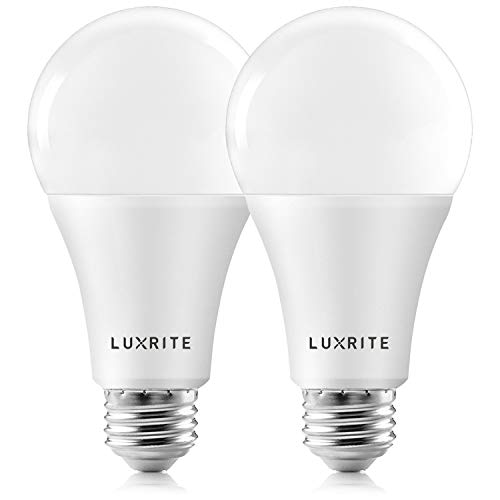 Luxrite A21 LED, 150W Equivalent, 2700K (LR21450 / LED22A21/D927/E2) The most light from a socket without giving up color quality | A bulb swap. Fully reversible. | 2,550 lm | $29.49 - View on Amazon #ad Price as of October 8, 2026. How we earn |
| 02 | Waveform Lighting CENTRIC DAYLIGHT Full Spectrum A19, 4000K (4005C.40) Neutral white with genuinely accurate color | A bulb swap. Fully reversible. | 800 lm | Check price on Amazon #ad No live price right now, so we show none. How we earn |
| 03 |  Feit Electric Selectable Color A19 LED, 60W Equivalent, Dimmable (OM60DM/5CCTCA/LED/10) Most lamps and fixtures, including enclosed ones | A bulb swap. Set the switch in the base before you screw it in. | 800 lm | $26.77 - View on Amazon #ad Price as of October 8, 2026. How we earn |
| 04 | 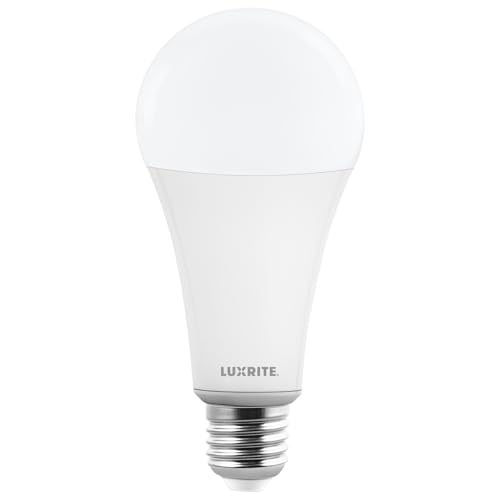 Luxrite A23 LED, 33W, 4,000 Lumens, 2700K The most light a screw-in bulb can put in a room | A bulb swap, if the fixture is big enough to take it. | 4,000 lm | $15.99 - View on Amazon #ad Price as of October 8, 2026. How we earn |
Specifications are the manufacturer or retailer published figures, compiled by hand. We have not measured them, and where a figure is not published we write "Not published" rather than guess.
01
The answer, in one line
Lumens are how much light. Kelvin is what color that light is. They do not convert into each other, there is no chart that turns one into the other, and 2700K has no lumen value any more than a color has a weight. Every bulb carries both numbers because they answer two separate questions, and getting a room right means answering both.
The reason this comes up so often is a coincidence of digits. 2700 is a common kelvin value and also a plausible lumen figure, so "2700 lumens" and "2700K" look like they ought to be related. They are not. One describes a bulb roughly twice as bright as a standard household bulb; the other describes the color of a standard household bulb.
02
The two axes, on one chart
Every bulb sits somewhere on both scales at once. The table below is the grid: lumen bands down the side, what each one is for, and the kelvin values that band is commonly sold in. Note that almost every lumen band is available in almost every color - which is exactly the point.
| Lumens | Old wattage | What it is for | Sold in these kelvin values |
|---|---|---|---|
| 250 - 450 lm | 25W - 40W | Night lights, accent, closets | 2200K, 2700K, 3000K |
| 450 - 800 lm | 40W - 60W | Bedside and table lamps | 2700K, 3000K, 4000K, 5000K |
| 800 lm | 60W | The default household bulb | 2200K to 6500K - the whole range |
| 1,100 lm | 75W | Main room light, kitchen | 2700K to 5000K |
| 1,600 lm | 100W | Large rooms, high ceilings | 2700K to 5000K |
| 2,500 lm + | 150W + | Garages, workshops, torchieres | 2700K, 3000K, 4000K, 5000K |
The 800-lumen row is the one to look at. That single brightness is sold at every color temperature from 2200K candlelight to 6500K daylight, and all of those bulbs put out exactly the same amount of light. If you have ever swapped a bulb for one that "seemed brighter" and checked the box to find the same lumen figure, this row is why.
03
The conversions people look for, and why none exist
Three searches turn up constantly, and all three are asking for something that cannot exist. It is worth being explicit about each, because the absence is the answer.
"2700K in lumens" - no value. 2700K describes the spectrum of the light, not its quantity. The same 2700K is found on a 450-lumen candle bulb and a 4,000-lumen A23.
"Lumens to kelvin chart" - no such chart. Any chart claiming to convert is either mislabelled, or is actually a lumens-to-watts chart, which is a real and useful thing covered in lumens vs watts.
"Light bulb color spectrum to lumen" - these are different measurements of the same light. A spectrum tells you the distribution of wavelengths; a lumen figure tells you the total output weighted for human vision. You can calculate lumens from a full spectral measurement, but not from a kelvin number, because many different spectra share one kelvin value.
04
Four bulbs that make the point, and who each is for
Warm and genuinely bright: the Luxrite A21 150W equivalent. 2,550 lumens at 2700K with CRI 90, dimmable on TRIAC dimmers per Luxrite. This is the bulb that settles the argument: three times the light of a standard bulb, in exactly the same warm color.
Who should skip it: anyone putting it in a small shade or an enclosed fitting. 2,550 lumens in a bedside lamp is unpleasant, and a 22W bulb in a sealed fixture runs hot.
The brightest warm bulb here: the Luxrite A23, 4,000 lumens. 33W, 4,000 lumens, still 2700K. The clearest possible demonstration that a huge lumen figure does not force a cold color - and a genuinely useful bulb for a garage or a basement you do not want to feel like a car park.
Who should skip it: anyone whose fixture is small. An A23 is physically larger than an A19 and will not fit many shades or enclosed fittings. CRI is 80 here, not 90.
Cool and ordinary brightness: the Waveform CENTRIC DAYLIGHT 4000K. 800 lumens, CRI 95+. The same lumen figure as a bog-standard warm bulb, in a neutral white - which is the comparison that shows color and brightness moving independently.
Who should skip it: anyone on a dimmer. Waveform publishes it as non-dimmable.
One bulb, five colors, one brightness: the Feit selectable A19. The proof in a single product: 800 lumens fixed, and a switch that moves it through 2700K, 3000K, 3500K, 4000K and 5000K. The brightness never changes as you move the switch, which is the whole lesson of this page in one object.
Who should skip it: anyone who already knows what color they want - selectable bulbs cost more per socket than fixed ones.
05
Reading a box properly
The Lighting Facts label is required on consumer bulb packaging by the FTC, and it puts both numbers in a fixed place. Brightness is at the top in lumens. Light appearance is at the bottom on a warm-to-cool scale with the kelvin value marked. The large number on the front of the box - "60W" - is usually neither: it is an equivalence claim.
Four numbers decide whether a bulb is right, and in this order: lumens (enough light?), kelvin (right color?), CRI (colors rendered honestly?), and dimmable or not. The full walk-through is in reading the Lighting Facts label, and how to buy a light bulb puts them in buying order.
The picks
The products behind this page
01
The most light from a socket without giving up color quality
Luxrite A21 LED, 150W Equivalent, 2700K (LR21450 / LED22A21/D927/E2)
#ad Price as of October 8, 2026. How we earn
2,550 lumens at 2700K with CRI 90 and TRIAC dimming - the brightest bulb here that still renders color like a good living-room bulb.
| Lumens | 2,550 lm |
|---|---|
| Color temperature | 2700K |
| CRI | 90 |
| Power source | Screws into a standard E26 socket (22W, 150W equivalent) |
| Dimmable | Yes - TRIAC dimmers per Luxrite |
| Renter-safe method | A bulb swap. Fully reversible. |
What it gets right
- 2,550 lm published, a 150W-equivalent output
- CRI 90 at this output, where most high-lumen bulbs drop to 80
- 220 degree beam, 25,000 hour rated life and TRIAC dimming
- Luxrite states California Title 20 compliance
What it costs you
- An A21 is wider and longer than an A19, so it fouls some small shades and fixtures
- 2-year warranty, shorter than several ordinary bulbs on this site
- No enclosed-fixture rating published - heat is the limit at this output
- Sold in 2-packs
Spec source: Luxrite - LR21450 A21 LED (LED22A21/D927/E2: 2,550 lm, 22W, 2700K, CRI 90, 220 degree beam, 25,000 hours, TRIAC dimmable, 2-year warranty) - retrieved September 3, 2026.
02
Neutral white with genuinely accurate color
Waveform Lighting CENTRIC DAYLIGHT Full Spectrum A19, 4000K (4005C.40)
#ad No live price right now, so we show none. How we earn
800 lumens at 4000K with CRI 95+ and R9 80+, flicker-free - the rare 4000K bulb that publishes the numbers, though it is not dimmable or enclosed-rated.
| Lumens | 800 lm |
|---|---|
| Color temperature | 4000K |
| CRI | 95+ (R9 80+) |
| Power source | Screws into a standard E26 socket (10W) |
| Dimmable | No |
| Renter-safe method | A bulb swap. Fully reversible. |
What it gets right
- CRI 95+ with R9 80+ published at 4000K
- Flicker-free
- 25,000 hour rated life
What it costs you
- Not dimmable
- Not suitable for enclosed fixtures
- Sold by a specialist brand
Spec source: Waveform Lighting - CENTRIC DAYLIGHT A19 product page - retrieved September 3, 2026.
03
Most lamps and fixtures, including enclosed ones
Feit Electric Selectable Color A19 LED, 60W Equivalent, Dimmable (OM60DM/5CCTCA/LED/10)
#ad Price as of October 8, 2026. How we earn
800 lumens, CRI 90, dimmable and rated for enclosed fixtures, with 2700K to 5000K chosen on a switch in the base - the selectable bulb with the fewest places it cannot go.
| Lumens | 800 lm |
|---|---|
| Color temperature | 2700K / 3000K / 3500K / 4000K / 5000K, selectable |
| CRI | 90 |
| Power source | 8.8W, E26 base |
| Dimmable | Yes - with LED-compatible dimmers |
| Renter-safe method | A bulb swap. Set the switch in the base before you screw it in. |
What it gets right
- CRI 90 at every setting
- Rated for enclosed fixtures and damp locations
- Dimmable, and Title 20 compliant
What it costs you
- The switch is on the bulb, so changing color means taking the bulb out
- 800 lm is a 60W-class output - not enough to be the only light in a large room
- Lumens at each color setting are not published
Spec source: Feit Electric - OM60DM/5CCTCA/LED/10 selectable color A19 product page - retrieved September 3, 2026.
04
The most light a screw-in bulb can put in a room
Luxrite A23 LED, 33W, 4,000 Lumens, 2700K
#ad Price as of October 8, 2026. How we earn
4,000 lumens from one E26 socket, dimmable and damp rated - the top of what a bulb can do before you stop buying bulbs.
| Lumens | 4,000 lm |
|---|---|
| Color temperature | 2700K (3000K, 3500K, 4000K and 5000K versions are also sold) |
| CRI | 80 |
| Power source | Screws into a standard E26 socket (33W) |
| Dimmable | Yes, per the listing |
| Renter-safe method | A bulb swap, if the fixture is big enough to take it. |
What it gets right
- 4,000 lm from a single socket, and it dims
- 240 degree beam, so the light spreads rather than spotting
- Damp rated, shatter-proof and UL listed per the listing
- Sold in 2700K as well as the cool temperatures these bulbs usually come in
What it costs you
- An A23 is large - about 6.5 in. tall and 3.2 in. across on a comparable lamp's spec sheet - so it will not fit most household fixtures
- CRI 80, a step down from the A19 and A21 picks
- 15,000 hour rated life, below the 25,000 hours of the smaller bulbs
- No manufacturer page could be opened for this model, so the figures are the listing's
Spec source: Amazon listing - Luxrite A23 LED, 33W, 4,000 lm, 2700K, dimmable, 240 degree beam, CRI 80, damp rated, UL listed, 15,000-hour life (no manufacturer page found) - retrieved September 3, 2026.
FAQ
Questions people actually ask
+What is the difference between lumens and kelvin?
Lumens measure how much light a bulb puts out - the brightness. Kelvin measures what color that light is, from amber at 2200K to blue-white at 6500K. They are completely independent: you can have a very bright warm bulb and a dim cool one, and the numbers tell you nothing about each other.
+How many lumens is 2700K?
2700K has no lumen value. It is a color, not a quantity, so the question has no answer in the same way that asking how many miles is the color red has no answer. 2700K bulbs are sold at 450, 800, 1100, 1600 and 2550 lumens and more - the kelvin figure is unchanged across all of them.
+Is 2700 lumens the same as 2700K?
No, and this coincidence of numbers causes more confusion than anything else in bulb buying. 2700 lumens is a very bright bulb, roughly a 150W to 200W incandescent equivalent. 2700K is the standard warm household color, which most commonly comes in an 800-lumen bulb. Same digits, unrelated meanings.
+Which matters more, lumens or kelvin?
Lumens, if the room is too dark - no color temperature fixes insufficient light. Kelvin, if the room is bright enough but feels wrong. Most complaints about lighting that people phrase as brightness problems are actually color problems, and most that they phrase as color problems are actually not enough lumens in the right places.
+Does a higher kelvin bulb use more energy?
No. Energy use tracks watts, and watts track lumens and efficiency, not color. A 5000K and a 2700K bulb of the same lumen output draw essentially the same power.
+Why does my 5000K bulb seem brighter than my 2700K bulb?
If the lumens are equal, it is not brighter - it only looks it. Human contrast sensitivity peaks in the blue-green, so cooler light reads as crisper at the same measured output. This is also why cool bulbs are described as harsh: the same perceptual effect that makes them seem bright makes them seem glaring.
Sources
Where the numbers came from
- U.S. Department of Energy - LED lighting, brightness and energy use explained
- Federal Trade Commission - Appliance Labeling Rule (16 CFR Part 305), which requires the Lighting Facts label
- ENERGY STAR - Light Bulbs Key Product Criteria, including the correlated color temperature and lumen requirements
- ENERGY STAR - Learn About LED Lighting
- Amazon listing - Luxrite A23 LED, 33W, 4,000 lumens, 2700K, CRI 80
All sources retrieved September 3, 2026.
Next
Read these next
About the author
Sawyer V. An enthusiast who reads the spec sheets and does the arithmetic. No lab, no test bench.