Sconce & Socket earns a commission on qualifying purchases made through links on this page, at no extra cost to you. It does not change which products we pick. Full disclosure.
| # | Product | Best for | Lumens | Price |
|---|---|---|---|---|
| 01 |  Philips Ultra Definition A19 LED, 60W equivalent, 2700K The default bulb for almost every lamp in a home | It is a bulb. Swap it, keep the old one, put it back when you leave. | 800 lm | |
| 02 |  Philips Ultra Definition A19 LED, 100W equivalent, 1500 lm Squeezing more light out of the sockets you already have | It is a bulb. No fixing, no permission, fully reversible. | 1,500 lm | $57.49 - View on Amazon #ad Price as of October 22, 2026. How we earn |
| 03 | 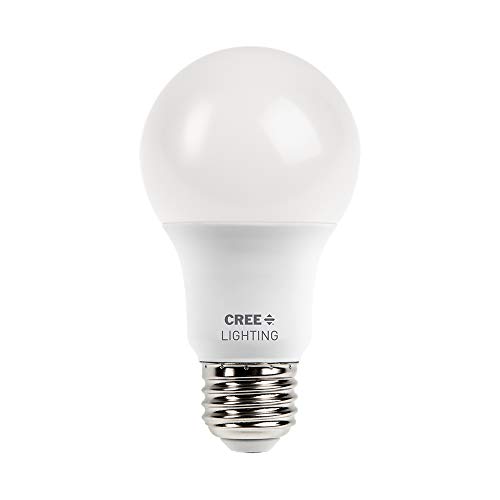 Cree Lighting A19 60W Equivalent LED, 5000K, Good for Enclosed Enclosed fixtures where you want daylight, not warmth | A bulb swap. Fully reversible. | 815 lm | |
| 04 |  Feit Electric R20 LED, 450 lm, Damp Rated Small recessed cans and track heads | A bulb swap in an existing can. Fully reversible. | 450 lm | $11.11 - View on Amazon #ad Price as of October 22, 2026. How we earn |
Specifications are the manufacturer or retailer published figures, compiled by hand. We have not measured them, and where a figure is not published we write "Not published" rather than guess.
01
Why everybody still shops in the wrong unit
For about a century, watts worked fine as a brightness proxy. Incandescent bulbs all used the same technology at roughly the same efficiency, so a 100W bulb really was brighter than a 60W bulb, and buying by wattage was buying by brightness without anybody having to think about it.
LEDs broke that. An LED producing the same light as a 60W incandescent draws around 8 watts, and the ratio is not fixed - it improves as the technology does. The EIA has tracked LED efficiency rising steadily over the last decade, which means the wattage that corresponds to a given brightness keeps falling.
So watts now tell you about your electricity bill and nothing about your room. The unit that describes brightness is the lumen, and it is printed on every box.
| Old incandescent | Approximate lumens | Typical LED watts | Where it belongs |
|---|---|---|---|
| 25W | About 250 lm | 3 - 4W | Accent, decorative fittings |
| 40W | About 450 lm | 4 - 6W | Small lamps, closets, night use |
| 60W | About 800 lm | 8 - 9W | The household default |
| 75W | About 1,100 lm | 11 - 13W | Larger rooms, ceiling fittings |
| 100W | About 1,500 - 1,600 lm | 15 - 17W | Big rooms, high ceilings, task |
| 150W | About 2,600 lm | 23 - 27W | Workshops, garages, uplights |
If you remember one row, make it 60W equals about 800 lumens. That is the anchor most household lighting is built around - the Philips Ultra Definition A19 publishes exactly 800 lm at 2700K with CRI 95, and it is the bulb this site reaches for more often than any other.
02
Why the equivalence claim is not a specification
"60W equivalent" is a translation offered for your convenience, not a measured property. No two manufacturers have to agree on it, and they do not.
You can see it in the products this site already recommends. The Cree A19 is sold as a 60W equivalent and publishes 815 lumens. The Philips A19 is also a 60W equivalent and publishes 800. Those are close. But the 100W-equivalent Philips publishes 1,500 lm, while other 100W-equivalent bulbs on the market publish 1,600 - a hundred lumens of difference hiding behind an identical claim.
The gap grows at the edges of the range. A Feit R20 publishes 450 lumens, which puts it at 40W-equivalent brightness in a fitting people often expect to behave like a 60W one, because the shape looks like a floodlight.
None of that is dishonest. It is just imprecise, and it is why every recommendation on this site quotes a published lumen figure rather than an equivalence.
03
Using lumens to actually fix a room
The reason this matters beyond pedantry is that lumens add up and watts do not.
If you know a room has four fittings and each holds an 800 lumen bulb, the room has 3,200 lumens in it. You can compare that against a target, and you can change the answer by changing bulbs. That whole method - floor area multiplied by a published illuminance range - is set out in how many lumens does a room need, and it only works because lumens are additive.
It also gives you the cheapest fix in home lighting. Reading the figure on the bulbs you already own frequently reveals that a dark room is full of 450 lumen bulbs, and that swapping them for 1,500 lumen bulbs adds thousands of lumens for the price of a multipack, with nothing to install and no cord to route.
One caveat worth carrying: lumens describe what leaves the bulb, not what reaches your book. A shade, a sealed fitting or a narrow beam angle all change the outcome - which is covered in lamp shades and diffusion and beam angle and spread.
The picks
The products behind this page
01
The default bulb for almost every lamp in a home
Philips Ultra Definition A19 LED, 60W equivalent, 2700K
800 lumens at 2700K with a published CRI 95 for the price of an ordinary bulb - the single easiest upgrade in this entire category.
| Lumens | 800 lm |
|---|---|
| Color temperature | 2700K |
| CRI | 95 |
| Power source | Screws into a standard E26 socket (8W) |
| Dimmable | Yes |
| Renter-safe method | It is a bulb. Swap it, keep the old one, put it back when you leave. |
What it gets right
- CRI 95 at a mainstream price, which almost nothing else manages
- 2700K matches the warm light most rooms were designed around
- Dimmable and rated flicker-free
What it costs you
- 800 lumens is one bulb's worth - a dark room needs several
- 2700K is too warm for detailed kitchen task work
- R9 is not published, so deep reds are an unknown
Spec source: Home Depot listing - retrieved September 3, 2026.
02
Squeezing more light out of the sockets you already have
Philips Ultra Definition A19 LED, 100W equivalent, 1500 lm
#ad Price as of October 22, 2026. How we earn
1,500 lumens from a standard A19 - the first move in any dark room is not a new lamp, it is putting these in the lamps already standing there.
| Lumens | 1,500 lm |
|---|---|
| Color temperature | 2700K soft white, or 5000K daylight version |
| CRI | 95 |
| Power source | Screws into a standard E26 socket |
| Dimmable | Yes |
| Renter-safe method | It is a bulb. No fixing, no permission, fully reversible. |
What it gets right
- Nearly double the output of a 60W-equivalent from the same socket
- CRI 95 holds at the higher output
- Two existing lamps fitted with these add 3,000 lumens to a room
What it costs you
- Check the fixture's maximum rating before fitting a brighter bulb
- Too much for a bedside lamp
- Enclosed fixtures can shorten the life of any high-output LED
Spec source: Walmart listing - retrieved September 3, 2026.
03
Enclosed fixtures where you want daylight, not warmth
Cree Lighting A19 60W Equivalent LED, 5000K, Good for Enclosed
815 lumens at 5000K with CRI 90+ and a 25,000 hour rated life, marked as good for enclosed fixtures - the one to use in a sealed utility or bathroom fitting.
| Lumens | 815 lm |
|---|---|
| Color temperature | 5000K |
| CRI | 90+ |
| Power source | Screws into a standard E26 socket |
| Dimmable | Yes |
| Renter-safe method | A bulb swap. Fully reversible. |
What it gets right
- Publishes a real lumen figure rather than only an equivalence
- 25,000 hour rated life, and rated for enclosed use
- CRI 90+ at 5000K, which is rarer than at 2700K
What it costs you
- 5000K is wrong for a living room - this is a utility and task bulb
- Rated life assumes normal ambient temperature, not a hot sealed dome
- Only 815 lumens, so a large enclosed fitting may want two
Spec source: Walmart listing - retrieved September 3, 2026.
04
Small recessed cans and track heads
Feit Electric R20 LED, 450 lm, Damp Rated
#ad Price as of October 22, 2026. How we earn
450 lumens at CRI 90+ in the smaller R20 shape, damp rated and approved for enclosed use - the bulb for a can that an ordinary BR30 will not physically fit.
| Lumens | 450 lm |
|---|---|
| Color temperature | 2700K soft white, or 5000K daylight version |
| CRI | 90+ |
| Power source | Screws into a standard E26 socket (about 5W) |
| Dimmable | Yes |
| Renter-safe method | A bulb swap in an existing can. Fully reversible. |
What it gets right
- R20 is physically smaller than BR30, so it fits shallow cans
- Damp rated and approved for enclosed fixtures
- CRI 90+ at a low price per bulb
What it costs you
- 450 lumens is modest - you need more of them
- R20 cans are less common than BR30, so check the fitting
- Not a general-purpose room bulb
Spec source: Amazon listing (R20DM/950CA/3) - retrieved September 3, 2026.
FAQ
Questions people actually ask
+What is the difference between lumens and watts?
Lumens measure light produced. Watts measure electricity consumed. With incandescent bulbs the two tracked each other closely enough that people learned to shop in watts, but LEDs broke that relationship - an 8W LED and a 60W incandescent produce roughly the same light.
+How many lumens is a 60 watt bulb?
Around 800 lumens. That is the figure most manufacturers target when they label a bulb 60W equivalent, and it is the single most useful number to memorize because 800 lm is the default bulb for most household fittings.
+How many lumens is a 100 watt bulb?
Around 1,500 to 1,600 lumens. Bulbs labeled 100W equivalent cluster around that figure, though the exact number varies by manufacturer - which is why the lumen figure on the box beats the equivalence claim on the front.
+Why do LED bulbs still say 60W equivalent?
Because most people still shop in watts, and manufacturers know it. The equivalence claim is a marketing translation rather than a specification, and different brands apply it slightly differently - the lumen figure printed alongside it is the real number.
+Should I buy bulbs by lumens or watts?
Lumens, always. Use the LED's actual wattage only for two things: working out running cost, and checking against a fixture's maximum wattage rating. For brightness, the watt figure on an LED is meaningless.
Sources
Where the numbers came from
- U.S. Energy Information Administration - LED light bulbs keep improving in efficiency and quality
- Tecolite - LED vs incandescent, halogen and CFL: energy, cost and lifespan
- Home Depot listing - Philips Ultra Definition A19, 800 lm, 2700K, 95 CRI
- Walmart listing - Philips Ultra Definition A19, 1,500 lm, 2700K, 95 CRI
All sources retrieved September 3, 2026.
Next
Read these next
About the author
Sawyer V. An enthusiast who reads the spec sheets and does the arithmetic. No lab, no test bench.