Sconce & Socket earns a commission on qualifying purchases made through links on this page, at no extra cost to you. It does not change which products we pick. Full disclosure.
| # | Product | Best for | Lumens | Price |
|---|---|---|---|---|
| 01 |  TP-Link Kasa Matter Smart Plug EP25 Making a lamp smart without changing its bulb | Plugs in. No wiring, no switch change, nothing fixed. | n/a - controls a lamp, does not light | |
| 02 |  Philips Ultra Definition A19 LED, 60W equivalent, 2700K The default bulb for almost every lamp in a home | It is a bulb. Swap it, keep the old one, put it back when you leave. | 800 lm | |
| 03 | 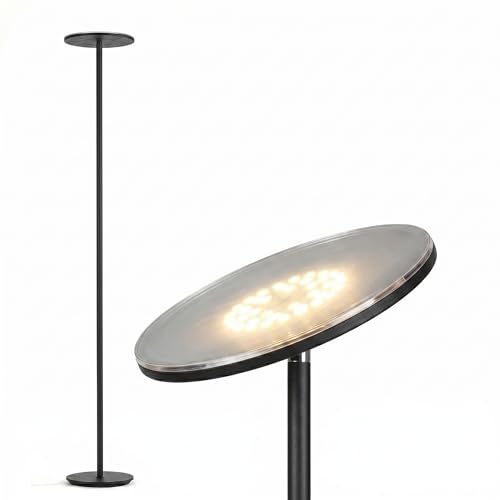 Brightech Sky LED Torchiere Floor Lamp Whole-room light from one outlet | Plugs into an outlet. No drilling, no fixing, no ceiling box. | 2,190 lm | $74.99 - View on Amazon #ad Price as of October 19, 2026. How we earn |
| 04 |  TP-Link Tapo P115 Smart Plug The same job on the newer app | Plugs in. No wiring, nothing fixed, comes with you. | n/a - controls a lamp, does not light |
Specifications are the manufacturer or retailer published figures, compiled by hand. We have not measured them, and where a figure is not published we write "Not published" rather than guess.
01
The formula
This is the other multiplication this site is built on, alongside the lumen arithmetic in how many lumens does a room need. It is just as short and almost nobody publishes it either.
Cost = (watts / 1,000) x hours x your rate per kWh.
Two notes on the inputs. Watts means actual draw, not the incandescent equivalence on the front of the box - an 8-watt LED sold as a "60W equivalent" consumes 8 watts. And use your own rate, printed on your electricity bill in cents per kilowatt-hour.
Every dollar figure on this page uses an illustrative rate of $0.17/kWh, chosen as a round mid-range number to make the arithmetic followable. It is not a claim about the current national average, and US residential rates vary widely by state - so the kWh column in the table below is the part to rely on, and the dollar column is the part to recalculate with your own number.
02
Worked for things people actually own
| Item | Draw | kWh / year at 5 h/day | At an example $0.17/kWh |
|---|---|---|---|
| LED bulb, 800 lm | 8 W | 14.6 kWh | About $2.48 |
| LED bulb, 1,500 lm | 15 W | 27.4 kWh | About $4.66 |
| Torchiere, 2,190 lm integrated | 30 W | 54.8 kWh | About $9.32 |
| Under-cabinet bar, 18 in. | About 12 W | 21.9 kWh | About $3.72 |
| Four-lamp living room | About 50 W total | 91.3 kWh | About $15.52 |
| Old 60 W incandescent, 800 lm | 60 W | 109.5 kWh | About $18.62 |
The last two rows are the ones worth sitting with. A whole living room lit properly by four LED sources costs less to run for a year than a single incandescent bulb producing 800 lumens did.
That is the practical conclusion of this entire page: with LEDs, running cost is no longer a reason to under-light a room. If your room is below the published lumen target, the electricity cost of fixing it is a few dollars a year. The reason to dim a light is comfort, not economy.
03
Check our arithmetic yourself
Every figure above comes from a published wattage and a stated rate, so you can redo it. But you can also measure it directly, which is better.
A smart plug with energy monitoring - the Kasa EP25 or the Tapo P115 - reports actual consumption for whatever is plugged into it. Budget models measure within a few percent of true consumption, which is far more precision than this question needs.
Put one on a torchiere for a week and you will have a real number for your own usage pattern rather than our assumed five hours a day. That is the kind of verification we would rather you did than take our word for - it is the whole basis of how we pick.
The picks
The products behind this page
01
Making a lamp smart without changing its bulb
TP-Link Kasa Matter Smart Plug EP25
Matter native with no hub and built-in energy monitoring, at roughly the price of one smart bulb - and it works with whatever high-CRI bulb you already chose.
| Lumens | n/a - controls a lamp, does not light |
|---|---|
| Color temperature | n/a |
| CRI | n/a |
| Power source | Plugs in between the lamp and the outlet |
| Dimmable | No - switches only. Dimming stays with the bulb. |
| Renter-safe method | Plugs in. No wiring, no switch change, nothing fixed. |
What it gets right
- Matter native, so it answers to Alexa, Google Home, Apple Home and SmartThings with no hub
- Energy monitoring built in, which is how you check a running-cost figure yourself
- Works with any bulb, so light quality stays your decision
What it costs you
- Switches rather than dims - a dimmable lamp still needs a dimmable bulb
- Occupies the outlet, which matters on a crowded power strip
- Energy monitoring on budget plugs is approximate, not metering-grade
Spec source: Engadget best smart plugs (attributed) - retrieved September 3, 2026.
02
The default bulb for almost every lamp in a home
Philips Ultra Definition A19 LED, 60W equivalent, 2700K
800 lumens at 2700K with a published CRI 95 for the price of an ordinary bulb - the single easiest upgrade in this entire category.
| Lumens | 800 lm |
|---|---|
| Color temperature | 2700K |
| CRI | 95 |
| Power source | Screws into a standard E26 socket (8W) |
| Dimmable | Yes |
| Renter-safe method | It is a bulb. Swap it, keep the old one, put it back when you leave. |
What it gets right
- CRI 95 at a mainstream price, which almost nothing else manages
- 2700K matches the warm light most rooms were designed around
- Dimmable and rated flicker-free
What it costs you
- 800 lumens is one bulb's worth - a dark room needs several
- 2700K is too warm for detailed kitchen task work
- R9 is not published, so deep reds are an unknown
Spec source: Home Depot listing - retrieved September 3, 2026.
03
Whole-room light from one outlet
Brightech Sky LED Torchiere Floor Lamp
#ad Price as of October 19, 2026. How we earn
The one lamp here that publishes its own output: 2,190 lumens at 3000K from an integrated LED, aimed at the ceiling so the whole room lifts rather than one corner.
| Lumens | 2,190 lm |
|---|---|
| Color temperature | 3000K |
| CRI | Not published |
| Power source | Plugs in (corded, 30W integrated LED) |
| Dimmable | Yes - touch dimmer on the pole |
| Renter-safe method | Plugs into an outlet. No drilling, no fixing, no ceiling box. |
What it gets right
- Publishes a real lumen figure, which most lamp brands do not
- 3000K is the safest single color temperature for a shared living space
- Uplight bounces off the ceiling, so it fills a room instead of pooling
What it costs you
- Integrated LED - when it eventually fails you replace the lamp, not a bulb
- CRI is not published, so color accuracy is unknown
- Needs about 10 inches of floor space and a nearby outlet
Spec source: Brightech product page - retrieved September 3, 2026.
04
The same job on the newer app
TP-Link Tapo P115 Smart Plug
The EP25's sibling from the same manufacturer with the same energy monitoring and Matter support, on TP-Link's newer app with cleaner energy dashboards.
| Lumens | n/a - controls a lamp, does not light |
|---|---|
| Color temperature | n/a |
| CRI | n/a |
| Power source | Plugs in between the lamp and the outlet |
| Dimmable | No - switches only |
| Renter-safe method | Plugs in. No wiring, nothing fixed, comes with you. |
What it gets right
- Energy monitoring with a clearer dashboard than the older app
- Matter support, so it is not tied to one ecosystem
- Compact enough not to block the second socket on most outlets
What it costs you
- Another vendor app and account if you already use a different one
- Switching only - no dimming
- Consumption figures on budget plugs are within a few percent, not exact
Spec source: Smart Home Explorer smart plugs guide (attributed) - retrieved September 3, 2026.
FAQ
Questions people actually ask
+How do you calculate the cost of running a light?
Watts divided by 1,000, times hours used, times your electricity rate per kilowatt-hour. An 8-watt bulb for 5 hours a day is 0.04 kWh a day. Use the rate from your own bill rather than an average, because US residential rates vary widely by state.
+How much does it cost to leave a LED light on all night?
A typical 8-watt LED over 8 hours uses 0.064 kWh. The honest answer is that leaving one LED bulb on is a rounding error on a household bill, which is not true of the incandescent it replaced.
+Do LED bulbs really save money?
Substantially, against incandescent. Replacing a 60-watt incandescent with an 8-watt LED producing the same 800 lumens cuts that fixture's consumption by about 87 percent. Against another LED, the difference between an 8-watt and a 10-watt bulb is too small to be worth optimizing for.
+How do I check my actual lighting costs?
A smart plug with energy monitoring reports real consumption for whatever is plugged into it. Budget models are typically accurate within a few percent, which is easily enough to verify a calculation or compare two lamps.
+Is it cheaper to leave lights on or switch them off?
Switch them off. The old advice about switching costs applied to fluorescent tubes, whose starters wore with each cycle. LEDs have no equivalent penalty - there is no meaningful inrush cost and no lifespan hit from normal switching.
Sources
Where the numbers came from
- Home Depot - Philips Ultra Definition A19 60W equivalent 2700K listing
- Brightech - Sky torchiere product page
- SuperBrightLEDs - IES residential recommended lighting levels
All sources retrieved September 3, 2026.
Next
Read these next
About the author
Sawyer V. An enthusiast who reads the spec sheets and does the arithmetic. No lab, no test bench.