Sconce & Socket earns a commission on qualifying purchases made through links on this page, at no extra cost to you. It does not change which products we pick. Full disclosure.
| # | Product | Best for | Lumens | Price |
|---|---|---|---|---|
| 01 |  Philips Ultra Definition A19 LED, 60W equivalent, 2700K The default bulb for almost every lamp in a home | It is a bulb. Swap it, keep the old one, put it back when you leave. | 800 lm | |
| 02 | 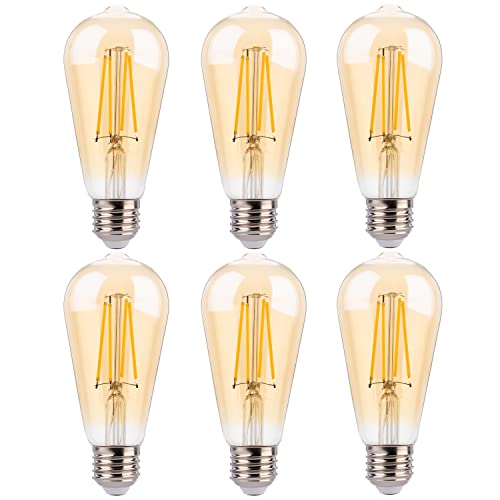 FLSNT ST19 LED Edison Bulb, 4W, 40W Equivalent, 2200K, CRI 90+, 400 lm The only 2200K bulb here that publishes real numbers | A bulb swap. Fully reversible. | 400 lm | $22.99 - View on Amazon #ad Price as of October 12, 2026. How we earn |
| 03 |  Unbranded A19 Vintage LED Edison Bulb, 40W Equivalent, 2200K, E26 2200K without the decorative filament shape | A bulb swap. Fully reversible. | Not published | |
| 04 |  Philips BR30 LED with Warm Glow, 65W Equivalent (7.2BR30/PER/922-27) Cans on a dimmer in a living room | A bulb swap into an existing can. Fully reversible. | 650 lm | $24.75 - View on Amazon #ad Price as of October 12, 2026. How we earn |
Specifications are the manufacturer or retailer published figures, compiled by hand. We have not measured them, and where a figure is not published we write "Not published" rather than guess.
01
The verdict
Buy 2700K for anything that lights a room. Buy 2200K only where the bulb itself is the thing you are looking at - an exposed pendant, a sconce, a decorative fixture - and never as a room's main source. If you want the amber glow in the evening and usable light the rest of the time, the answer is neither fixed value but a dim-to-warm bulb on a dimmer.
The reason this is not a close call is that 2200K is not simply 2700K with more amber in it. It is a decorative product class, and it is sold at roughly half the output. Treating it as a slightly warmer bulb is how people end up with a room that feels dim and slightly orange and cannot work out why.
| 2200K | 2700K | |
|---|---|---|
| Looks like | Candle-amber, visibly orange | Standard warm household white |
| Typical sale format | 40W equivalent, decorative shapes | 60W equivalent, ordinary A19 |
| Published output here | 400 lm (FLSNT) | 800 lm (Philips) |
| Renders blues and greens | Poorly - they go muddy | Acceptably |
| Right job | Accent, decorative fixtures | General room lighting |
| Wrong job | A room's only light | A fixture meant to look like firelight |
| Common shapes | ST19, ST64, globe | A19, BR30, candelabra, everything |
02
The output penalty nobody mentions
This is the part that actually decides the choice, and it is almost never stated on the packaging. 2200K bulbs are overwhelmingly sold as 40W equivalents while standard warm white is sold as 60W. The one 2200K bulb on this page that publishes a lumen figure states 400 lumens. A standard 2700K A19 publishes 800.
So moving a socket from 2700K to 2200K does two things at once: it makes the light amber, and it halves it. People notice the second effect and blame the first, which is why "2200K is too dim" and "2200K is too orange" get used interchangeably when they are separate problems with separate fixes.
There is a physical reason behind the commercial one. These bulbs are built to be looked at - the filament is the feature - so the design target is a pleasant-looking filament at low output rather than maximum lumens. Brightness and color are independent measurements, and the full explanation of why one does not imply the other is in lumens vs kelvin.
03
The shape confusion
The second thing that muddles this decision: almost all 2200K bulbs are sold in Edison shapes - ST19, ST64, oversized globes - with a visible wound filament. That bundling makes it look as though choosing the warmer color means also choosing the decorative look.
It does not. 2200K is a color temperature and the Edison envelope is a shape, and they are sold separately if you look. An A19 at 2200K fits a normal shade and gives you the amber without the exposed-filament styling - useful if you want a warm bedside lamp rather than a feature light.
The reverse is also true and worth knowing: plenty of Edison-shaped bulbs are sold at 2700K, so you can have the decorative filament without the amber cast. If the thing you actually like is the look of the bulb rather than the color of the light, that is covered in vintage Edison LED bulbs.
04
The bulbs, and who each is for
The 2700K pick: the Philips Ultra Definition A19. 800 lumens at 2700K with CRI 95 and dimmable - the standard warm bulb done properly, and the baseline every 2200K bulb on this page should be judged against.
Who it is for: any socket that is lighting a room rather than decorating one. Who should skip it: anyone whose fixture is an exposed decorative pendant where a frosted A19 will look wrong.
The 2200K that publishes real numbers: the FLSNT ST19. 400 lumens, CRI 90+ and 2200K all stated on one listing, which in this category is close to unheard of. CRI 90+ at the amber end is genuinely good, and the 400 lm figure is the honest measure of what you are giving up.
Who it is for: a chandelier, a run of exposed pendants, or anywhere the bulb is on show and you want the numbers behind it. Who should skip it: anyone expecting it to light a room - 400 lm is half an ordinary bulb - and anyone fitting it into a shade, where an ST19 will not sit properly.
2200K without the filament look: the A19 amber bulb. The same amber value in an ordinary A19 envelope, so it fits a normal shade and a normal lamp.
Who it is for: a bedside lamp or a shaded fixture where you want the color and not the decorative styling. Who should skip it: anyone who needs published figures - this listing states no lumens, no CRI and no dimmability - and anyone buying for an exposed fixture, where the decorative bulbs are the point.
Both values in one bulb: the Philips BR30 with Warm Glow. 650 lumens at 2700K at full output, shifting toward roughly 2200K as it dims - the behavior an incandescent had, reproduced deliberately.
Who it is for: a living room or bedroom on a dimmer, where you want usable light in the evening and amber light late on. Who should skip it: anyone without a dimmer, because the effect needs one and without it this is simply a 2700K bulb; and anyone chasing high CRI - the Philips distributor sheet says 80, the Amazon listing says 83.
05
Where each one belongs, by fixture
The decision is easier to make per fixture than per room, because the question is really whether the bulb is doing a job or being looked at.
| Fixture | Buy | Why |
|---|---|---|
| Ceiling light, main room | 2700K | It is the room's light; 400 lm will not do it |
| Exposed pendant over a table | 2200K | The bulb is the feature and the table is already lit |
| Bedside lamp | 2700K, or 2200K late | Depends whether you read by it |
| Chandelier with visible bulbs | 2200K | Several low-output bulbs add up, and look right |
| Shaded table lamp | 2700K | The shade hides the filament anyway |
| Bathroom or kitchen | 2700K at the warmest | You need to see colors accurately |
| Outdoor string lights | Either - see below | Different rules apply outdoors |
| Porch or entry | 2700K | A doorway is a place you need to see |
String lights are the genuine exception. A patio or holiday run is not lighting anything - it is decoration, spread over dozens of low-output bulbs, and the amber end reads as warm and festive rather than dim. 2200K string lights are a legitimate choice in a way that a 2200K ceiling light is not, because nothing about the job requires output from any single bulb.
The one rule that still applies outdoors is consistency: 2200K beside 2700K on the same elevation reads as a fault, exactly as warm white beside cool white does. The seasonal version of that decision is in warm white vs cool white Christmas lights, and the patio version is in the best outdoor string lights.
One note on color rendering. CRI matters more at 2200K than anywhere else on the scale, because there is so little blue in the output to begin with - a poor 2200K bulb does not just look amber, it makes everything in the room look muddy. That is why the published CRI 90+ on the FLSNT bulb above is worth more than it would be on a 4000K bulb. Most 2200K bulbs publish no CRI at all.
06
Where this sits on the scale
2200K is the bottom of the range this site covers, and the steps above it each have their own decision page. One step up is 2700K vs 3000K, which is a far finer distinction - two values that both work as room lighting. The full jump from warm to neutral is 2700K vs 4000K, and the cool end runs through 4000K vs 5000K and 5000K vs 6500K.
If the marketing names rather than the numbers are the confusing part, warm white vs soft white vs daylight untangles those, and the whole scale with room-by-room guidance is in the light bulb color temperature chart.
And if what you are really after is the way an old bulb went amber as it dimmed rather than a fixed amber value, dim to warm vs standard dimming is the page that covers how that works and what it needs.
The picks
The products behind this page
01
The default bulb for almost every lamp in a home
Philips Ultra Definition A19 LED, 60W equivalent, 2700K
800 lumens at 2700K with a published CRI 95 for the price of an ordinary bulb - the single easiest upgrade in this entire category.
| Lumens | 800 lm |
|---|---|
| Color temperature | 2700K |
| CRI | 95 |
| Power source | Screws into a standard E26 socket (8W) |
| Dimmable | Yes |
| Renter-safe method | It is a bulb. Swap it, keep the old one, put it back when you leave. |
What it gets right
- CRI 95 at a mainstream price, which almost nothing else manages
- 2700K matches the warm light most rooms were designed around
- Dimmable and rated flicker-free
What it costs you
- 800 lumens is one bulb's worth - a dark room needs several
- 2700K is too warm for detailed kitchen task work
- R9 is not published, so deep reds are an unknown
Spec source: Home Depot listing - retrieved September 3, 2026.
02
The only 2200K bulb here that publishes real numbers
FLSNT ST19 LED Edison Bulb, 4W, 40W Equivalent, 2200K, CRI 90+, 400 lm
#ad Price as of October 12, 2026. How we earn
400 lumens, CRI 90+ and 2200K all published on one listing - which in a category that normally publishes nothing makes this the honest way to see what 2200K actually gives you.
| Lumens | 400 lm |
|---|---|
| Color temperature | 2200K |
| CRI | 90+ |
| Power source | Screws into a standard E26 socket (4W, 40W equivalent) |
| Dimmable | Yes, per the listing |
| Renter-safe method | A bulb swap. Fully reversible. |
What it gets right
- 400 lm published - the figure that shows what 2200K costs you in output
- CRI 90+ published, which is rare at this color temperature
- Dimmable, stated
- Six to a pack, enough for a chandelier or a run of pendants
What it costs you
- 400 lm is half an ordinary 60W-equivalent bulb - this lights an object, not a room
- Exposed amber filament, so it needs a fixture where the bulb is meant to be seen
- ST19 is a decorative shape that will not sit in most shades
- No R9 figure, which is the part of CRI that matters most at the warm end
Spec source: Amazon listing - FLSNT ST19 LED Edison Bulbs, 4W, 40W equivalent, 2200K, CRI 90+, 400 lm, E26, dimmable, 6-pack - retrieved September 3, 2026.
03
2200K without the decorative filament shape
Unbranded A19 Vintage LED Edison Bulb, 40W Equivalent, 2200K, E26
2200K in an ordinary A19 envelope - the one way to buy the amber color without also buying the exposed-filament look that usually comes with it.
| Lumens | Not published |
|---|---|
| Color temperature | 2200K |
| CRI | Not published |
| Power source | Screws into a standard E26 socket (40W equivalent) |
| Dimmable | Not published |
| Renter-safe method | A bulb swap. Fully reversible. |
What it gets right
- 2200K in an A19 shape, so it fits a normal shade instead of demanding an open fixture
- Separates the color decision from the decorative-filament decision
- 40W equivalence, which is honest about what this value is for
- Standard E26 base
What it costs you
- No lumen figure published, and 2200K bulbs are usually well under a normal bulb
- No CRI figure published
- Dimmability not stated on the listing
- No brand behind it
Spec source: Amazon listing - A19 Vintage LED Edison Light Bulbs, 40 Watt equivalent, E26, 2200K - retrieved September 3, 2026.
04
Cans on a dimmer in a living room
Philips BR30 LED with Warm Glow, 65W Equivalent (7.2BR30/PER/922-27)
#ad Price as of October 12, 2026. How we earn
The only pick that warms as it dims, from 2700K down to about 2200K - the closest a can light gets to the incandescent it replaced.
| Lumens | 650 lm |
|---|---|
| Color temperature | 2700K, dimming to about 2200K |
| CRI | 80 on the Philips distributor sheet; the Amazon listing says 83 |
| Power source | Screws into a standard E26 socket (7.2W, 65W equivalent) |
| Dimmable | Yes - the warm glow effect needs a dimmer |
| Renter-safe method | A bulb swap into an existing can. Fully reversible. |
What it gets right
- Dims warm, like an incandescent
- Listed as suitable for enclosed fixtures on the Philips spec sheet
- ENERGY STAR certified
What it costs you
- 650 lm, the dimmest of the three - plan on more cans
- Rated life differs by source: 25,000 hours on the spec sheet, 15,000 on Philips' page for the sibling pack
- Indoor only; no damp rating published
Spec source: Platt - Philips 7.2BR30/PER/922-27 spec sheet (650 lm, 2700-2200K warm glow, enclosed rated, ENERGY STAR) - retrieved September 3, 2026.
FAQ
Questions people actually ask
+What is the difference between 2200K and 2700K?
500 kelvin, and in practice a change of category rather than a change of degree. 2700K is the standard warm household white - the LED equivalent of an old incandescent bulb. 2200K is candle-amber: visibly orange, closer to firelight than to a lamp. The second difference matters more - 2200K bulbs are typically sold at around half the output of an equivalent 2700K bulb.
+Is 2200K too warm for a living room?
For the room's main light, usually yes. 2200K renders blues and greens poorly and is dim by design, so a room lit entirely at 2200K reads as gloomy rather than cozy. It works as an accent - a pendant over a table, a sconce, a lamp in the corner - alongside 2700K doing the actual lighting.
+How bright is a 2200K bulb?
Much dimmer than people expect. The 2200K bulbs on this page are sold as 40W equivalents, and the one that publishes a figure states 400 lumens. A standard 2700K A19 is 800 lumens at 60W equivalent. So switching to 2200K typically halves the light from that socket, which is a brightness decision as much as a color one.
+Is 2200K the same as Edison bulbs?
Not the same thing, though they are sold together. 2200K is a color temperature; an Edison bulb is a shape with a visible decorative filament. Most 2200K bulbs happen to be sold in Edison shapes, which makes people think choosing the color means accepting the shape. It does not - 2200K is also sold in ordinary A19 envelopes.
+Can you get 2200K and 2700K in one bulb?
Yes, through dim-to-warm. Those bulbs run at 2700K at full output and shift toward roughly 2200K as you dim them, mimicking how an incandescent behaved. Philips calls its version Warm Glow. It needs a dimmer to do anything, and at full brightness it is simply a 2700K bulb.
+Which is better for a bedroom?
2700K for the main light, because you still need to see. 2200K suits a bedside lamp used only in the last hour before sleep, where low output is the point rather than a drawback. A dim-to-warm bulb on a dimmer arguably serves a bedroom better than either fixed value.
Sources
Where the numbers came from
- ENERGY STAR - Light Bulbs Key Product Criteria, including correlated color temperature requirements
- U.S. Department of Energy - LED lighting, brightness and energy use explained
- Home Depot listing - Philips 60W Equivalent A19 Ultra Definition Dimmable LED, 2700K, 800 lm, CRI 95
- Amazon listing - FLSNT ST19 LED Edison Bulbs, 4W, 40W equivalent, 2200K, CRI 90+, 400 lm, E26, dimmable
- Amazon listing - A19 Vintage LED Edison Light Bulbs, 40 Watt equivalent, E26, 2200K
- Platt distributor sheet - Philips 7.2W BR30 LED with Warm Glow (7.2BR30/PER/922-27), 650 lm, 2700K dimming toward 2200K
All sources retrieved September 3, 2026.
Next
Read these next
About the author
Sawyer V. An enthusiast who reads the spec sheets and does the arithmetic. No lab, no test bench.