Sconce & Socket earns a commission on qualifying purchases made through links on this page, at no extra cost to you. It does not change which products we pick. Full disclosure.
| # | Product | Best for | Lumens | Price |
|---|---|---|---|---|
| 01 |  Philips Ultra Definition A19 LED, 60W equivalent, 2700K The default bulb for almost every lamp in a home | It is a bulb. Swap it, keep the old one, put it back when you leave. | 800 lm | |
| 02 | 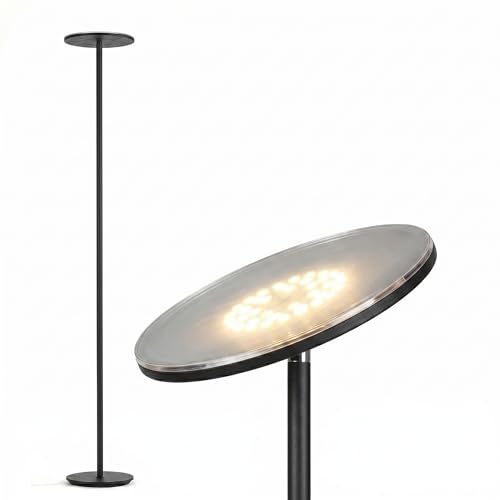 Brightech Sky LED Torchiere Floor Lamp Whole-room light from one outlet | Plugs into an outlet. No drilling, no fixing, no ceiling box. | 2,190 lm | $74.99 - View on Amazon #ad Price as of October 18, 2026. How we earn |
| 03 |  WiZ WiZ Connected Color A19 Smart Bulb The cheapest way into hub-free smart lighting | A bulb swap on your own Wi-Fi. No hub, no wiring, no switch change. | Not published | $21.10 - View on Amazon #ad Price as of October 18, 2026. How we earn |
Specifications are the manufacturer or retailer published figures, compiled by hand. We have not measured them, and where a figure is not published we write "Not published" rather than guess.
01
Glare is not the same as brightness
Brightness is how many lumens are in the room. Glare is how intense the source is where you can see it. They are separate, and confusing them is why people turn lights off in rooms that were already too dark.
An old 60W incandescent spread its 800 lumens across a large frosted glass envelope. A modern LED produces the same 800 lumens from a much smaller emitting area. Same quantity of light in the room, several times the intensity at the source - so it reads as harsh even though nothing about the room got brighter.
That is why the answer is so often shading or aiming rather than reducing output. Reducing output makes a dark room darker without addressing the thing that was actually uncomfortable. When a room genuinely does need more light rather than better light, the brightest LED bulbs you can actually fit covers how far one socket goes.
02
Which one do you have?
| Symptom | Likely cause | Fix |
|---|---|---|
| Uncomfortable only when the source is in view | Glare | Shade it, aim it up, or move it out of the eye line |
| Room feels harsh but corners are dark | Glare plus poor distribution | Split the lumens across more sources |
| Everything feels overlit and flat | Genuinely too many lumens | Dim it, or fit lower-output bulbs |
| Fine by day, wrong in the evening | Color temperature, not output | 2700K bulbs, or a tunable bulb set warm at night |
| Bright but colors look flat and gray | Low CRI | Higher-CRI bulbs - see the high-CRI roundup |
Only one row there is fixed by less light. Check your room against the lumen target before assuming it is that one - plenty of rooms that feel overlit are, on the arithmetic, underlit and badly distributed.
03
Five fixes, cheapest first
- Move it or aim it. Free. Turn a lamp to face a wall, move it out of the sight line from your usual seat, or point it at the ceiling. An uplight converts a harsh point source into a large soft one at no cost.
- Shade or diffuse it. A few dollars. A fabric shade, a frosted bulb rather than a clear one, or a diffuser over a bare fitting. Anything between the emitter and your eye.
- Lower the output where it is genuinely too much. An 800-lumen bulb where a 1,500 sits now, but only after checking the room is not short overall.
- Add sources rather than removing them. Counter-intuitive and usually correct: two 800-lumen lamps are more comfortable than one 1,600-lumen lamp, because neither is intense enough to glare.
- Fit a smart bulb and dim it electronically. No dimmer in the wall, no wiring, no permission needed, and you can set different levels for different times of day. The renter-safe options are in best smart bulbs without a hub.
The picks
The products behind this page
01
The default bulb for almost every lamp in a home
Philips Ultra Definition A19 LED, 60W equivalent, 2700K
800 lumens at 2700K with a published CRI 95 for the price of an ordinary bulb - the single easiest upgrade in this entire category.
| Lumens | 800 lm |
|---|---|
| Color temperature | 2700K |
| CRI | 95 |
| Power source | Screws into a standard E26 socket (8W) |
| Dimmable | Yes |
| Renter-safe method | It is a bulb. Swap it, keep the old one, put it back when you leave. |
What it gets right
- CRI 95 at a mainstream price, which almost nothing else manages
- 2700K matches the warm light most rooms were designed around
- Dimmable and rated flicker-free
What it costs you
- 800 lumens is one bulb's worth - a dark room needs several
- 2700K is too warm for detailed kitchen task work
- R9 is not published, so deep reds are an unknown
Spec source: Home Depot listing - retrieved September 3, 2026.
02
Whole-room light from one outlet
Brightech Sky LED Torchiere Floor Lamp
#ad Price as of October 18, 2026. How we earn
The one lamp here that publishes its own output: 2,190 lumens at 3000K from an integrated LED, aimed at the ceiling so the whole room lifts rather than one corner.
| Lumens | 2,190 lm |
|---|---|
| Color temperature | 3000K |
| CRI | Not published |
| Power source | Plugs in (corded, 30W integrated LED) |
| Dimmable | Yes - touch dimmer on the pole |
| Renter-safe method | Plugs into an outlet. No drilling, no fixing, no ceiling box. |
What it gets right
- Publishes a real lumen figure, which most lamp brands do not
- 3000K is the safest single color temperature for a shared living space
- Uplight bounces off the ceiling, so it fills a room instead of pooling
What it costs you
- Integrated LED - when it eventually fails you replace the lamp, not a bulb
- CRI is not published, so color accuracy is unknown
- Needs about 10 inches of floor space and a nearby outlet
Spec source: Brightech product page - retrieved September 3, 2026.
03
The cheapest way into hub-free smart lighting
WiZ WiZ Connected Color A19 Smart Bulb
#ad Price as of October 18, 2026. How we earn
Wi-Fi and Matter with no bridge to buy, at roughly the price of two ordinary bulbs - the sensible default when you are lighting a rental you may leave next year.
| Lumens | Not published |
|---|---|
| Color temperature | Tunable white plus color |
| CRI | Not published |
| Power source | Screws into a standard E26 socket |
| Dimmable | Yes - in app |
| Renter-safe method | A bulb swap on your own Wi-Fi. No hub, no wiring, no switch change. |
What it gets right
- No bridge, no hub, nothing extra plugged into the router
- Matter support, so it is not locked to one ecosystem
- Cheap enough to do a whole apartment rather than one room
What it costs you
- Wi-Fi bulbs each take an address on your network
- CRI and lumen figures are not published per SKU
- Anyone flipping the wall switch takes the bulb offline
Spec source: PCWorld smart bulb guide (attributed) - retrieved September 3, 2026.
FAQ
Questions people actually ask
+Why are my LED lights so harsh?
Usually glare rather than quantity. An LED concentrates its output in a small physical area, so the source itself is far more intense than an old frosted incandescent even at the same lumens. Anything that puts the emitter in your eye line reads as harsh, regardless of the room's total light level.
+How do I make LED lights less bright without a dimmer?
Lower-lumen bulbs, a shade or diffuser between you and the emitter, aiming the light at a ceiling or wall instead of into the room, or a smart bulb that dims electronically with no dimmer in the wall. All four work; the last one needs no wiring.
+Can a room be too bright and too dark at the same time?
Yes, and it is common. One over-bright source produces glare in your eye line and leaves the corners in shadow, so the room reads as harsh and gloomy at once. Splitting the same lumens across several sources fixes both symptoms simultaneously.
+Is bright LED light bad for your eyes?
Ordinary domestic LEDs are not damaging, but glare causes real eye strain and headaches, and cool light in the evening interferes with sleep for many people. Both are worth fixing - not because the light is dangerous, but because the discomfort is genuine.
Sources
Where the numbers came from
- SuperBrightLEDs - IES residential recommended lighting levels
- Archtoolbox - Recommended Lighting Levels in Buildings
- Home Depot - Philips Ultra Definition A19 60W equivalent 2700K listing
All sources retrieved September 3, 2026.
Next
Read these next
About the author
Sawyer V. An enthusiast who reads the spec sheets and does the arithmetic. No lab, no test bench.