Sconce & Socket earns a commission on qualifying purchases made through links on this page, at no extra cost to you. It does not change which products we pick. Full disclosure.
| # | Product | Best for | Lumens | Price |
|---|---|---|---|---|
| 01 |  Satco 5.5W Vintage Edison B11 Candelabra LED, 90 CRI A chandelier over a dining table, where color matters | A bulb swap. Fully reversible. | 500 lm | $16.99 - View on Amazon #ad Price as of September 24, 2026. How we earn |
| 02 | 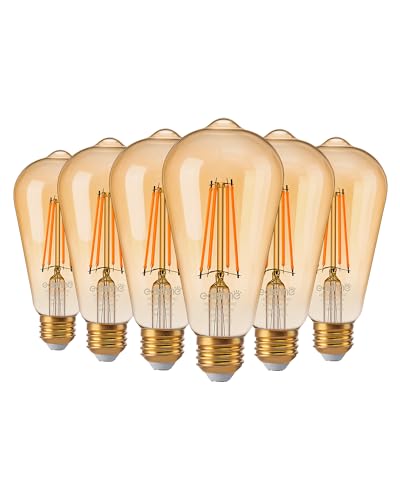 EDISHINE Vintage LED Edison Bulb, A19, 8W, 2200K Exposed fittings where the bulb is the decoration | A bulb swap. Fully reversible. | 700 lm | |
| 03 |  Philips Ultra Definition A19 LED, 60W equivalent, 2700K The default bulb for almost every lamp in a home | It is a bulb. Swap it, keep the old one, put it back when you leave. | 800 lm |
Specifications are the manufacturer or retailer published figures, compiled by hand. We have not measured them, and where a figure is not published we write "Not published" rather than guess.
01
Three rules, and which one to use
Sizing a hanging fixture is one of the few lighting questions with published, repeatable answers. There are three, and the one you use depends on what the fixture is over.
Over a table: half to two thirds the width of the table. Schoolhouse and Lamps Plus both publish it in those words; Capitol Lighting adds a shortcut - roughly 12 inches narrower than the table.
In a room, with nothing under it: add the room's length and width in feet, and use that number in inches. Schoolhouse's own example is a 12 by 10 foot room: 22 feet, so a 22 inch fixture.
Over an island: divide the island length by four for two pendants and by three for three, per Visual Comfort - which gives you the count and the spacing in one step.
All three are rules of thumb. Schoolhouse says as much on its own page. They exist because they land in the right neighborhood almost every time, and because the failure modes at either extreme - a tiny fixture over a big table, a vast one in a small room - are so obvious.
| Situation | Rule | Worked example |
|---|---|---|
| Over a dining table | Half to two thirds the table width | A 42 in. wide table = 21 to 28 in. fixture |
| Over a dining table (alternative) | About 12 in. narrower than the table | A 42 in. table = about 30 in. |
| A room, nothing beneath | Length + width in feet, read as inches | 12 x 10 ft room = 22 in. fixture |
| Over an island, two pendants | Island length divided by four | A 6 ft island = pendants at 18 in. and 54 in. |
02
Hanging height, where the sources split
Over a table, the published window is 30 to 36 inches from the tabletop to the bottom of the fixture. Schoolhouse gives that figure for standard 8-foot ceilings, and Capitol Lighting gives the same.
Lamps Plus publishes 28 to 34 inches instead. The two-inch difference sounds trivial and is not, because the bottom of the window is where a fixture starts blocking the face of the person across the table.
For taller ceilings, Capitol Lighting publishes the adjustment: three inches higher for every additional foot of ceiling above eight feet. On a 10-foot ceiling that puts the fixture 36 to 42 inches above the table.
Over an island, Visual Comfort's window is the same 30 to 36 inches above the counter - which, because a counter is higher than a table, puts the fixture noticeably higher in the room.
03
What goes in it
A chandelier is a fixture full of small sockets, and the bulbs decide how it actually looks. Three practical cases:
Exposed bulbs, visible from the table. Go warm and low-output per bulb, because six bright bulbs at eye level is glare. A 2200K vintage LED reads as candlelight and is meant to be looked at.
Shaded or frosted arms. Prioritize color rendering, because the light is landing on food and faces - a CRI 90 candelabra bulb is the upgrade that shows.
A single pendant over an island. One standard socket, so a good A19 does the job and you choose brightness by lumens rather than by fixture.
Whatever the fixture, put it on a dimmer if you can. A dining fixture at full output is a work light; at a third it is the reason the room feels good.
04
The common mistakes
Buying too small. This is the error in nearly every case, because fixtures look bigger in a shop than they do on a ceiling. If you are between two sizes, take the larger.
Hanging it too high. A fixture pushed up toward the ceiling stops being a dining light and becomes a room light. The 30 to 36 inch window exists because that is where the pool of light lands on the table rather than on the floor.
Centering on the room instead of the table. The fixture belongs over the table, even if that is not the middle of the room. A chandelier centered on a room and offset from the table looks like a mistake nobody can unsee.
Forgetting the slope. On a vaulted ceiling a standard canopy will hang crooked - the fixes are in the best sloped ceiling light fixtures.
The picks
The products behind this page
01
A chandelier over a dining table, where color matters
Satco 5.5W Vintage Edison B11 Candelabra LED, 90 CRI
#ad Price as of September 24, 2026. How we earn
500 lumens at 2700K with a published 90 CRI - the candelabra bulb to use where the light lands on food and faces rather than on a hallway wall.
| Lumens | 500 lm |
|---|---|
| Color temperature | 2700K |
| CRI | 90 |
| Power source | Screws into an E12 candelabra socket (5.5W) |
| Dimmable | Yes |
| Renter-safe method | A bulb swap. Fully reversible. |
What it gets right
- 90 CRI published, which is unusual for a candelabra bulb
- 2700K suits the living and dining rooms where chandeliers live
- Vintage B11 shape works in fittings that show the bulb
What it costs you
- Enclosed-fixture suitability is not stated
- Slightly higher wattage than rivals for the same 500 lm
- Decorative shape is wrong for a fitting with small shades
Spec source: Bulbs.com - 90+ CRI LED bulbs with a candelabra (E12) base - retrieved September 3, 2026.
02
Exposed fittings where the bulb is the decoration
EDISHINE Vintage LED Edison Bulb, A19, 8W, 2200K
700 lumens at 2200K with a published CRI of 80+ - a decorative amber bulb that still produces a useful amount of light, which most vintage bulbs do not.
| Lumens | 700 lm |
|---|---|
| Color temperature | 2200K |
| CRI | 80+ |
| Power source | Screws into a standard E26 socket (8W, 60W equivalent) |
| Dimmable | Yes |
| Renter-safe method | A bulb swap. Fully reversible. |
What it gets right
- 700 lumens is genuinely useful output for a decorative bulb
- 2200K amber reads as candlelight, which is the whole point of the format
- CRI is published at 80+, which most vintage-style bulbs do not disclose at all
What it costs you
- 2200K is far too warm to work as a room's main light
- 80+ CRI is ordinary - fine for atmosphere, not for anywhere color matters
- The filament look only works in a fitting that shows the bulb
Spec source: Amazon listing - EDISHINE vintage LED Edison bulbs, 2200K - retrieved September 3, 2026.
03
The default bulb for almost every lamp in a home
Philips Ultra Definition A19 LED, 60W equivalent, 2700K
800 lumens at 2700K with a published CRI 95 for the price of an ordinary bulb - the single easiest upgrade in this entire category.
| Lumens | 800 lm |
|---|---|
| Color temperature | 2700K |
| CRI | 95 |
| Power source | Screws into a standard E26 socket (8W) |
| Dimmable | Yes |
| Renter-safe method | It is a bulb. Swap it, keep the old one, put it back when you leave. |
What it gets right
- CRI 95 at a mainstream price, which almost nothing else manages
- 2700K matches the warm light most rooms were designed around
- Dimmable and rated flicker-free
What it costs you
- 800 lumens is one bulb's worth - a dark room needs several
- 2700K is too warm for detailed kitchen task work
- R9 is not published, so deep reds are an unknown
Spec source: Home Depot listing - retrieved September 3, 2026.
FAQ
Questions people actually ask
+What size chandelier for a dining table?
Half to two thirds the width of the table, per Schoolhouse and Lamps Plus. Capitol Lighting offers the same rule and an alternative: about 12 inches narrower than the table's width.
+How do I size a fixture to a room rather than a table?
Add the room's length and width in feet and use that number in inches. A 12 by 10 foot room gives 22, so a 22 inch diameter fixture. Schoolhouse, which publishes it, calls it a general rule of thumb.
+How high should a chandelier hang above a table?
30 to 36 inches above the tabletop on a standard 8-foot ceiling, per Schoolhouse and Capitol Lighting. Lamps Plus says 28 to 34 inches. Capitol adds three inches of height for every extra foot of ceiling.
+How high should pendants hang over a kitchen island?
Visual Comfort, a manufacturer, publishes 30 to 36 inches between the bottom of the fixture and the top of the counter - the same window as a dining table.
+How many pendants over an island, and how far apart?
Visual Comfort's method is to divide the island length by four for two pendants and by three for three, which sets both the count and the positions. We could not verify the commonly-quoted center-to-center figure, so we do not publish one.
+Are these rules or requirements?
Rules of thumb, published by retailers and manufacturers. Schoolhouse says so explicitly. They produce good results in ordinary rooms and should be broken deliberately in unusual ones.
Sources
Where the numbers came from
- Schoolhouse - choosing chandelier and pendant size (half to two thirds the table width; room length plus width in feet as diameter in inches; 30 to 36 inches above a table)
- Lamps Plus - choosing and hanging dining room chandeliers (one half to two thirds the width of the table; 28 to 34 inches above it)
- Capitol Lighting - chandelier height over a dining table (30 to 36 inches above the surface; three inches higher per extra foot of ceiling)
- Visual Comfort - pendant height over an island (30 to 36 inches above the counter; divide island length by four for two pendants, by three for three)
All sources retrieved September 3, 2026.
Next
Read these next
About the author
Sawyer V. An enthusiast who reads the spec sheets and does the arithmetic. No lab, no test bench.