Sconce & Socket earns a commission on qualifying purchases made through links on this page, at no extra cost to you. It does not change which products we pick. Full disclosure.
| # | Product | Best for | Lumens | Price |
|---|---|---|---|---|
| 01 |  Philips Ultra Definition A19 LED, 60W equivalent, 2700K The default bulb for almost every lamp in a home | It is a bulb. Swap it, keep the old one, put it back when you leave. | 800 lm | |
| 02 | 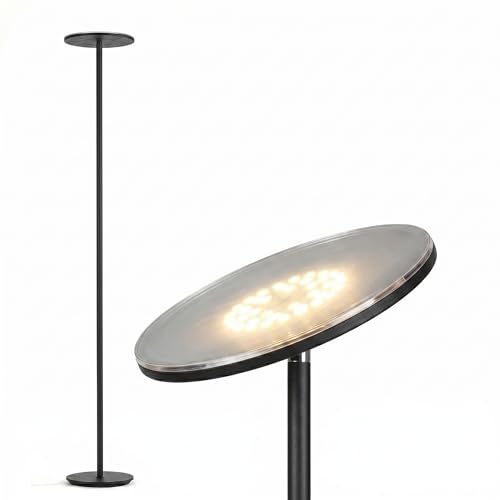 Brightech Sky LED Torchiere Floor Lamp Whole-room light from one outlet | Plugs into an outlet. No drilling, no fixing, no ceiling box. | 2,190 lm | $74.99 - View on Amazon #ad Price as of October 22, 2026. How we earn |
| 03 |  Enbrighten 18 in. Plug-in Under Cabinet Light Bar (82785-T1) Kitchen counters, no wiring, no compromise on color | Plugs in. Mounts with the supplied adhesive or two screws - adhesive keeps the deposit. | 1,245 lm | $34.98 - View on Amazon #ad Price as of October 22, 2026. How we earn |
| 04 |  Philips Ultra Definition A19 LED, 100W equivalent, 1500 lm Squeezing more light out of the sockets you already have | It is a bulb. No fixing, no permission, fully reversible. | 1,500 lm | $57.49 - View on Amazon #ad Price as of October 22, 2026. How we earn |
Specifications are the manufacturer or retailer published figures, compiled by hand. We have not measured them, and where a figure is not published we write "Not published" rather than guess.
01
Stage one: read what you already have
Almost everybody starts a lighting project by shopping. It is the wrong first move, and it is expensive, because the most common cause of a dark room in an ordinary home is not a missing fixture - it is weak bulbs in the fittings that are already there.
So stage one costs nothing. Walk the house with a notepad and write down, for each room, the number of sockets and the lumen figure printed on the bulbs in them. Add them up. Compare against the target for that room's size and use, from how many lumens does a room need.
This routinely changes the plan. A living room with five sockets holding 450 lumen bulbs has 2,250 lumens in it; the same five sockets holding 1,500 lumen bulbs have 7,500. That is a transformation for the price of a multipack, with nothing to install, no cord to route and no landlord to ask.
02
The order to work in
| Stage | What | Cost | Why here |
|---|---|---|---|
| 1 | Audit and upgrade bulbs everywhere | Lowest | Changes what else you need |
| 2 | Fix color temperature inconsistencies | None, if done with stage 1 | Free while you are buying bulbs anyway |
| 3 | Add task light where there is a real task | Low | Biggest daily improvement |
| 4 | Add an ambient layer to evening rooms | Medium | Where the evenings actually happen |
| 5 | Add dimming | Low to medium | Makes stages 3 and 4 usable all day |
| 6 | Accent and decorative | Whatever you like | Last, because it changes nothing functional |
Stage 2 is free if you do it with stage 1. Since you are buying bulbs anyway, buy one color temperature. Mixed warmth within a single sight line is the most common thing that makes an otherwise fine house look slightly wrong, and it costs nothing to avoid at purchase time. 2700K throughout living spaces is the straightforward answer, with cooler light reserved for a laundry, a garage or a workbench.
Stage 3 is where daily life improves most. Task lighting is disproportionately valuable because it is light delivered exactly where a real activity happens. A kitchen counter is the clearest case - an under-cabinet bar at 1,245 lumens and CRI 92 changes cooking more than any ceiling fixture can, because it lights the counter from in front of you rather than from behind your head.
Stage 4 is the evening rooms only. An ambient layer in a living room you sit in every night is worth far more than the same spend in a spare bedroom. A torchiere in a corner is the standard move, for the reasons in where to put a floor lamp.
03
Sequencing it against your actual life
Two things should reorder the list above, and both are about circumstances rather than lighting.
If you rent, buy things that leave with you. Bulbs, lamps, plug-in bars and clamp fixtures all move house. Anything screwed to a wall may not, and anything hardwired definitely does not. That is not a reason to accept bad lighting - it is a reason to spend the budget on the portable half of the list, which happens to be stages 1, 3 and 4 anyway. The framework is in can you change a light fixture in an apartment.
If you are about to redecorate, do lighting after paint, not before. Wall and ceiling color changes how much light comes back into a room by a large margin - a pale ceiling is the difference between an uplight working and not working. Painting after you have sized the lighting means re-sizing it.
Beyond that, work room by room rather than layer by layer across the house. Finishing one room completely gives you a reference for what "right" looks like, and it is far more motivating than having every room half done. The room pages are all in room-by-room lighting, and the three-layer framework each of them uses is in layered lighting.
The picks
The products behind this page
01
The default bulb for almost every lamp in a home
Philips Ultra Definition A19 LED, 60W equivalent, 2700K
800 lumens at 2700K with a published CRI 95 for the price of an ordinary bulb - the single easiest upgrade in this entire category.
| Lumens | 800 lm |
|---|---|
| Color temperature | 2700K |
| CRI | 95 |
| Power source | Screws into a standard E26 socket (8W) |
| Dimmable | Yes |
| Renter-safe method | It is a bulb. Swap it, keep the old one, put it back when you leave. |
What it gets right
- CRI 95 at a mainstream price, which almost nothing else manages
- 2700K matches the warm light most rooms were designed around
- Dimmable and rated flicker-free
What it costs you
- 800 lumens is one bulb's worth - a dark room needs several
- 2700K is too warm for detailed kitchen task work
- R9 is not published, so deep reds are an unknown
Spec source: Home Depot listing - retrieved September 3, 2026.
02
Whole-room light from one outlet
Brightech Sky LED Torchiere Floor Lamp
#ad Price as of October 22, 2026. How we earn
The one lamp here that publishes its own output: 2,190 lumens at 3000K from an integrated LED, aimed at the ceiling so the whole room lifts rather than one corner.
| Lumens | 2,190 lm |
|---|---|
| Color temperature | 3000K |
| CRI | Not published |
| Power source | Plugs in (corded, 30W integrated LED) |
| Dimmable | Yes - touch dimmer on the pole |
| Renter-safe method | Plugs into an outlet. No drilling, no fixing, no ceiling box. |
What it gets right
- Publishes a real lumen figure, which most lamp brands do not
- 3000K is the safest single color temperature for a shared living space
- Uplight bounces off the ceiling, so it fills a room instead of pooling
What it costs you
- Integrated LED - when it eventually fails you replace the lamp, not a bulb
- CRI is not published, so color accuracy is unknown
- Needs about 10 inches of floor space and a nearby outlet
Spec source: Brightech product page - retrieved September 3, 2026.
03
Kitchen counters, no wiring, no compromise on color
Enbrighten 18 in. Plug-in Under Cabinet Light Bar (82785-T1)
#ad Price as of October 22, 2026. How we earn
1,245 lumens at 92 CRI with five white settings from 2700K to 6500K, on a plug - the rare renter-safe fixture that beats most hardwired ones on light quality.
| Lumens | 1,245 lm |
|---|---|
| Color temperature | 2700K-6500K, five settings |
| CRI | 92 |
| Power source | Plugs in |
| Dimmable | Yes - full range |
| Renter-safe method | Plugs in. Mounts with the supplied adhesive or two screws - adhesive keeps the deposit. |
What it gets right
- 92 CRI, so food and worktops read true rather than gray
- Five color temperatures means you tune it to the room, not the box
- Full-range dimming, not a two-step hi/low
What it costs you
- The cord has to reach an outlet and then be hidden
- 18 inches is longer than some cabinet sections allow
- One more power adapter on a kitchen outlet
Spec source: Enbrighten product page - retrieved September 3, 2026.
04
Squeezing more light out of the sockets you already have
Philips Ultra Definition A19 LED, 100W equivalent, 1500 lm
#ad Price as of October 22, 2026. How we earn
1,500 lumens from a standard A19 - the first move in any dark room is not a new lamp, it is putting these in the lamps already standing there.
| Lumens | 1,500 lm |
|---|---|
| Color temperature | 2700K soft white, or 5000K daylight version |
| CRI | 95 |
| Power source | Screws into a standard E26 socket |
| Dimmable | Yes |
| Renter-safe method | It is a bulb. No fixing, no permission, fully reversible. |
What it gets right
- Nearly double the output of a 60W-equivalent from the same socket
- CRI 95 holds at the higher output
- Two existing lamps fitted with these add 3,000 lumens to a room
What it costs you
- Check the fixture's maximum rating before fitting a brighter bulb
- Too much for a bedside lamp
- Enclosed fixtures can shorten the life of any high-output LED
Spec source: Walmart listing - retrieved September 3, 2026.
FAQ
Questions people actually ask
+Where should I start when relighting a house?
With the bulbs you already own. Reading the lumen figure on existing bulbs and upgrading the weak ones is the cheapest change available, needs no installation, and frequently fixes rooms you were about to buy a lamp for.
+Which rooms should be relit first?
The ones you spend evenings in, and the ones with a genuine task. A living room used every night and a kitchen counter you cook at repay attention far more than a spare bedroom or a hallway.
+How much does it cost to relight a home?
It depends entirely on how much of it is bulbs. Bulb upgrades across a whole house cost less than a single decent floor lamp, and they should always be done first because they change what else you need.
+Do I need the same color temperature throughout a house?
Not identical, but consistent within each sight line. Rooms visible from one another should match, and utility spaces like a laundry or garage can reasonably be cooler than living spaces without it looking like a mistake.
+What is the biggest mistake in a whole-home plan?
Buying fixtures before measuring anything. A lamp bought to fix a dark room that turns out to be full of 450 lumen bulbs solves a problem that a multipack would have solved for a tenth of the price.
Sources
Where the numbers came from
- SuperBrightLEDs - IES residential recommended lighting levels
- Home Depot listing - Philips Ultra Definition A19, 800 lm, 2700K, 95 CRI
- Walmart listing - Philips Ultra Definition A19, 1,500 lm, 2700K, 95 CRI
- Enbrighten - 18 in. plug-in dimmable LED light bar, 1,245 lm, 92 CRI
All sources retrieved September 3, 2026.
Next
Read these next
About the author
Sawyer V. An enthusiast who reads the spec sheets and does the arithmetic. No lab, no test bench.