Sconce & Socket earns a commission on qualifying purchases made through links on this page, at no extra cost to you. It does not change which products we pick. Full disclosure.
| # | Product | Best for | Lumens | Price |
|---|---|---|---|---|
| 01 | 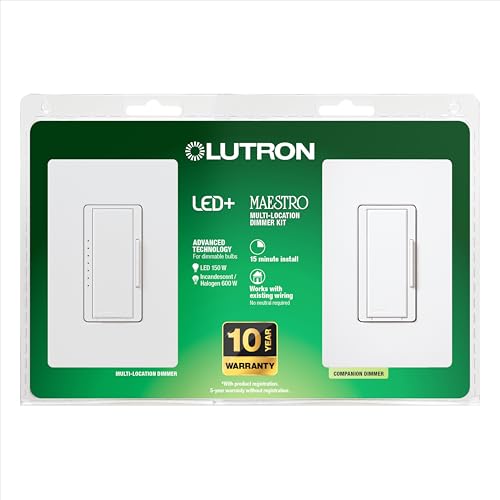 Lutron Maestro LED+ Dimmer Switch (MACL-153M) A non-smart wall dimmer that actually handles LEDs | NOT renter-safe. Replacing a switch is an electrical alteration needing permission. | n/a - controls a circuit, does not light | $62.77 - View on Amazon #ad Price as of October 20, 2026. How we earn |
| 02 | Lutron Credenza Plug-In Lamp Dimmer (TTCL-100H) Dimming a lamp with nothing installed in the wall | Plugs in. No wiring, no switch change, nothing fixed. | n/a - controls a lamp, does not light | Check price on Amazon #ad No live price right now, so we show none. How we earn |
| 03 |  Philips Ultra Definition A19 LED, 60W equivalent, 2700K The default bulb for almost every lamp in a home | It is a bulb. Swap it, keep the old one, put it back when you leave. | 800 lm |
Specifications are the manufacturer or retailer published figures, compiled by hand. We have not measured them, and where a figure is not published we write "Not published" rather than guess.
01
What a dimmer actually does
A dimmer does not reduce voltage in the way people imagine. Mains power arrives as a wave that reverses direction a hundred and twenty times a second, and a dimmer switches the supply off for part of each half-cycle. Less of the wave gets through, so less energy reaches the lamp, so the light is dimmer.
The two families differ in which part of each half-cycle they cut.
| Leading edge | Trailing edge | |
|---|---|---|
| Cuts | The start of each half-cycle | The end of each half-cycle |
| Designed for | Incandescent and halogen filaments | Electronic drivers - LED and CFL |
| Typical age | Pre-2010 designs | Modern, usually marked LED or LED+ |
| With LEDs | Flicker, buzz, dead zone at the bottom | Smooth across the range |
| Noise | Often an audible buzz from the dimmer | Generally silent |
| Minimum load | Often around 40W | Specified far lower |
02
Why the filament design fails an LED
Two reasons, and they compound.
Thermal inertia. An incandescent filament is a lump of hot metal. Chop the waveform and it keeps glowing through the gaps, smoothing the result into a continuous light. An LED has no thermal inertia at all - it follows the supply almost instantly, so it reproduces the chopping as visible flicker.
Current draw. A leading edge dimmer needs a certain current flowing to hold itself in a stable state, which is why many specify a minimum load around 40W. Three modern LED bulbs might total 24W, so the dimmer is operating outside its specification and behaves erratically at the bottom of its range.
Together, those explain the whole symptom set: fine at full brightness, unstable as you dim, cutting out entirely somewhere around a third, and a buzz from the wall. The diagnostic walkthrough is in why dimmable LED bulbs flicker.
03
What to do about it
If you own the place: change the dimmer, not the bulbs. A dimmer built for LED loads solves the whole class of problem at once, and the picks are in best dimmer switches for LEDs.
If you rent: you cannot change the dimmer, so change where the dimming happens. Leave the wall dimmer at full and dim the lamp with a plug-in dimmer on the cord, or a smart bulb that dims in its own driver. Either way the wall dimmer stops being part of the circuit's behavior.
Either way, the bulb still has to be marked dimmable, and dimming quality varies between bulbs that all carry the word - see best dimmable LED bulbs.
The picks
The products behind this page
01
A non-smart wall dimmer that actually handles LEDs
Lutron Maestro LED+ Dimmer Switch (MACL-153M)
#ad Price as of October 20, 2026. How we earn
150W of LED on a dimmer built for LED drivers rather than filaments, with no neutral needed - the honest fix when the flicker is the dimmer and you own the place.
| Lumens | n/a - controls a circuit, does not light |
|---|---|
| Color temperature | n/a |
| CRI | n/a |
| Power source | Replaces a wall switch. Electrical work. |
| Dimmable | Yes - tap for on/off, slide for level |
| Renter-safe method | NOT renter-safe. Replacing a switch is an electrical alteration needing permission. |
What it gets right
- Designed for LED dimming rather than adapted from an incandescent design
- Handles LED, incandescent or halogen on the same circuit
- No neutral wire required; single-pole or multi-location
What it costs you
- Electrical work, so not an option in most rentals
- No app or voice control - this is a plain dimmer done properly
- Still cannot dim a bulb that is not marked dimmable
Spec source: Lutron - Maestro LED+ dimmer switch product page - retrieved September 3, 2026.
02
Dimming a lamp with nothing installed in the wall
Lutron Credenza Plug-In Lamp Dimmer (TTCL-100H)
#ad No live price right now, so we show none. How we earn
A dimmer that sits on the cord between the lamp and the outlet, rated for 100W of dimmable LED - the only route to real dimming that touches no wiring at all.
| Lumens | n/a - controls a lamp, does not light |
|---|---|
| Color temperature | n/a |
| CRI | n/a |
| Power source | Plugs in between the lamp and the outlet (6 ft cord) |
| Dimmable | That is the whole product - slide to dim, slide to off |
| Renter-safe method | Plugs in. No wiring, no switch change, nothing fixed. |
What it gets right
- Rated for 100W of dimmable CFL/LED or 250W incandescent - well beyond any single lamp
- Lutron's dimming circuitry is designed for high-efficiency bulbs, which is where cheap dimmers fail
- UL and CSA listed, and it comes with you when you move
What it costs you
- The bulb still has to be marked dimmable - a plug-in dimmer cannot fix a non-dimmable bulb
- Sits visibly on the cord, so it wants to be behind furniture
- One lamp per dimmer
Spec source: Home Depot listing (TTCL-100H-WH) - retrieved September 3, 2026.
03
The default bulb for almost every lamp in a home
Philips Ultra Definition A19 LED, 60W equivalent, 2700K
800 lumens at 2700K with a published CRI 95 for the price of an ordinary bulb - the single easiest upgrade in this entire category.
| Lumens | 800 lm |
|---|---|
| Color temperature | 2700K |
| CRI | 95 |
| Power source | Screws into a standard E26 socket (8W) |
| Dimmable | Yes |
| Renter-safe method | It is a bulb. Swap it, keep the old one, put it back when you leave. |
What it gets right
- CRI 95 at a mainstream price, which almost nothing else manages
- 2700K matches the warm light most rooms were designed around
- Dimmable and rated flicker-free
What it costs you
- 800 lumens is one bulb's worth - a dark room needs several
- 2700K is too warm for detailed kitchen task work
- R9 is not published, so deep reds are an unknown
Spec source: Home Depot listing - retrieved September 3, 2026.
FAQ
Questions people actually ask
+What is the difference between leading edge and trailing edge dimmers?
Both work by chopping part of the mains waveform. A leading edge dimmer cuts the start of each half-cycle and was designed for incandescent filaments, which draw a lot of current. A trailing edge dimmer cuts the end and is designed for the low-current electronic drivers inside LEDs, which is why it is far smoother with them.
+Which dimmer type do LEDs need?
Trailing edge, or a modern dimmer explicitly rated for LED loads. Leading edge dimmers can work with some LEDs and are the usual cause when they do not - flicker, buzzing, a dead zone at the bottom of the range, or the light dropping out entirely below a third.
+How do I tell which dimmer I have?
Read the faceplate or the back of the unit. Anything that says LED, LED+ or trailing edge is the modern type. Anything from before roughly 2010 with no LED marking is almost certainly leading edge. A loud buzz from the dimmer itself is a strong hint.
+Can I use a leading edge dimmer with LED bulbs?
Sometimes, badly. Some bulb and dimmer combinations happen to work, which is why the advice is confusing - one person's LEDs are fine on the same dimmer another person's flicker on. If yours misbehave, the combination is the problem rather than the bulb alone.
Sources
Where the numbers came from
- Lutron - Maestro LED+ dimmer switch product page
- Lutron support - Caseta plug-in lamp dimmer bulb compatibility
- Home Depot - Philips Ultra Definition A19 60W equivalent 2700K listing
All sources retrieved September 3, 2026.
Next
Read these next
About the author
Sawyer V. An enthusiast who reads the spec sheets and does the arithmetic. No lab, no test bench.