Sconce & Socket earns a commission on qualifying purchases made through links on this page, at no extra cost to you. It does not change which products we pick. Full disclosure.
| # | Product | Best for | Lumens | Price |
|---|---|---|---|---|
| 01 |  Philips Ultra Definition A19 LED, 60W equivalent, 2700K The default bulb for almost every lamp in a home | It is a bulb. Swap it, keep the old one, put it back when you leave. | 800 lm | |
| 02 |  Waveform Lighting Ultra High 95 CRI BR30 LED Bulb Recessed cans where color accuracy is the whole point | A bulb swap in an existing can. Fully reversible. | 800 lm | $19.38 - View on Amazon #ad Price as of October 20, 2026. How we earn |
| 03 | 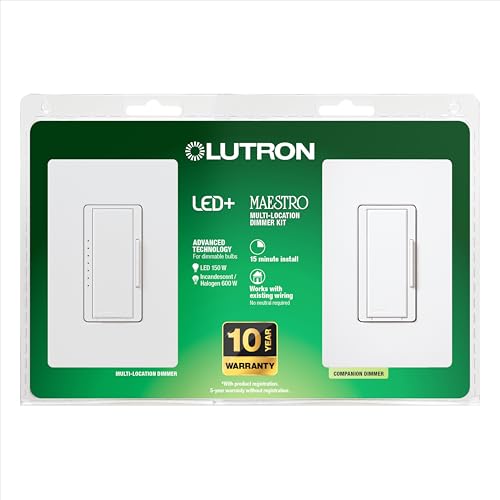 Lutron Maestro LED+ Dimmer Switch (MACL-153M) A non-smart wall dimmer that actually handles LEDs | NOT renter-safe. Replacing a switch is an electrical alteration needing permission. | n/a - controls a circuit, does not light | $62.77 - View on Amazon #ad Price as of October 20, 2026. How we earn |
| 04 | Lutron Credenza Plug-In Lamp Dimmer (TTCL-100H) Dimming a lamp with nothing installed in the wall | Plugs in. No wiring, no switch change, nothing fixed. | n/a - controls a lamp, does not light | Check price on Amazon #ad No live price right now, so we show none. How we earn |
Specifications are the manufacturer or retailer published figures, compiled by hand. We have not measured them, and where a figure is not published we write "Not published" rather than guess.
01
The resource nobody uses
Dimmer manufacturers publish compatibility lists: spreadsheets of bulb makes and models tested against each of their dimmers, with notes on which combinations dim smoothly and which do not. Lutron publishes them, and so do the other serious manufacturers.
They are free, they are specific to your exact hardware, and almost nobody looks at one before buying. It is genuinely the highest-value five minutes available in this whole subject - more useful than any roundup, including ours, because it is testing we could not do and they did.
Find the model number on your dimmer, find the manufacturer's compatibility page, and check the bulb before you buy a multipack of it. If your intended bulb is not on the list, that is not a prohibition - it means nobody tested it, and you are taking a small gamble rather than a known-good pairing.
02
Minimum load, and the three-bulb trap
The second thing on the datasheet worth reading is minimum load. Older dimmers specify a floor - commonly around 40W - below which they are not guaranteed to behave. It existed because a dimmer designed for filaments assumes filament current.
Swapping a room from incandescent to LED cuts the load by roughly 85 percent, which routinely drops a circuit below that floor. The room worked fine for twenty years and now flickers, and nothing about the wiring changed.
03
Mixing bulbs, and the five-minute check
Use one make and model across a dimmed circuit. Different drivers hit their minimum at different points, so a mixed set steps out of sync visibly as you dim - one bulb drops out while the rest are still going, which reads as a fault in the fixture. Buy the multipack.
Do not mix LED and incandescent unless the dimmer explicitly says it supports mixed loads. Some modern dimmers do and say so; on anything else the two draw current so differently that the result is unpredictable.
Then the diagnostic, which costs nothing:
- Does it flicker only when dimmed? Steady at full, unstable as you dim, points at the dimmer.
- Remove one bulb. Worse means you are below minimum load. Better means the dimmer is struggling with the total.
- Read the dimmer. No LED marking and pre-2010 means leading edge - see leading edge vs trailing edge.
- Check the bulb says dimmable. The one case where the bulb is straightforwardly at fault.
- Try the bulb in an undimmed lamp. Steady there and flickering on the dimmer confirms it.
The picks
The products behind this page
01
The default bulb for almost every lamp in a home
Philips Ultra Definition A19 LED, 60W equivalent, 2700K
800 lumens at 2700K with a published CRI 95 for the price of an ordinary bulb - the single easiest upgrade in this entire category.
| Lumens | 800 lm |
|---|---|
| Color temperature | 2700K |
| CRI | 95 |
| Power source | Screws into a standard E26 socket (8W) |
| Dimmable | Yes |
| Renter-safe method | It is a bulb. Swap it, keep the old one, put it back when you leave. |
What it gets right
- CRI 95 at a mainstream price, which almost nothing else manages
- 2700K matches the warm light most rooms were designed around
- Dimmable and rated flicker-free
What it costs you
- 800 lumens is one bulb's worth - a dark room needs several
- 2700K is too warm for detailed kitchen task work
- R9 is not published, so deep reds are an unknown
Spec source: Home Depot listing - retrieved September 3, 2026.
02
Recessed cans where color accuracy is the whole point
Waveform Lighting Ultra High 95 CRI BR30 LED Bulb
#ad Price as of October 20, 2026. How we earn
800 lumens from 10.5W at CRI 95+ with R9 above 80 - and Waveform publishes the R9 figure, which is the number almost every other brand quietly omits.
| Lumens | 800 lm |
|---|---|
| Color temperature | 2700K or 3000K |
| CRI | 95+ (R9 80+) |
| Power source | Screws into a standard E26 socket (10.5W) |
| Dimmable | Yes |
| Renter-safe method | A bulb swap in an existing can. Fully reversible. |
What it gets right
- R9 above 80 is published, so deep reds are actually accounted for
- Two warm color temperatures rather than one compromise
- BR30 shape drops straight into standard recessed cans
What it costs you
- Several times the price of a supermarket BR30
- Sold direct rather than through every retailer
- 800 lumens is standard output, not high output
Spec source: Waveform Lighting product page - retrieved September 3, 2026.
03
A non-smart wall dimmer that actually handles LEDs
Lutron Maestro LED+ Dimmer Switch (MACL-153M)
#ad Price as of October 20, 2026. How we earn
150W of LED on a dimmer built for LED drivers rather than filaments, with no neutral needed - the honest fix when the flicker is the dimmer and you own the place.
| Lumens | n/a - controls a circuit, does not light |
|---|---|
| Color temperature | n/a |
| CRI | n/a |
| Power source | Replaces a wall switch. Electrical work. |
| Dimmable | Yes - tap for on/off, slide for level |
| Renter-safe method | NOT renter-safe. Replacing a switch is an electrical alteration needing permission. |
What it gets right
- Designed for LED dimming rather than adapted from an incandescent design
- Handles LED, incandescent or halogen on the same circuit
- No neutral wire required; single-pole or multi-location
What it costs you
- Electrical work, so not an option in most rentals
- No app or voice control - this is a plain dimmer done properly
- Still cannot dim a bulb that is not marked dimmable
Spec source: Lutron - Maestro LED+ dimmer switch product page - retrieved September 3, 2026.
04
Dimming a lamp with nothing installed in the wall
Lutron Credenza Plug-In Lamp Dimmer (TTCL-100H)
#ad No live price right now, so we show none. How we earn
A dimmer that sits on the cord between the lamp and the outlet, rated for 100W of dimmable LED - the only route to real dimming that touches no wiring at all.
| Lumens | n/a - controls a lamp, does not light |
|---|---|
| Color temperature | n/a |
| CRI | n/a |
| Power source | Plugs in between the lamp and the outlet (6 ft cord) |
| Dimmable | That is the whole product - slide to dim, slide to off |
| Renter-safe method | Plugs in. No wiring, no switch change, nothing fixed. |
What it gets right
- Rated for 100W of dimmable CFL/LED or 250W incandescent - well beyond any single lamp
- Lutron's dimming circuitry is designed for high-efficiency bulbs, which is where cheap dimmers fail
- UL and CSA listed, and it comes with you when you move
What it costs you
- The bulb still has to be marked dimmable - a plug-in dimmer cannot fix a non-dimmable bulb
- Sits visibly on the cord, so it wants to be behind furniture
- One lamp per dimmer
Spec source: Home Depot listing (TTCL-100H-WH) - retrieved September 3, 2026.
FAQ
Questions people actually ask
+How do I know if a bulb is compatible with my dimmer?
Dimmer manufacturers publish compatibility lists by bulb make and model, and they are the single most useful and least used resource in this category. Find your dimmer's model number, find the list, and check the bulb you are about to buy against it.
+What is minimum load on a dimmer?
The lowest total wattage the dimmer needs to operate stably, commonly around 40W on older designs. Three modern LED bulbs may total under 30W, which puts the circuit below the minimum and makes the bottom of the dimming range erratic.
+Can I mix LED and incandescent bulbs on one dimmer?
Some modern dimmers explicitly support mixed loads, and that is the only situation in which it is a good idea. On a dimmer not specified for it, mixing bulb types produces unpredictable behavior because the two draw current in completely different ways.
+Do all bulbs on a dimmer need to be the same?
They should be the same make and model wherever possible. Different drivers reach their minimum at different points, so a mixed set will visibly step out of sync as you dim - one bulb drops out while the others are still going.
Sources
Where the numbers came from
- Lutron support - Caseta plug-in lamp dimmer bulb compatibility
- Lutron - Maestro LED+ dimmer switch product page
- Home Depot - Philips Ultra Definition A19 60W equivalent 2700K listing
All sources retrieved September 3, 2026.
Next
Read these next
About the author
Sawyer V. An enthusiast who reads the spec sheets and does the arithmetic. No lab, no test bench.