Sconce & Socket earns a commission on qualifying purchases made through links on this page, at no extra cost to you. It does not change which products we pick. Full disclosure.
| # | Product | Best for | Lumens | Price |
|---|---|---|---|---|
| 01 |  Satco 5.5W Vintage Edison B11 Candelabra LED, 90 CRI A chandelier over a dining table, where color matters | A bulb swap. Fully reversible. | 500 lm | $16.99 - View on Amazon #ad Price as of October 19, 2026. How we earn |
| 02 |  Hizashi B10 Candelabra LED, 40W Equivalent, 3000K, 90+ CRI A kitchen or bathroom fitting that takes E12 | A bulb swap. Fully reversible. | 450 lm | $21.24 - View on Amazon #ad Price as of October 19, 2026. How we earn |
| 03 |  FLSNT B11 Amber Candelabra LED, 40W Equivalent, 2200K A chandelier you want to look like candles | A bulb swap. Fully reversible. | 330 lm | $15.99 - View on Amazon #ad Price as of October 19, 2026. How we earn |
| 04 | 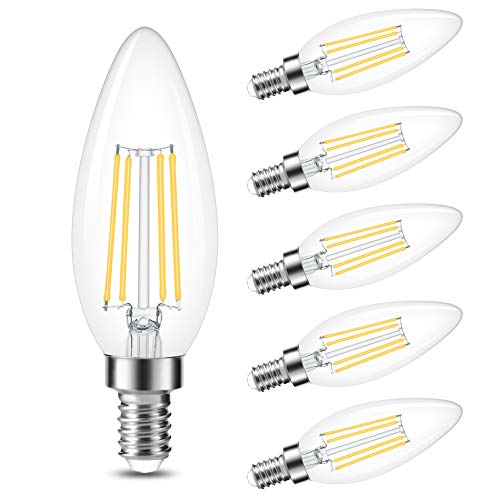 Cotanic B11 Clear Filament Candelabra LED, 60W Equivalent, 4000K A hallway, a laundry or a fan kit that needs to be bright | A bulb swap. Fully reversible. | 600 lm | $11.99 - View on Amazon #ad Price as of October 19, 2026. How we earn |
| 05 |  FLSNT CA11 Candelabra LED, 60W Equivalent, 5000K, 90+ CRI Slim candelabra fan kits where you want bright, cool light | A bulb swap. Fully reversible. | 550 lm | $13.99 - View on Amazon #ad Price as of October 19, 2026. How we earn |
Specifications are the manufacturer or retailer published figures, compiled by hand. We have not measured them, and where a figure is not published we write "Not published" rather than guess.
01
The short answer
E12 is sold in five common color temperatures - 2200K, 2700K, 3000K, 4000K and 5000K - with 6000K at the far end and tunable smart versions available but rare. For a chandelier, a wall sconce or a ceiling fan light kit, buy 2700K. That is not a hedge: it is where the format's best bulbs are, it suits the rooms E12 fittings actually hang in, and it is the only step with real choice at CRI 90 and above.
The reason the question gets asked at all is that E12 feels like a restricted format. Walk a store aisle and the candelabra section is a third the size of the standard one, with far fewer labels on the box. That impression is half right. The base imposes nothing - a 12 millimeter screw thread carries current and holds glass, and the LED inside is the same technology sold in every other package. What is genuinely narrower is the range retailers stock, because E12 goes into decorative fittings and decorative fittings are bought on looks.
So the useful version of the answer is not a list of kelvin values. It is which values you can actually buy well, which ones exist but come with compromises, and the two things E12 barely offers at all.
02
The ladder, as E12 is actually stocked
Each step below is a color temperature you can buy today in a candelabra base. The last column is the honest part: how much choice exists at that step, as opposed to whether a single bulb exists.
| Kelvin | Sold as | What it looks like | Belongs in | Depth of choice in E12 |
|---|---|---|---|---|
| 2200K | Amber, vintage, candle | Orange, close to a real flame | Open decorative fittings, ambience only | Good - amber glass is a whole sub-category |
| 2700K | Soft white, warm white | Standard household warm | Dining rooms, living rooms, bedrooms | Best - including several at CRI 90+ |
| 3000K | Warm white, bright white | Warm but noticeably cleaner than 2700K | Kitchens, bathrooms, hallways | Good - some at CRI 90+ |
| 4000K | Cool white, neutral, sometimes daylight | Neutral, no warmth and no blue | Laundry, garage, utility fittings | Moderate - mostly CRI 80 to 85 |
| 5000K | Daylight | Cool and clinical in a decorative fitting | Workshops, task fan kits | Moderate - a few at CRI 90+ |
| 6000K+ | Cool daylight, super white | Visibly blue in a home | Nothing in a decorative fitting | Thin, and we would not buy it |
| Tunable / RGB | Smart, color changing | Whatever you set in an app | One accent socket, not a whole chandelier | Rare and expensive per socket |
Two patterns are worth pulling out of that table. The first is that the depth of choice collapses as you go up the scale: at 2700K there are dozens of E12 bulbs including several that publish CRI 90 or better, while at 4000K most of what exists sits at CRI 80 to 85 and says nothing else. The second is that the marketing names drift badly at the top. One of the picks below is a perfectly good 4000K bulb whose own listing calls it daylight, and 4000K is not daylight - daylight starts around 5000K. The full decoder for that problem is in the color temperature chart.
03
Why a chandelier is the least forgiving place to get this wrong
Most color temperature advice is written for a room with one or two sockets, where a bulb that is slightly off is a mood you adjust to. E12 is different, because E12 fittings almost always hold several bulbs and almost always show them.
Mismatches are visible, not subtle. A 2700K bulb next to a 3000K bulb in the same chandelier is immediately obvious - one reads yellow, the other reads white, and the eye compares them because they are six inches apart in the same sightline. In a floor lamp across the room from a table lamp, the same 300K gap passes unnoticed.
The bulbs are part of the fitting's appearance. In an exposed chandelier the glass is as visible as the metal, which is why amber-glass 2200K bulbs are a whole category and why clear filament shapes sell at every step on the ladder. This is the one place in a house where buying a bulb for how it looks switched off is a legitimate decision.
Replacement is a set problem. When one bulb in six dies in three years, the matching bulb may not be on sale any more - and a single replacement that is 200K out is more noticeable than the dead socket was. Keep one spare from the original pack, which is a good reason to buy six-packs rather than singles even for a five-socket fitting.
04
Choosing the step for the fitting you have
E12 fittings cluster in a handful of places in a house, and each has a defensible answer.
- Dining room chandelier - 2700K. The light lands on food and faces, which is also the argument for paying for CRI 90 here rather than anywhere else in the house. 2200K is a legitimate alternative if the chandelier is decorative and another light does the work.
- Living room chandelier or sconces - 2700K. Same reasoning, and it matches the A19 bulbs in the lamps around it. Matching matters more than the absolute value.
- Bathroom sconce or vanity - 3000K. Warm enough at seven in the morning, clean enough to judge color at a mirror. Going to 4000K here is a real choice rather than a mistake, but it is a cold one in a small room.
- Kitchen fitting - 3000K. Surfaces and work, with enough warmth that the room still reads as part of the house.
- Ceiling fan light kit - 2700K or 3000K, depending on the room it is in. These are the E12 sockets most likely to be a room's main light, so output matters more here than shape.
- Hallway, laundry, garage or basement fitting - 4000K. Neutral, bright, and nobody is eating under it.
Whatever you choose, apply it to the whole fitting and ideally to the whole room. The general case is covered in the color temperature chart, and the warm end specifically in 2200K vs 2700K.
05
One bulb at each step
These are not ranked against each other, because they are different colors for different rooms. Each is the one we would buy at that step, and all five are currently sold.
2700K - Satco 5.5W B11, 90 CRI, the one most people want. 500 lumens at 2700K with a published 90 CRI, in the vintage B11 shape. The published CRI is the point: it is unusual in this format and it matters most in exactly the room chandeliers hang in.
Who it is for: a dining or living room chandelier. Who should skip it: anyone with a fitting that uses small shades, where the decorative shape is wasted.
Cons: enclosed-fixture suitability is not stated; slightly higher wattage than rivals for the same 500 lm.
3000K - Hizashi B10, 90+ CRI, for a kitchen or a bathroom. 450 lumens at 3000K with a published 90+ CRI and a UL listing, twelve to a pack. The half-step between living-room warm and task neutral, and one of the few bulbs at this step that states its color accuracy at all.
Who it is for: a bathroom sconce, a kitchen fitting, a hallway. Who should skip it: anyone with one small sconce - twelve bulbs is a lifetime supply.
Cons: 450 lm is modest; B10 is slim and looks sparse in a fitting built for fatter bulbs; enclosed-fixture suitability is not stated.
2200K - FLSNT amber B11, when the fitting is the point. 330 lumens at 2200K in amber glass, UL and CA65 listed, six to a pack. The warmest color E12 is widely sold in, and the one that reads as flame rather than as a bulb.
Who it is for: an openly decorative chandelier with another light doing the real work. Who should skip it: anyone whose chandelier IS the room's light - six of these is 1,980 lm of deeply orange light.
Cons: no CRI published, and amber glass filters color heavily regardless; obvious as a mismatch beside any 2700K bulb in the same room.
4000K - Cotanic clear filament B11, for a utility fitting. 600 lumens at 4000K with CRI 85+, six to a pack - the brightest bulb here and a genuinely useful neutral for a laundry or hallway fitting that happens to be decorative.
Who it is for: hallways, laundries, garages, fan kits used as work light. Who should skip it: a dining room, categorically.
Cons: the listing calls 4000K daylight, which it is not; clear glass shows the filament and can be glary at eye level; enclosed-fixture suitability is not stated.
5000K - FLSNT CA11, 90+ CRI, if you genuinely need daylight. 550 lumens at 5000K with a published CRI 90+, UL and CA65 listed, six to a pack. A 90+ figure at the cool end of E12 is rare, and it is what separates a usable task bulb from a cheap blue one.
Who it is for: a slim fan kit or a utility fitting being used for task work. Who should skip it: a bedroom fan, where 5000K at bedtime is the wrong light entirely.
Cons: cool for most rooms an E12 fitting is in; rated life not published; enclosed-fixture suitability is not stated.
06
The two things E12 barely does
If you have shopped A19 bulbs recently, two features are now so normal that their absence in E12 is a genuine surprise.
Selectable color temperature. A standard A19 with a small switch on the base, offering 2700K through 5000K, is ordinary and cheap - color-selectable bulbs covers that category. In E12 it is close to absent. There is not much mystery about why: the switch needs somewhere to live, and a candelabra bulb is a narrow stem with a 12 millimeter base. The practical consequence is that with an E12 fitting you commit to a color at purchase, so it is worth being right the first time.
Published CRI across the range. At 2700K and 3000K you can find CRI 90 and above without much trouble. Above that it thins out quickly, and a large share of E12 listings print no CRI figure at all. In a format whose entire job is lighting a dining table or a face at a mirror, that is backwards - which is why the picks on this page lead with the CRI figure wherever one is published, and say plainly where one is not.
Everything else transfers normally from the standard bulb aisle: dimmable versions are common and clearly labeled, filament and frosted finishes are both available at every step, and the shape codes behave exactly as they do elsewhere - bulb shapes and bases decodes B11, B10 and CA10 if the letters are new to you.
The picks
The products behind this page
01
A chandelier over a dining table, where color matters
Satco 5.5W Vintage Edison B11 Candelabra LED, 90 CRI
#ad Price as of October 19, 2026. How we earn
500 lumens at 2700K with a published 90 CRI - the candelabra bulb to use where the light lands on food and faces rather than on a hallway wall.
| Lumens | 500 lm |
|---|---|
| Color temperature | 2700K |
| CRI | 90 |
| Power source | Screws into an E12 candelabra socket (5.5W) |
| Dimmable | Yes |
| Renter-safe method | A bulb swap. Fully reversible. |
What it gets right
- 90 CRI published, which is unusual for a candelabra bulb
- 2700K suits the living and dining rooms where chandeliers live
- Vintage B11 shape works in fittings that show the bulb
What it costs you
- Enclosed-fixture suitability is not stated
- Slightly higher wattage than rivals for the same 500 lm
- Decorative shape is wrong for a fitting with small shades
Spec source: Bulbs.com - 90+ CRI LED bulbs with a candelabra (E12) base - retrieved September 3, 2026.
02
A kitchen or bathroom fitting that takes E12
Hizashi B10 Candelabra LED, 40W Equivalent, 3000K, 90+ CRI
#ad Price as of October 19, 2026. How we earn
450 lumens at 3000K with a published 90+ CRI - the half-step between living-room warm and task neutral, and one of the few E12 bulbs that states its color accuracy.
| Lumens | 450 lm |
|---|---|
| Color temperature | 3000K |
| CRI | 90+ |
| Power source | Screws into an E12 candelabra socket (4W, 40W equivalent), 12 to a pack |
| Dimmable | Yes |
| Renter-safe method | A bulb swap. Fully reversible. |
What it gets right
- 90+ CRI published, which most E12 bulbs do not state at all
- 3000K suits a kitchen or bathroom fitting without going cold
- UL listed, stated on the listing
- Twelve to a pack, so a big fitting and its spares arrive together
What it costs you
- 450 lm is modest - this is a multi-socket format, not a single-bulb one
- B10 is a slim shape, so it looks sparse in a fitting designed for fat bulbs
- Enclosed-fixture suitability is not stated
- Twelve bulbs is more than a small sconce will ever need
Spec source: Amazon listing - Hizashi E12 LED bulb dimmable, 3000K, 40W equivalent, 12 pack, 90+ CRI, UL listed, 4W 450 lm, B10 - retrieved September 3, 2026.
03
A chandelier you want to look like candles
FLSNT B11 Amber Candelabra LED, 40W Equivalent, 2200K
#ad Price as of October 19, 2026. How we earn
330 lumens at 2200K in amber glass - the warmest color E12 is commonly sold in, and the one that reads as flame rather than as a bulb.
| Lumens | 330 lm |
|---|---|
| Color temperature | 2200K |
| CRI | Not published |
| Power source | Screws into an E12 candelabra socket (40W equivalent), 6 to a pack |
| Dimmable | Yes |
| Renter-safe method | A bulb swap. Fully reversible. |
What it gets right
- 2200K is the warmest color temperature E12 is widely sold in
- Amber glass, so the bulb itself looks right in a fitting that shows it
- UL and CA65 listed, both stated on the listing
- Six to a pack, which is one chandelier in one purchase
What it costs you
- No CRI published, and amber glass filters color heavily whatever the figure
- 330 lm is the dimmest bulb here - six of these is a mood, not a working light
- 2200K beside a 2700K bulb in the same room reads as a fault
- Enclosed-fixture suitability is not stated
Spec source: Amazon listing - FLSNT 40W equivalent LED chandelier bulbs, dimmable amber B11 E12, 2200K, 330 lm, 6 pack, UL and CA65 listed - retrieved September 3, 2026.
04
A hallway, a laundry or a fan kit that needs to be bright
Cotanic B11 Clear Filament Candelabra LED, 60W Equivalent, 4000K
#ad Price as of October 19, 2026. How we earn
600 lumens at 4000K with CRI 85+ - the brightest honest step before daylight, in the clear filament shape, though the listing calls 4000K daylight when it is neutral white.
| Lumens | 600 lm |
|---|---|
| Color temperature | 4000K |
| CRI | 85+ |
| Power source | Screws into an E12 candelabra socket (60W equivalent), 6 to a pack |
| Dimmable | Yes |
| Renter-safe method | A bulb swap. Fully reversible. |
What it gets right
- 600 lm is the brightest bulb on this page, and the figure is published
- CRI 85+ published, which is above the 80 floor most E12 bulbs sit at
- Clear glass filament, so it suits a fitting that shows the bulb
- 4000K is the right neutral for a utility space that still has a decorative fitting
What it costs you
- The listing calls 4000K daylight; daylight is 5000K and above, and the difference is visible
- 4000K in a dining room or bedroom reads as an office
- Enclosed-fixture suitability is not stated
- Clear glass shows the filament, which some people find glary at eye level
Spec source: Amazon listing - Cotanic dimmable E12 candelabra LED bulb, 4000K, 60W equivalent, 6 pack, 600 lm, CRI 85+, clear glass candle shape - retrieved September 3, 2026.
05
Slim candelabra fan kits where you want bright, cool light
FLSNT CA11 Candelabra LED, 60W Equivalent, 5000K, 90+ CRI
#ad Price as of October 19, 2026. How we earn
550 lumens at 5000K with a published 90+ CRI in the slim CA11 candelabra shape, dimmable and UL listed - the daylight end of E12 without giving up color accuracy.
| Lumens | 550 lm |
|---|---|
| Color temperature | 5000K |
| CRI | 90+ |
| Power source | Screws into an E12 candelabra socket (5.5W, 60W equivalent), 6 to a pack |
| Dimmable | Yes |
| Renter-safe method | A bulb swap. Fully reversible. |
What it gets right
- 90+ CRI published at 5000K, which is rare at the cool end of E12
- Slim CA11 shape fits tight candelabra kits
- UL and CA65 listed, both stated on the listing
- Six to a pack, and the cheapest bulb per unit on this page
What it costs you
- 5000K is cool for a bedroom fan, and wrong in a dining room
- Rated life not published
- Enclosed-fixture suitability is not stated
- Clear candle glass shows the emitter, which can be glary at eye level
Spec source: Amazon listing - FLSNT LED candelabra bulbs, CA11 E12, 60W equivalent, 5000K daylight, 550 lm, 5.5W, 90+ CRI, 6 pack, dimmable, UL and CA65 listed - retrieved September 3, 2026.
FAQ
Questions people actually ask
+What color temperatures are available for E12 bulbs?
In practice, five common steps: 2200K amber, 2700K soft white, 3000K warm white, 4000K neutral white and 5000K daylight, with 6000K sold at the extreme end and RGB or tunable-white smart versions available but uncommon. E12 is a base size, not a technology, so nothing about it restricts color - the narrower range simply reflects what manufacturers stock for the decorative fittings E12 goes into.
+What color temperature is best for a chandelier?
2700K for a dining room or living room, which is where most chandeliers hang. Go to 2200K only if the fitting is openly decorative and you want it to read as candlelight rather than as light. 4000K and above in a dining room makes the table look like a meeting room, and it is the most common mistake in this format.
+Does the E12 base affect the color of the light?
No. The base is a 12 millimeter screw thread and nothing more - it carries current and holds the bulb. Color temperature is a property of the LED inside, and the same 2700K emitter is sold in E12, E26 and GU10 packages. What differs between bases is the range a retailer bothers to carry.
+Can you get high-CRI E12 bulbs?
Yes, but you have to look. Most E12 sits at CRI 80 with no figure printed at all, because the format is sold on appearance rather than on light quality. Bulbs at 90 and above do exist at 2700K, 3000K and 5000K - the picks on this page include three of them - and they cost a few dollars more per bulb.
+Are there color-selectable E12 bulbs?
Barely. The 3-in-1 and 5-in-1 selectable bulbs that are now standard in A19 are rare in E12, so with a candelabra fitting you are generally choosing the color once, at purchase. The workaround is a smart E12 bulb with tunable white, which exists but is expensive per socket and makes a six-bulb chandelier an expensive network of devices.
+Can you mix color temperatures in one chandelier?
You can, and it looks like a fault rather than a choice. Several exposed bulbs in one sightline is the least forgiving place in a house to mismatch color - two bulbs 300K apart are obvious from across a room. Buy the full set at once, and keep a spare from the same pack.
Sources
Where the numbers came from
- Amazon listing - FLSNT 40W equivalent LED chandelier bulbs, dimmable amber B11 E12, 2200K, 330 lm, 6 pack, UL and CA65 listed
- Amazon listing - Satco 5.5W vintage Edison B11 candelabra LED, 500 lm, 2700K, 90 CRI
- Amazon listing - Hizashi E12 LED bulb dimmable, 3000K, 40W equivalent, 12 pack, 90+ CRI, UL listed, 4W 450 lm, B10
- Amazon listing - Cotanic dimmable E12 candelabra LED bulb, 4000K, 60W equivalent, 6 pack, 600 lm, CRI 85+, clear glass candle shape
- Amazon listing - FLSNT LED candelabra bulbs, CA11 E12, 60W equivalent, 5000K daylight, 550 lm, 5.5W, 90+ CRI, 6 pack, dimmable, UL and CA65 listed
- Bulbs.com - 90+ CRI LED bulbs with a candelabra (E12) base (the filtered catalog this page's CRI claims were checked against)
- U.S. Department of Energy - LED lighting, brightness and energy use explained
All sources retrieved September 3, 2026.
Next
Read these next
About the author
Sawyer V. An enthusiast who reads the spec sheets and does the arithmetic. No lab, no test bench.