Sconce & Socket earns a commission on qualifying purchases made through links on this page, at no extra cost to you. It does not change which products we pick. Full disclosure.
| # | Product | Best for | Lumens | Price |
|---|---|---|---|---|
| 01 |  LIFX Z TV LED Light Strip (LZTV1MUS) Bias lighting behind a television | Adhesive to the back of the television, not the wall. Nothing on paint. | 1,500 lm | $41.99 - View on Amazon #ad Price as of September 27, 2026. How we earn |
| 02 |  Govee M1 Smart LED Strip Light (RGBICWW) Color effects with a warm white that is actually usable | Adhesive backing. Use a channel or tape underlayer on paint. | Not published | $59.99 - View on Amazon #ad Price as of September 27, 2026. How we earn |
| 03 | 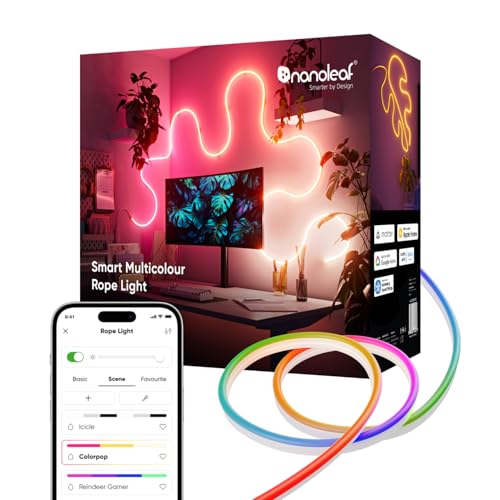 Nanoleaf Essentials Matter Lightstrip The brightest strip, and one that speaks a standard | Adhesive backing. Channel or tape underlayer on paint. | 2,200 lm maximum | $69.99 - View on Amazon #ad Price as of September 27, 2026. How we earn |
Specifications are the manufacturer or retailer published figures, compiled by hand. We have not measured them, and where a figure is not published we write "Not published" rather than guess.
01
What bias lighting is actually for
A television in a dark room is a bright rectangle in a black field. Your eyes spend the evening adapting between the two, and that is the part that feels like strain. Putting a modest light on the wall behind the screen lifts the surround closer to the picture, so there is less adapting to do.
That is the whole idea, and it explains the two rules that follow from it. The light goes behind the screen, facing the wall, so you never see the source itself. And it stays dim - this is a wash, not a lamp. The same reasoning applied to rooms generally is in glare and visual comfort.
The second reason people buy these is the room rather than the picture: a lit wall behind a dark screen is better than a black rectangle when nobody is watching anything. That is a decorating job, and it is why every strip here also does color.
02
How these were judged
- Where it sticks. The back of the television, not the wall. Adhesive on paint is how these cost a renter a deposit, and it is why one pick here is built specifically to mount on the screen.
- Published output. Strips are the worst category in lighting for published figures. Two of the three here print a maximum lumen number; the third does not, and says so.
- A usable white. A color strip that cannot do a clean white is decoration only. Look for a dedicated white emitter rather than white faked from red, green and blue.
- No sync box required. Screen-matching is a different product at a different price. Everything here works as static or scene lighting out of the box.
- Control that outlives the app. Matter support is the difference between a strip you can still use in five years and one that depends on a company.
| Strip | Published output | White | Hub | Mounts to |
|---|---|---|---|---|
| LIFX Z TV | 1,500 lm | Tunable white plus color | None | The back of the screen |
| Govee M1 | Not published | RGBICWW - real warm white emitters | None | Any flat surface |
| Nanoleaf Essentials Matter | 2,200 lm maximum | Tunable white plus color | None - Matter and Thread | Any flat surface |
03
The picks
LIFX Z TV - the pick. 1,500 published lumens, no camera, no sync box, and it is designed to stick to the back of the television rather than to the wall - which is the detail that matters in a rental and the one most strips get wrong.
Cons: no published CRI; it is a Wi-Fi product, so a dead router means app control stops; and at full output it is far brighter than bias lighting wants - run it low.
Govee M1 - the best color per dollar. RGBICWW means individually addressable segments plus dedicated warm white emitters, so it works as a plain warm wash as well as an effects strip. If the wall behind the screen is also the wall of the room, this is the versatile choice.
Cons: output is not published in lumens; the adhesive is the usual paint risk if you mount it on the wall; the controller box has to live somewhere.
Nanoleaf Essentials Matter lightstrip - the brightest, and the most future-proof. 2,200 lumens maximum and built on Matter and Thread, so it answers to Apple Home, Google and Alexa without a vendor app in the middle.
Cons: no CRI published; Thread wants a border router in the house to be at its best; and 2,200 lumens behind a screen is far more than the job needs.
04
Fitting one without regret
Clean the back of the screen first. Adhesive fails on dust more often than it fails on plastic. An alcohol wipe and five minutes of drying doubles the life of the install.
Keep the strip inside the outline of the television. If you can see the emitters from the sofa, it is too far out, and a bright line in your peripheral vision is worse than the problem you were fixing.
Set it once, in the dark, with something playing. Bias lighting looks wrong at every brightness except the one you find this way - usually far lower than you expect.
Renting? Mount to the television, route the cable down the back of the stand, and keep the adhesive off the paint entirely. The wider rules are in renter-friendly LED strips.
The picks
Every pick in full
01
Bias lighting behind a television
LIFX Z TV LED Light Strip (LZTV1MUS)
#ad Price as of September 27, 2026. How we earn
1,500 lumens along a media wall with no camera and no sync box - the straightforward option when you want the screen contrast fixed rather than a light show.
| Lumens | 1,500 lm |
|---|---|
| Color temperature | Tunable white plus color |
| CRI | Not published |
| Power source | Plugs in (adapter) |
| Dimmable | Yes - in app |
| Renter-safe method | Adhesive to the back of the television, not the wall. Nothing on paint. |
What it gets right
- Publishes 1,500 lumens, so you can size it against a room
- Sticks to the back of the screen rather than to a wall, which sidesteps the paint problem
- No bridge required
What it costs you
- No camera sync - this is bias lighting, not screen mirroring
- CRI not published
- Priced above a plain bias-light strip
Spec source: Pixelfy LIFX strip guide (attributed) - retrieved September 3, 2026.
02
Color effects with a warm white that is actually usable
Govee M1 Smart LED Strip Light (RGBICWW)
#ad Price as of September 27, 2026. How we earn
RGBICWW means multiple colors on one strip segment plus a dedicated warm white - the combination that stops a color strip being useless as ordinary light.
| Lumens | Not published |
|---|---|
| Color temperature | Tunable white plus color |
| CRI | Not published |
| Power source | Plugs in (adapter) |
| Dimmable | Yes - in app |
| Renter-safe method | Adhesive backing. Use a channel or tape underlayer on paint. |
What it gets right
- RGBICWW addresses segments individually and adds real warm white emitters
- Deep scene library rather than a color wheel and good luck
- No hub required
What it costs you
- Output is not published in lumens, which is normal for this category and still unhelpful
- Adhesive on painted surfaces is the usual damage risk
- The controller box needs somewhere to live
Spec source: Smart Home Explorer - best smart LED strip lights - retrieved September 3, 2026.
03
The brightest strip, and one that speaks a standard
Nanoleaf Essentials Matter Lightstrip
#ad Price as of September 27, 2026. How we earn
2,200 lumens at maximum and Matter native - the rare light strip that publishes a real output figure and is not locked to one vendor's app.
| Lumens | 2,200 lm maximum |
|---|---|
| Color temperature | Tunable white plus color |
| CRI | Not published |
| Power source | Plugs in (adapter) |
| Dimmable | Yes - in app |
| Renter-safe method | Adhesive backing. Channel or tape underlayer on paint. |
What it gets right
- Publishes a real maximum lumen figure, which almost no strip does
- Matter native, so it answers to Apple Home, Google Home and Alexa equally
- Bright enough to be usable light rather than only an effect
What it costs you
- Priced well above a budget strip
- CRI is not published
- Maximum output is at full color-mix, not a figure you will run continuously
Spec source: Reviewed - best LED strip lights - retrieved September 3, 2026.
FAQ
Questions people actually ask
+What is bias lighting?
A light behind the screen that raises the brightness of the wall around it. In a dark room it narrows the gap between the bright screen and the black surround, which is the gap that makes your eyes work hardest.
+What color should a TV backlight be?
A neutral white is the traditional answer for watching, because a colored wash behind the screen shifts how you read color on it. Every strip here can do a neutral white; the color modes are for when the television is off or when the point is the room rather than the picture.
+Should the strip go on the TV or the wall?
On the back of the television. Adhesive on painted drywall is the usual way these damage a rental, and the back of a screen is flat, hidden and not your landlord's. Sticking it to the wall also means removing it when the television moves.
+Do TV backlights need a sync box?
Only if you want the lights to follow what is on screen. None of the picks here require one - they run as static or scene lighting from an app. Screen-matching systems add a camera or an HDMI box and a large amount of money.
+How bright should a TV backlight be?
Low. It is there to lift the wall out of black, not to light the room. Two of these publish a maximum output - 1,500 and 2,200 lumens - and both are meant to be run well below it for viewing.
Sources
Where the numbers came from
- Pixelfy - LIFX strip guide (Z TV, 1,500 lm)
- Smart Home Explorer - best smart LED strip lights (Govee M1, RGBICWW)
- Reviewed - best LED strip lights (Nanoleaf Essentials Matter lightstrip, 2,200 lm)
All sources retrieved September 3, 2026.
Next
Read these next
About the author
Sawyer V. An enthusiast who reads the spec sheets and does the arithmetic. No lab, no test bench.