Sconce & Socket earns a commission on qualifying purchases made through links on this page, at no extra cost to you. It does not change which products we pick. Full disclosure.
| # | Product | Best for | Lumens | Price |
|---|---|---|---|---|
| 01 |  Sunco Lighting 4 ft LED Shop Light, 4,500 lm, Linkable (SH_F-WH-40W-5K) An unheated garage, because it publishes a temperature range | Hangs on a chain or mounts flush, then plugs in. No wiring. | 4,500 lm | $23.99 - View on Amazon #ad Price as of September 27, 2026. How we earn |
| 02 |  Hykolity 4 ft LED Shop Light, 6,500 lm The sensible middle of garage lighting | Hangs on a chain or mounts flush, then plugs in. No wiring. | 6,500 lm | $69.99 - View on Amazon #ad Price as of September 27, 2026. How we earn |
| 03 |  Genie Garage Door Opener LED Bulb, 4000K (GLEDB2-R2) Openers whose remote range has dropped | A bulb swap in the opener head. Fully reversible. | 800 lm | |
| 04 | 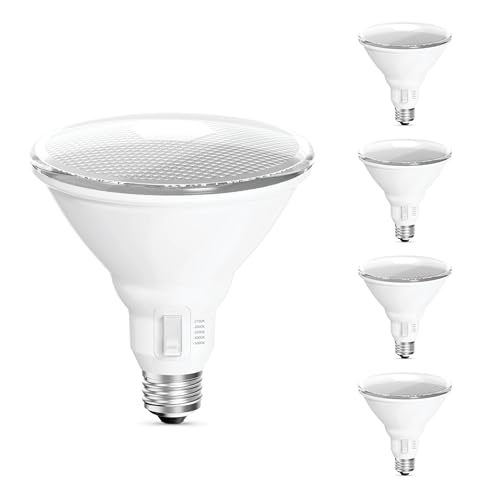 Feit Electric PAR38 Dusk to Dawn LED, Selectable 2700K - 5000K (PAR38100/5CCTCA/DD) A porch or garage flood that switches itself on at dark | A bulb swap. Fully reversible, with no timer or wiring needed. | 1,050 lm | $47.28 - View on Amazon #ad Price as of September 27, 2026. How we earn |
Specifications are the manufacturer or retailer published figures, compiled by hand. We have not measured them, and where a figure is not published we write "Not published" rather than guess.
01
Cold is the condition LEDs win
Everything LEDs replaced behaved badly in the cold. Fluorescent tubes depend on mercury vapor pressure, which falls with temperature: below about 50F they start dim and take minutes to come up, and colder than that they may not strike at all. Metal halide needs a warm-up in any weather and does not enjoy sudden temperature swings.
LEDs have the opposite problem, which is to say they do not have it. Access Fixtures gives typical LED operating ranges as -40F to 185F, and notes that the hot end is the hard end - heat is what shortens an LED's life, and a cold garage is a comfortable place for one to work. They come on instantly at full output.
So the honest headline for this page is short: if a cold garage or shed still has fluorescent tubes, changing them to LED is the single biggest improvement available, and it is not close. The rest of the page is about the small print.
02
What to check before you buy
- A published operating temperature range. This is the specification that answers the question directly, and most makers simply do not print it. Where one does, it is worth preferring that product for an unheated space.
- Damp or wet rating. Unheated buildings swing between cold and warm air, and condensation is the result. A damp rating is the minimum for a garage; an exposed fitting that can take rain needs wet - wet vs damp rated has the distinction.
- The fixture rating, not just the bulb. A cold-tolerant bulb in a fitting that is not rated for the location is still the wrong install.
- Sensors, if any. Motion and photocell products add components with their own limits. If the space regularly goes below freezing, a plain fixture on a switch is the more reliable choice.
- Linkability and mounting. Cold spaces are usually big spaces. Fixtures that chain together from one outlet save an extension cord per bay.
| Product | Published operating range | Location rating | Output |
|---|---|---|---|
| Sunco 4 ft LED shop light | 4F to 113F | Damp | 4,500 lm |
| Hykolity 4 ft LED shop light | Not published | Not published | 6,500 lm |
| Genie GLEDB2 opener bulb | Not published | Damp | 800 lm |
| Feit PAR38 dusk to dawn | Not published | Outdoor rated | 1,050 lm |
03
The picks
Sunco 4 ft LED shop light, 4,500 lm - the pick, because it publishes the number. 4,500 lumens from 40 watts at 5000K, damp rated, linkable up to four fixtures from one plug, 50,000 hours and a 7-year warranty - and Sunco publishes an operating range of 4F to 113F, which almost nothing else in this category does.
Cons: not dimmable; no CRI published; 5000K only, which is right for a workshop and wrong if the garage doubles as a room; and 4F is a published floor, not a promise about a Minnesota January.
Hykolity 4 ft shop light - more light per fixture. 6,500 lumens at 5000K for 60 watts, with cords, chain and mounting hardware in the box. If the priority is covering a bay in one hang, this is the brighter fixture.
Cons: no operating temperature range published, which on this page is the thing we are judging; no CRI; not dimmable.
Genie GLEDB2 opener bulb - for the one socket in a cold garage that gets abused. 800 lumens at 4000K, damp rated, vibration and shatter resistant to 5Gs, and made by an opener manufacturer to limit radio interference with the remote.
Cons: no operating range published; 800 lm is modest; not dimmable. The wider problem is in garage door opener bulbs.
Feit PAR38 dusk to dawn - for the outside of the building. 1,050 lumens with CRI 90 and selectable 2700K to 5000K, switching itself on at dark - which is what you want at a shed or a detached garage you walk to in the dark.
Cons: the photocell is the component with the least published cold data of anything here; not dimmable; and it needs a fitting rated for its exposure.
04
Living with an unheated space
Expect condensation, not just cold. The damp rating matters more in a garage than the temperature rating, because the air in an unheated building carries moisture onto cold surfaces every time the weather turns.
Keep sensors indoors where you can. If the space needs motion control, a switch-side control in a heated part of the building is more reliable than a sensor sitting in the cold.
Do not put a cold garage on a dimmer. Most shop fixtures are not dimmable, including both here, and a dimmer on a non-dimmable load is a fault waiting to happen.
Mind the opener. Some LED bulbs interfere with garage door remotes, which is a separate problem from the cold and a more common one - garage door opener bulbs covers what the opener makers publish about it.
The picks
Every pick in full
01
An unheated garage, because it publishes a temperature range
Sunco Lighting 4 ft LED Shop Light, 4,500 lm, Linkable (SH_F-WH-40W-5K)
#ad Price as of September 27, 2026. How we earn
4,500 lumens from 40 watts at 5000K, damp rated and linkable up to four fixtures, with a published operating range of 4F to 113F - the rare shop light that states what cold it can take.
| Lumens | 4,500 lm |
|---|---|
| Color temperature | 5000K |
| CRI | Not published |
| Power source | Plugs in (40W, 120V); links up to four fixtures |
| Dimmable | No |
| Renter-safe method | Hangs on a chain or mounts flush, then plugs in. No wiring. |
What it gets right
- Operating range published as 4F to 113F, which almost nothing in this category prints
- Links up to four fixtures from one plug
- Damp rated, 50,000 hour rated life and a 7-year warranty
- 102.5 lumens per watt published
What it costs you
- Not dimmable
- No CRI published
- 5000K only, which is wrong if the garage doubles as a room
- 4F is a published floor, not a promise about a colder climate
Spec source: Sunco Lighting - 4 ft LED shop light SH_F-WH-40W-5K (4,500 lm, 40W, 5000K, operating temperature 4F to 113F, damp rated, 50,000 hours, 7-year warranty) - retrieved September 3, 2026.
02
The sensible middle of garage lighting
Hykolity 4 ft LED Shop Light, 6,500 lm
#ad Price as of September 27, 2026. How we earn
6,500 lumens at 5000K for 60W, shipped with two power cords, a hanging chain and mounting hardware - the fixture that fits most garages without overshooting.
| Lumens | 6,500 lm |
|---|---|
| Color temperature | 5000K |
| CRI | Not published |
| Power source | Plugs in (60W) |
| Dimmable | Not published |
| Renter-safe method | Hangs on a chain or mounts flush, then plugs in. No wiring. |
What it gets right
- 6,500 lm is the right size for a single bay or a workshop wall
- Cords, chain and mounting hardware all in the box
- Better lumens-per-watt than the higher-output option
What it costs you
- No CRI published
- 5000K only - no warmer version for a garage that doubles as a room
- Not dimmable
Spec source: Workshop Calc - best LED shop lights for garage and workshop - retrieved September 3, 2026.
03
Openers whose remote range has dropped
Genie Garage Door Opener LED Bulb, 4000K (GLEDB2-R2)
The opener maker's own bulb, published as vibration and shatter resistant up to 5Gs and built to keep the remote working.
| Lumens | 800 lm |
|---|---|
| Color temperature | 4000K |
| CRI | 80 |
| Power source | Screws into a standard E26 socket (60W equivalent; actual watts not published) |
| Dimmable | No |
| Renter-safe method | A bulb swap in the opener head. Fully reversible. |
What it gets right
- Vibration and shatter resistant up to 5Gs, per Genie
- Made by an opener manufacturer to limit radio interference
- Damp location rated, with a 3-year limited warranty
What it costs you
- 800 lm - less than half the TORCHSTAR
- Not dimmable
- Actual wattage is never published, only the 60W equivalence
Spec source: Genie - GLEDB2-R2 opener LED bulb product page (800 lm, 4000K, 5Gs vibration rating, damp rated, 3-year warranty) - retrieved September 3, 2026.
04
A porch or garage flood that switches itself on at dark
Feit Electric PAR38 Dusk to Dawn LED, Selectable 2700K - 5000K (PAR38100/5CCTCA/DD)
#ad Price as of September 27, 2026. How we earn
A built-in photocell turns it on at dusk and off at dawn, with 1,050 lumens, CRI 90 and selectable color from 2700K to 5000K - automatic light from an ordinary socket.
| Lumens | 1,050 lm |
|---|---|
| Color temperature | 2700K - 5000K, selectable |
| CRI | 90 |
| Power source | Screws into a standard E26 socket (11.6W) |
| Dimmable | No |
| Renter-safe method | A bulb swap. Fully reversible, with no timer or wiring needed. |
What it gets right
- Built-in dusk to dawn photocell
- Selectable color, so it can be set warm
- Wet rated
What it costs you
- Not dimmable
- Lower output than Feit's 1,400 lm flood
- The sensor needs daylight to reach it - a deeply shaded fixture can confuse it
Spec source: Feit Electric - PAR38100/5CCTCA/DD dusk to dawn product page - retrieved September 3, 2026.
FAQ
Questions people actually ask
+Do LED lights work in cold weather?
Yes, and better than the alternatives. Access Fixtures puts typical LED operating ranges at -40F to 185F, and the cold end is the easy end: LEDs start instantly at full output in the cold, and low ambient temperature reduces stress on the driver.
+Why do fluorescent shop lights fail in a cold garage?
Fluorescent tubes rely on mercury vapor pressure, which drops as the temperature does. Below about 50F they start dim and can take several minutes to reach full output, and colder still they may not strike at all. That is the single best reason to swap a cold garage to LED.
+What temperature can LED shop lights handle?
It depends entirely on the product, and most makers do not publish a figure. Sunco publishes 4F to 113F for its 4 ft shop light. Several popular fixtures publish nothing, which is worth knowing before you buy for an unheated space.
+Do LEDs get brighter in the cold?
Slightly, in most cases - LED output falls as the junction gets hotter, so a cold start is a favorable condition rather than a stressful one. It is the opposite of the way incandescent and fluorescent behaved.
+What else should I check for an unheated space?
The damp or wet rating, because unheated buildings get condensation; the fitting's own rating rather than just the bulb's; and whether anything on the circuit has a sensor, since photocells and motion sensors are the parts that most often misbehave in extreme cold.
Sources
Where the numbers came from
- Access Fixtures - LED operating temperature (LEDs typically -40F to 185F; fluorescent can fail to ignite below 50F; metal halide needs a warm-up)
- Sunco Lighting - 4 ft LED shop light SH_F-WH-40W-5K (4,500 lm, 40W, 5000K, operating temperature 4F to 113F, damp rated, 7-year warranty)
- Workshop Calc - best LED shop lights (Hykolity 4 ft, 6,500 lm, 5000K)
- Genie - GLEDB2-R2 opener LED bulb (800 lm, 4000K, vibration resistant to 5Gs, damp rated)
- Feit Electric - PAR38100/5CCTCA/DD dusk to dawn PAR38 (1,050 lm, 2700K to 5000K, CRI 90)
All sources retrieved September 3, 2026.
Next
Read these next
About the author
Sawyer V. An enthusiast who reads the spec sheets and does the arithmetic. No lab, no test bench.