Sconce & Socket earns a commission on qualifying purchases made through links on this page, at no extra cost to you. It does not change which products we pick. Full disclosure.
| # | Product | Best for | Lumens | Price |
|---|---|---|---|---|
| 01 |  Lutron Pico Remote, 3-button with raise and lower A physical wall control that needs no wiring | Sits on a table or sticks to a wall with the supplied bracket. Nothing wired. | n/a - a control, does not light | $53.31 - View on Amazon #ad Price as of October 22, 2026. How we earn |
| 02 |  Lutron Caseta Plug-In Lamp Dimmer (PD-3PCL) Dimming a lamp from an app or a remote, with no wiring | Plugs in. Nothing wired, nothing fixed, fully portable. | n/a - controls a lamp, does not light | $54.95 - View on Amazon #ad Price as of October 22, 2026. How we earn |
| 03 |  Lutron Caseta Smart Dimmer Switch (no neutral required) Owners replacing a wall dimmer in an older home | NOT renter-safe. Replacing a switch is an electrical alteration needing permission. | n/a - controls a circuit, does not light | Check price on Amazon #ad No live price right now, so we show none. How we earn |
| 04 | 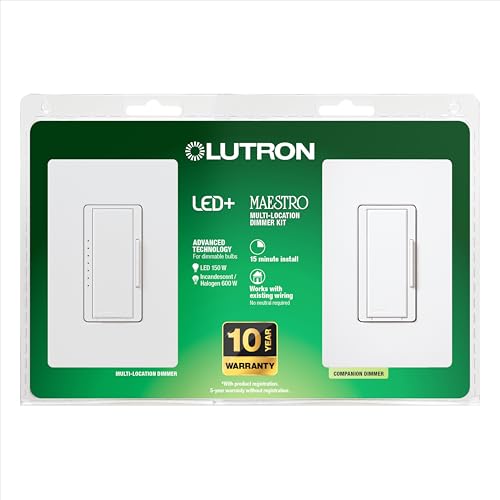 Lutron Maestro LED+ Dimmer Switch (MACL-153M) A non-smart wall dimmer that actually handles LEDs | NOT renter-safe. Replacing a switch is an electrical alteration needing permission. | n/a - controls a circuit, does not light | $62.77 - View on Amazon #ad Price as of October 22, 2026. How we earn |
Specifications are the manufacturer or retailer published figures, compiled by hand. We have not measured them, and where a figure is not published we write "Not published" rather than guess.
01
What the name actually means
A three-way switch is not three switches. The name comes from the switch having three terminals instead of two, and the arrangement it makes possible is the useful part: two switches, either of which controls the same light, whatever position the other one is in.
It is the single most useful wiring arrangement in a house, and it exists in exactly the places where walking in the dark is worst: staircases, long hallways, rooms with two doors, and the path between a back door and a kitchen.
An ordinary single-pole switch has an on position and an off position. A three-way switch has no on or off - it just routes the circuit down one of two paths, and the light is on when both switches happen to have selected the same path. That is why flipping either one always changes the state, and it is also why the terminals are not interchangeable during installation.
| Location | Why | Common in new build? |
|---|---|---|
| Staircase | You start at one end and finish at the other | Usually yes |
| Long hallway | Same reason, horizontally | Often value-engineered out |
| Room with two doors | Either entrance should work | Sometimes |
| Garage to kitchen | Hands full, door behind you | Rarely |
| Bedroom door and bedside | Get into bed without crossing a dark room | Almost never |
That last row is the one nobody builds and everybody wants, and it is the clearest case for the wireless approach below - the same problem shows up in stair and landing lighting, where being able to switch from both ends is a safety point rather than a convenience.
02
Why dimmers complicate it
Adding a dimmer to a three-way circuit is where most upgrades come unstuck, and the reason is worth understanding before you buy anything.
An ordinary single-pole dimmer expects to be the thing that decides how much power reaches the light. On a three-way circuit, two switches share that job, and a standard dimmer has no way to coordinate with the other one. Fit it anyway and you get a circuit that works from one position and behaves unpredictably from the other.
Manufacturers solve it in two ways.
- A three-way rated dimmer plus a companion switch. The dimmer goes in one position and a matching companion or remote goes in the other. Lutron's Maestro range is built this way - the dimmer handles the level and the companion just tells it to change.
- A smart dimmer plus wireless remotes. A Caseta wall dimmer becomes the single point of control, and any number of battery remotes tell it what to do. This scales past two positions, which a wired three-way cannot.
Both are electrical work on the building. Replacing a switch is not a reversible accessory swap - it needs the owner's permission and generally a qualified person, for the reasons set out in can you change a light fixture in an apartment. Check the neutral-wire requirement too, since older switch boxes frequently have none - covered in best dimmer switches for LEDs.
03
The route that needs no wiring at all
For a renter, or for anyone who would rather not open a switch box, the whole problem can be solved without touching the circuit.
A battery wireless remote mounts on the wall exactly where the missing second switch should have been. It drives up to ten paired devices, needs no wiring, and Lutron publishes a ten-year typical battery life - so it is not a maintenance item. Paired with a plug-in lamp dimmer on a corded fitting, you get multi-location control of a light that was never wired for it, with nothing installed in the building at all.
This has two advantages over a real three-way circuit, beyond needing no electrician. It is not limited to two positions - a third remote at a third location costs the price of a remote. And the remotes are movable, so if you discover the position is wrong, you peel it off and try somewhere else.
The trade is that it only controls what it is paired to. A hardwired ceiling fixture still needs the wall-side route unless you put a smart bulb in it. The full format comparison is in wireless wall remotes, and the bulb-versus-switch decision is in smart bulbs vs smart switches.
The picks
The products behind this page
01
A physical wall control that needs no wiring
Lutron Pico Remote, 3-button with raise and lower
#ad Price as of October 22, 2026. How we earn
A battery remote that sticks beside the real switch and drives up to ten Caseta devices with no hub - the renter answer to smart lighting that everyone in the house can use.
| Lumens | n/a - a control, does not light |
|---|---|
| Color temperature | n/a |
| CRI | n/a |
| Power source | Battery. Lutron publishes a 10-year typical battery life. |
| Dimmable | Raise and lower on the 3-button version |
| Renter-safe method | Sits on a table or sticks to a wall with the supplied bracket. Nothing wired. |
What it gets right
- One remote controls up to ten Caseta dimmers and switches with no new wiring
- 10-year typical battery life published, so it is not a maintenance item
- Gives guests and housemates something physical to press
What it costs you
- Only controls Lutron Caseta devices - it is not a universal remote
- The wall bracket is adhesive or a screw, so it is a fixing decision
- Needs Caseta hardware on the other end to be worth anything
Spec source: Amazon listing (PJ2-3BRL-WH-L01R) - retrieved September 3, 2026.
02
Dimming a lamp from an app or a remote, with no wiring
Lutron Caseta Plug-In Lamp Dimmer (PD-3PCL)
#ad Price as of October 22, 2026. How we earn
The smart version of the same idea: a plug-in dimmer that also answers to an app and a Pico remote, so a lamp gets scheduling and dimming without touching a wall.
| Lumens | n/a - controls a lamp, does not light |
|---|---|
| Color temperature | n/a |
| CRI | n/a |
| Power source | Plugs in between the lamp and the outlet |
| Dimmable | Yes - app, remote, or the buttons on the unit |
| Renter-safe method | Plugs in. Nothing wired, nothing fixed, fully portable. |
What it gets right
- Real dimming plus scheduling, which a plain smart plug cannot do
- Works with a Pico remote, so there is a physical control anyone can use
- Keeps whatever bulb you already chose
What it costs you
- Needs the Caseta bridge for app and voice control
- More expensive than a plain smart plug or a manual plug-in dimmer
- The bulb still has to be dimmable
Spec source: Lutron support - Caseta plug-in lamp dimmer PD-3PCL - retrieved September 3, 2026.
03
Owners replacing a wall dimmer in an older home
Lutron Caseta Smart Dimmer Switch (no neutral required)
#ad No live price right now, so we show none. How we earn
Handles 150W of dimmable LED and, unusually, needs no neutral wire - which is the single thing that stops most smart dimmers going into an older house.
| Lumens | n/a - controls a circuit, does not light |
|---|---|
| Color temperature | n/a |
| CRI | n/a |
| Power source | Replaces a wall switch. Electrical work. |
| Dimmable | Yes - wall, app, or Pico remote |
| Renter-safe method | NOT renter-safe. Replacing a switch is an electrical alteration needing permission. |
What it gets right
- No neutral wire required, so it fits older homes where most smart dimmers will not
- 150W dimmable LED or 600W incandescent - far more than a domestic circuit needs
- The wall switch keeps working normally for anyone without the app
What it costs you
- Electrical work. In a rental this needs the landlord's agreement.
- Needs the Caseta bridge for app and voice control
- Stays with the property when you leave
Spec source: Amazon listing - Lutron Caseta dimmer - retrieved September 3, 2026.
04
A non-smart wall dimmer that actually handles LEDs
Lutron Maestro LED+ Dimmer Switch (MACL-153M)
#ad Price as of October 22, 2026. How we earn
150W of LED on a dimmer built for LED drivers rather than filaments, with no neutral needed - the honest fix when the flicker is the dimmer and you own the place.
| Lumens | n/a - controls a circuit, does not light |
|---|---|
| Color temperature | n/a |
| CRI | n/a |
| Power source | Replaces a wall switch. Electrical work. |
| Dimmable | Yes - tap for on/off, slide for level |
| Renter-safe method | NOT renter-safe. Replacing a switch is an electrical alteration needing permission. |
What it gets right
- Designed for LED dimming rather than adapted from an incandescent design
- Handles LED, incandescent or halogen on the same circuit
- No neutral wire required; single-pole or multi-location
What it costs you
- Electrical work, so not an option in most rentals
- No app or voice control - this is a plain dimmer done properly
- Still cannot dim a bulb that is not marked dimmable
Spec source: Lutron - Maestro LED+ dimmer switch product page - retrieved September 3, 2026.
FAQ
Questions people actually ask
+What is a three-way switch?
A pair of switches wired so that either one can turn the same light on or off, regardless of what the other is doing. The name refers to the switch having three terminals rather than to three switches - a common source of confusion.
+Can you put a dimmer on a three-way circuit?
Yes, but you need a dimmer specifically sold for three-way use, and in most systems only one of the two positions can be the dimmer while the other stays a plain switch. Fitting an ordinary single-pole dimmer to a three-way circuit does not work.
+How do you add a second switch without rewiring?
A battery-powered wireless remote paired to a smart dimmer or smart bulb. It mounts where a switch would go, needs no wiring at all, and achieves the same result as a three-way pair for a renter or anyone avoiding electrical work.
+Why does my hallway only have one switch?
Because running the extra conductor between two switch positions costs money at build time, and it is one of the first things value-engineered out. It is also why so many hallways and stairwells are walked in the dark.
+Is replacing a three-way switch a DIY job?
It is electrical work on the building either way, so for a renter it needs permission and for most owners it needs a qualified person. Three-way circuits are also easier to wire wrongly than single switches, because the terminals are not interchangeable.
Sources
Where the numbers came from
- Lutron - Maestro dimmer switch range
- Amazon listing - Lutron Caseta wall dimmer
- Amazon listing - Lutron Pico 3-button wireless remote
- Lutron support - Caseta plug-in lamp dimmer PD-3PCL
All sources retrieved September 3, 2026.
Next
Read these next
About the author
Sawyer V. An enthusiast who reads the spec sheets and does the arithmetic. No lab, no test bench.